
Try It Now

Category: Security Testing

SSL TLS check overview — protocol versions, cipher suites, certificate chain, hostname coverage, HSTS and revocation examined across one HTTPS endpoint | SelfHack AI

SSL/TLS Check: How to Test Your Certificates and Protocol Configuration

SSL TLS check: certificate validity and chain, protocol versions, cipher suites and HSTS — what each result means and what to fix first.
Read More
Subdomain takeover explained — a dangling CNAME on your domain still points at a third-party service that released the name, letting someone else serve content from your subdomain | SelfHack AI

Subdomain Takeover: How Dangling DNS Records Hand Attackers Your Domain

Subdomain takeover: how a dangling CNAME lets someone else serve content on your domain, how to find them safely, and how to prevent the next.
Read More
How to check open ports on your own domain safely and legally — listening services, firewall reachability, nmap and ss on assets you own | SelfHack AI

How to Check Open Ports on Your Own Servers (and What to Close)

How to check open ports on infrastructure you own: the commands that work, what each exposed service means, and the decision rule for what to close.
Read More
DMARC check explained — SPF authorises sending IPs, DKIM signs the message, and DMARC aligns both to the visible From domain before telling receivers to reject spoofed mail | SelfHack AI

DMARC Check: How to Test Whether Anyone Can Spoof Your Domain

DMARC check: find out whether anyone can send email as your domain, how to read your SPF, DKIM and DMARC records, and how to reach enforcement.
Read More
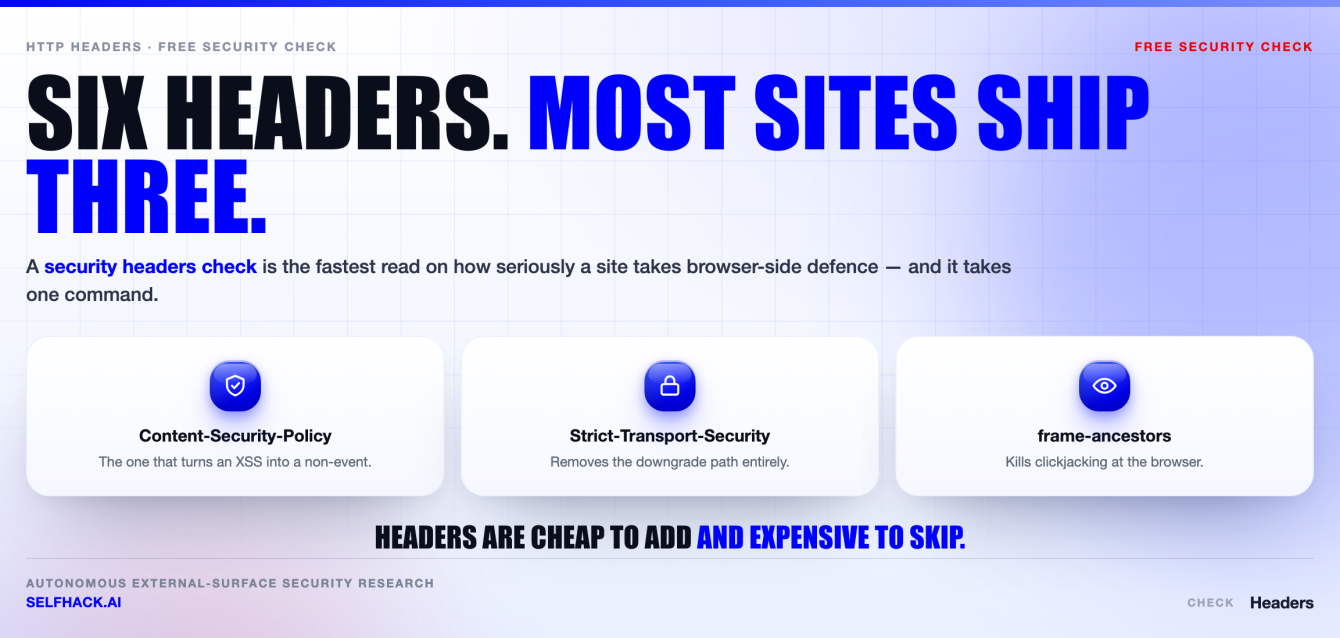
Security headers check overview — the HTTP response headers a security headers check looks for: Content-Security-Policy, Strict-Transport-Security, X-Frame-Options, X-Content-Type-Options nosniff, Referrer-Policy and Permissions-Policy | SelfHack AI

Security Headers Check: What Each Header Does and How to Test Yours

Security headers check: what HSTS, CSP, X-Frame-Options and Referrer-Policy each stop, how to test yours, and how to fix what is missing.
Read More
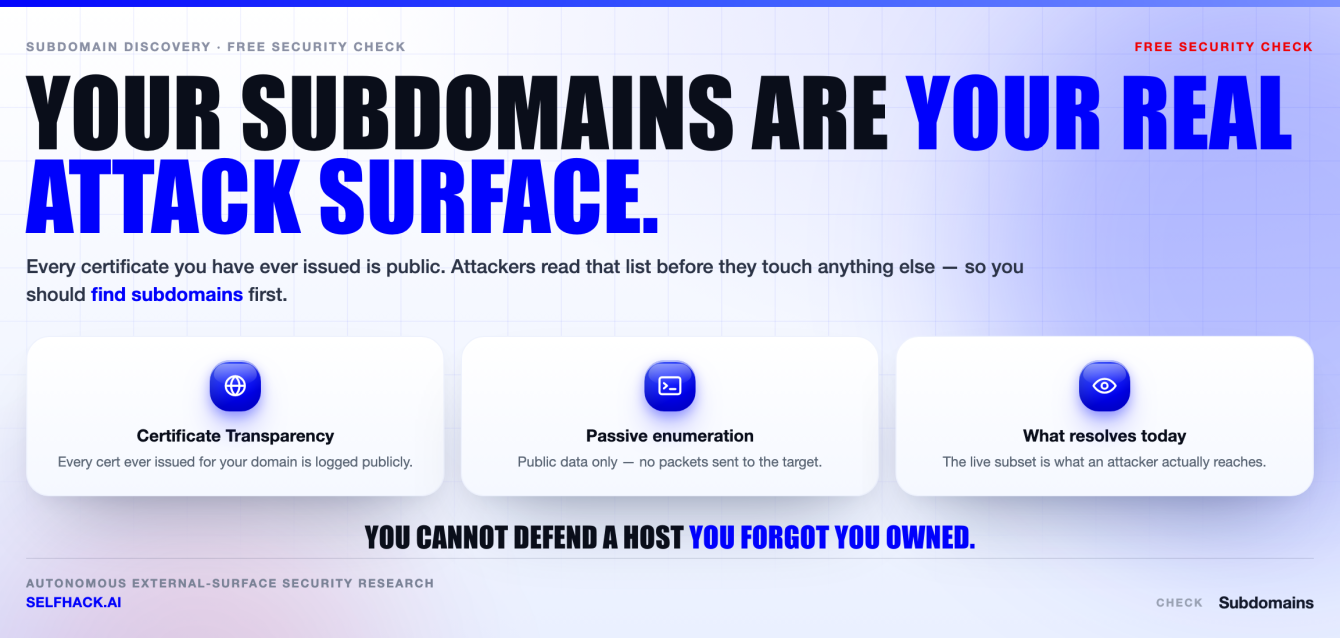
How to find subdomains of a domain — passive OSINT sources including Certificate Transparency logs, DNS records, passive DNS and web archives feeding a subdomain inventory | SelfHack AI

How to Find Subdomains: A Practical Guide to Mapping Your Own Attack Surface

How to find subdomains of a domain you own: certificate transparency, passive DNS, brute force and resolution — plus what to do with the list you get.
Read More
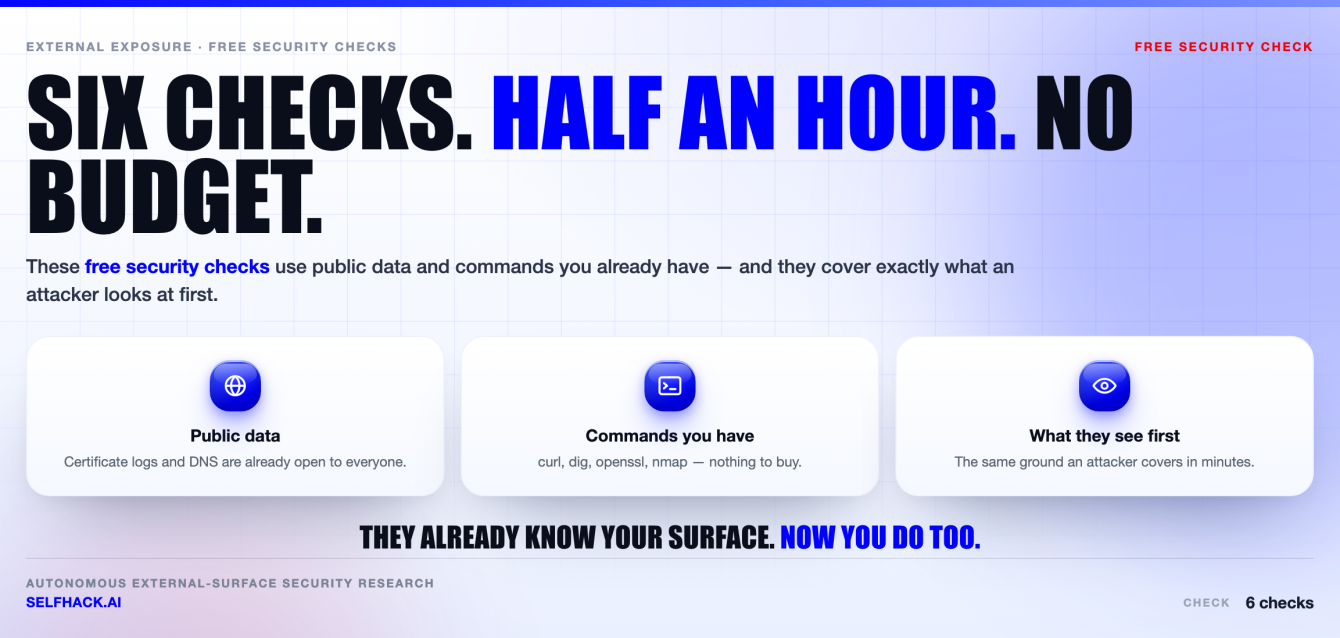
Free security checks — six things to test on your own domain: subdomains, security headers, DMARC, open ports, subdomain takeover and SSL TLS | SelfHack AI

Free Security Checks: 6 Things to Test on Your Own Domain

Free security checks: six tests you can run on your own domain today — subdomains, headers, DMARC, open ports, dangling DNS and TLS, with real commands.

Read More