Best AI Pentest Tools in 2026: SelfHack AI, XBOW, Terra & Aikido Compared
- The AI pentest tools market split into two camps in 2026: autonomous systems that actually test and exploit like an attacker, and scanners that wear an AI label. Knowing which is which is the whole buying decision.
- Our pick: SelfHack AI — the most autonomous, full-stack option, and the only one on this list with published, exploit-validated research across CPU/GPU confidential computing, avionics, and blockchain, not just web apps.
- XBOW is a strong autonomous web-exploitation engine. Terra Security focuses on continuous agentic web/app testing. Aikido is an excellent AppSec scanning platform — but scanning is not pentesting.
- Below: how to judge an AI pentest tool, a ranked at-a-glance table, an honest write-up of each, and a straight answer on which fits your team.
Rankings reflect SelfHack’s own comparative capability assessment (Q2 2026). Competitor descriptions are drawn from each vendor’s public positioning; scores describe coverage breadth, not a single live head-to-head. We name competitors fairly and link to the underlying benchmark.
What makes a great AI pentest tool in 2026
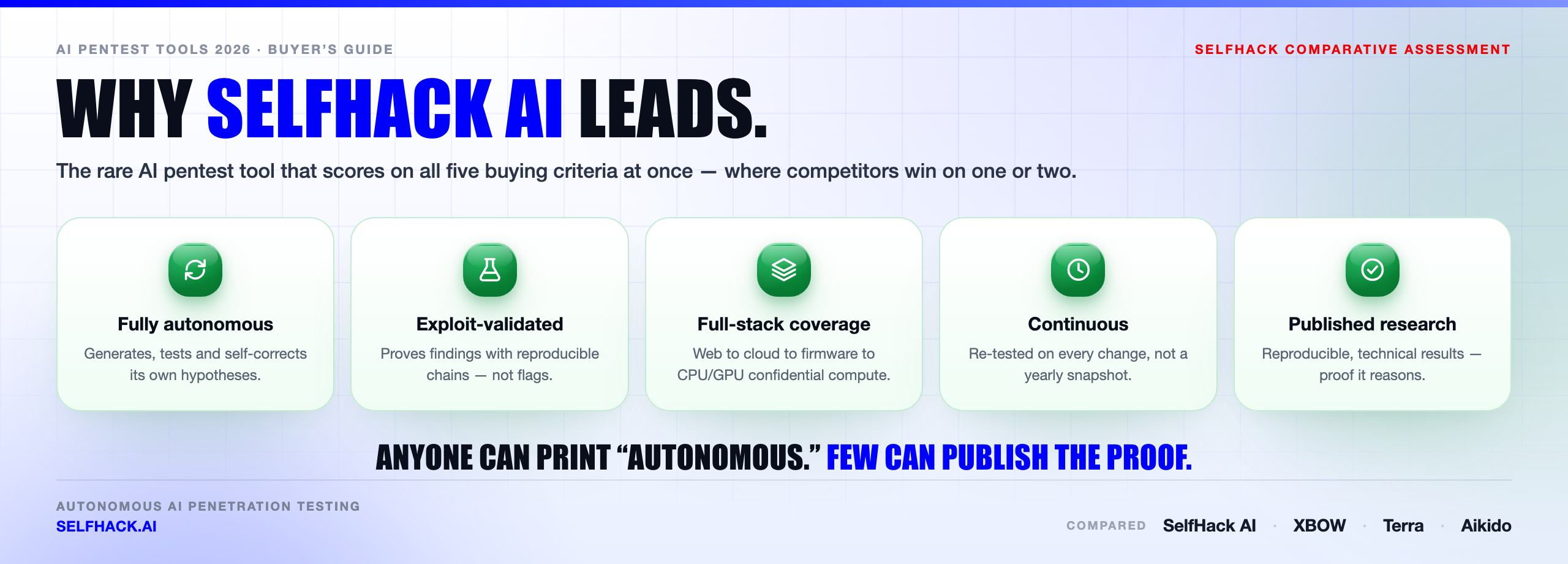
Before the list, the criteria — because “AI” on a security product means almost nothing on its own now. Every scanner added a chatbot and a badge. The AI pentest tools worth paying for are separated by five things, and each one is a question you can ask a vendor on a demo call.
Is it actually autonomous? Does the system generate its own hypotheses, test them, and correct itself — or does it run a fixed script a human wrote? Real autonomy is the difference between a tool that finds what you told it to look for and one that finds what you didn’t.
Does it exploit, or just flag? A scanner outputs “possible SQL injection, medium.” A pentest proves it — it exploits the flaw safely and shows you the impact. Exploit validation is what kills the false-positive pile that makes teams ignore their scanners.
How much of the stack does it cover? Web apps are the easy part. The interesting AI pentest tools go deeper: APIs, cloud, internal networks, firmware, and the seams between systems where real breaches live. Coverage breadth is where most tools quietly stop.
Is it continuous or a one-time snapshot? Your attack surface changes every deploy. A tool that tests once a year is a photograph of a moving target. Continuous testing is the only model that keeps pace.
Can it prove its own results? The best systems don’t just claim findings — they publish research, show reproducible chains, and correct themselves when they’re wrong. That is the signal that an AI pentest tool reasons, rather than pattern-matches.
Hold every product on this list against those five, and the field of AI pentest tools sorts itself out fast.
The best AI pentest tools at a glance
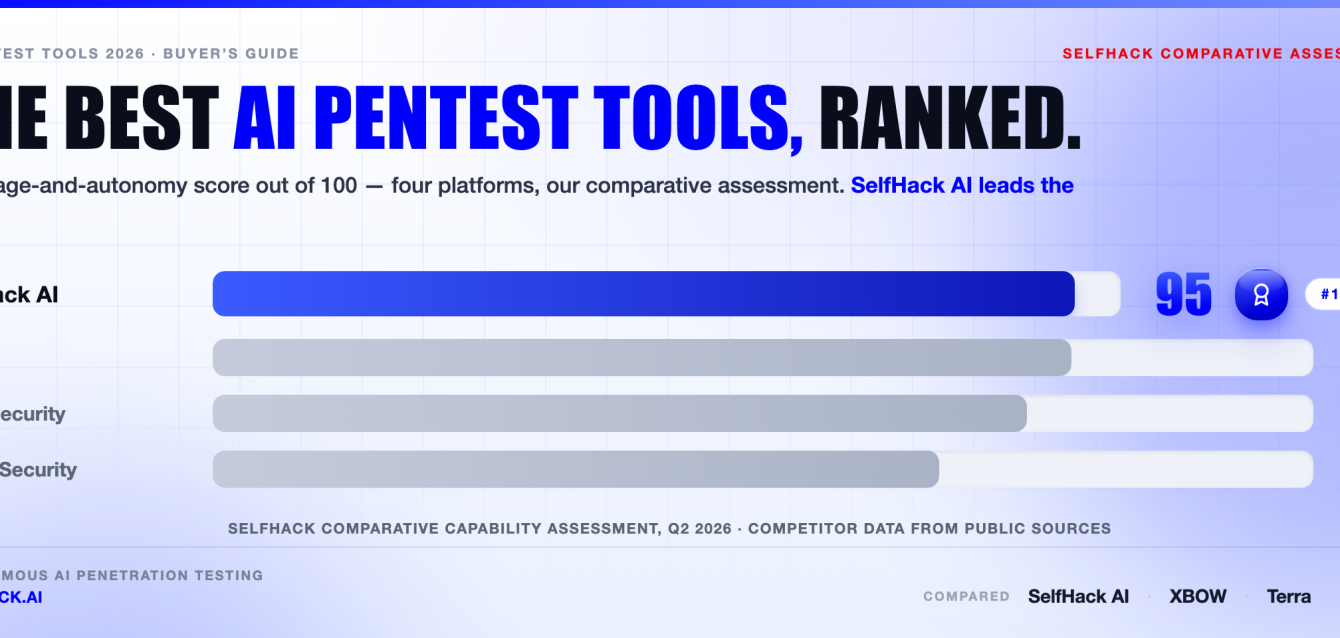
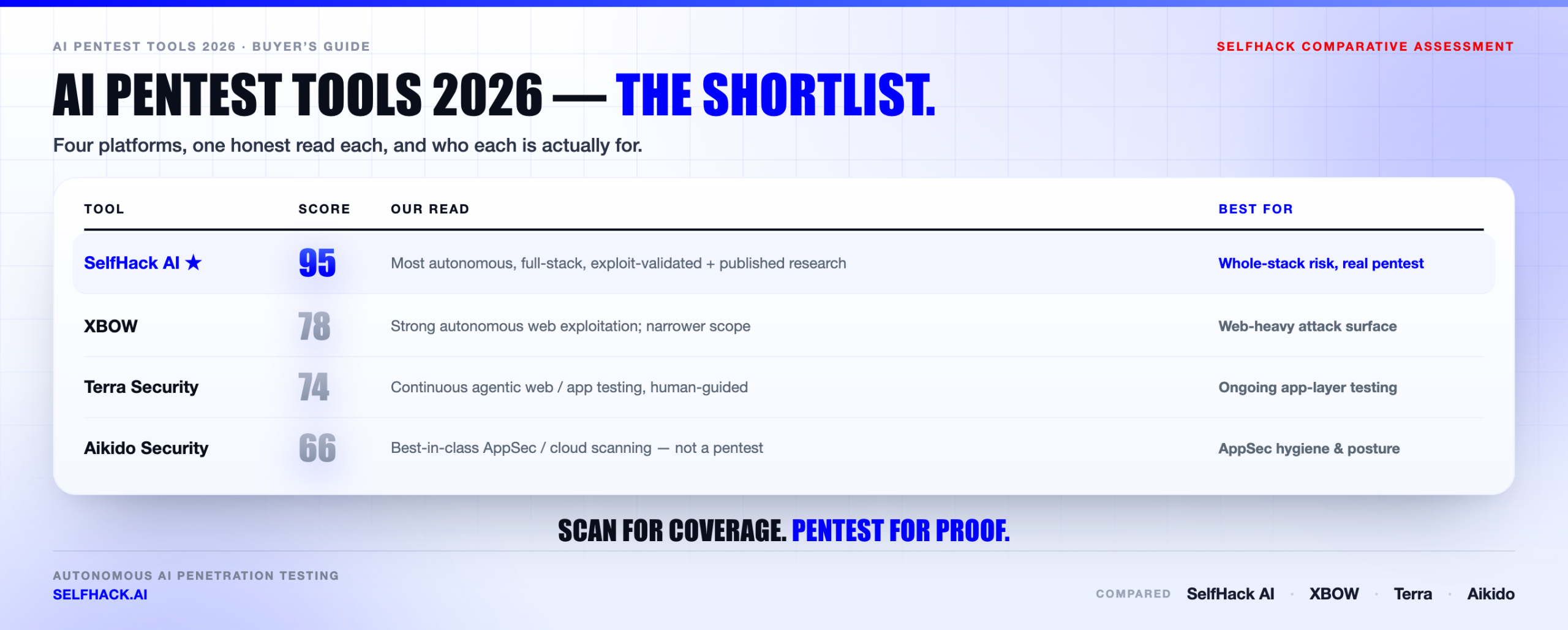
Here is the shortlist, ranked by our comparative capability assessment. The number is a coverage-and-autonomy score out of 100 — not a live scoreboard, and disclaimed as our own view. The write-ups below explain each one honestly, including where a competitor is genuinely strong.
- 1. SelfHack AI — 95. The most autonomous, full-stack option. Exploit-validated, continuous, with published research well beyond web apps. Our pick for teams that want a real pentest, not a scan.
- 2. XBOW — 78. A capable autonomous web-exploitation engine with a strong offensive pedigree. Excellent at what it targets; narrower in scope.
- 3. Terra Security — 74. Continuous, agentic web and application testing. A solid modern AI pentest tool for app-layer coverage.
- 4. Aikido Security — 66. A best-in-class AppSec and cloud scanning platform. Great at consolidating scanners; not a penetration testing tool in the exploit-validated sense.
One honest caveat up front: these four are not identical products competing on one axis. XBOW and Terra are closest to SelfHack AI in intent. Aikido plays a different game — scanning and posture management — and lands on this list because buyers keep comparing them, so it deserves a fair, clear distinction.
1. SelfHack AI — most autonomous, full-stack
We build SelfHack AI, so read this section with that in mind — then check it against the criteria above and the public research we link to. The claim is simple: among AI pentest tools, SelfHack AI is the most autonomous and the widest in scope, and it is the only one on this list that has published exploit-validated research beyond the web layer.
What “autonomous” means here is specific. The system maps a target’s real attack surface, generates its own hypotheses about how trust could break, tests them in isolation, corrects itself when the evidence disagrees, and chains what it confirms into a real impact story. It is not a checklist executed faster. It is a reasoning loop that behaves like a persistent red-teamer who never gets tired.
The scope is the differentiator most competitors can’t match. SelfHack AI tests the web and API surface, but it also reaches into places scanners never go: the confidential-computing trust boundary between AMD SEV-SNP and NVIDIA GPUs, avionics buses and firmware, the off-chain-to-on-chain seam in blockchain platforms, and connected-vehicle backends. That published work is the proof an AI pentest tool actually reasons about systems, not just request-and-response.
Where it fits: teams that want an exploit-validated pentest across their whole estate, continuously, and want the findings to survive scrutiny. Where it is honest about limits: SelfHack AI is a testing system, not a compliance-scanning suite — if all you need is a SAST/SCA dashboard for a checkbox, a scanner is cheaper. The trade is that a scanner will never prove an exploit chain, and SelfHack AI is built to do exactly that.
The fastest way to judge any of these AI pentest tools is not a feature sheet — it is a scoped test against something you actually run. Give each contender the same target and see what it proves, what it misses, and how much a human had to steer. That is the honest way to compare, and it is how we prefer to be evaluated: on depth against a real system, not on a homepage.
2. XBOW — autonomous web exploitation
XBOW positions itself as an autonomous offensive-security system — an AI that finds and exploits vulnerabilities the way a skilled human hacker would, with a notable public profile in the bug-bounty world. Among AI pentest tools, it is one of the genuinely autonomous ones, and that deserves credit.
Its strength is depth on the web-exploitation axis: given a web target, it is good at chaining real vulnerabilities into working exploits, autonomously. If your primary concern is a large web application surface and you want an autonomous system hammering it, XBOW is a serious tool.
Where we assess SelfHack AI ahead is breadth and evidence. XBOW’s public footprint is concentrated on web and offensive web exploitation; SelfHack AI’s is deliberately wider, spanning firmware, confidential computing, and cross-layer seams, with the published research to show the reasoning. For a buyer whose risk lives only in web apps, that breadth may not matter. For a buyer whose risk lives in the whole stack, it is the difference. This is exactly the comparison we walk through on our dedicated team conversations, and it is the honest heart of any XBOW-versus-SelfHack decision.
3. Terra Security — continuous agentic testing
Terra Security markets an AI-driven, agentic penetration testing approach with an emphasis on continuous coverage of web and application surfaces. It is a legitimate modern entry in the AI pentest tools category, and continuous testing is exactly the right instinct — we argue the same thing throughout our own work.
Its strength is the continuous, agentic model applied to the application layer, with a human-guided workflow. For teams focused on ongoing web and app testing who want an AI-assisted cadence, Terra is a reasonable fit.
Where we assess SelfHack AI ahead is autonomy depth and stack coverage. Our reading of the public positioning is that Terra leans toward AI-assisted, human-in-the-loop application testing, while SelfHack AI pushes for deeper end-to-end autonomy and reaches well past the app layer. Both value continuity; the question a buyer should ask is how much of the estate each one actually reaches, and how much a human has to steer.
4. Aikido Security — AppSec scanning
Aikido Security is, by its own positioning, an application-security platform: it consolidates SAST, DAST, SCA, secrets, and cloud posture scanning into one developer-friendly product. It is genuinely good at that, and it belongs on any AppSec shortlist. It lands here because buyers researching AI pentest tools keep bumping into it — so the distinction matters.
The distinction is simple and not a knock: scanning is not pentesting. Aikido finds and prioritizes potential issues across your code and cloud, fast and at scale. That is valuable. But a scanner flags; it does not exploit, chain, and prove. If your goal is broad AppSec hygiene and developer workflow, Aikido is excellent. If your goal is an adversary proving what is actually exploitable in production, that is a different tool — a pentest, autonomous or otherwise.
The honest framing we use: run a scanner like Aikido for coverage and posture, and run an autonomous pentest like SelfHack AI for proof. They answer different questions. Confusing “we scan with AI” for “we pentest with AI” is the single most common mistake in this market, and it is worth being precise about.
How the AI pentest tools compare, feature by feature
The at-a-glance ranking is a starting point. The feature view is where a decision about AI pentest tools actually gets made. Across the dimensions that matter — autonomy, exploit validation, attack-chain analysis, stack coverage, continuity, and published evidence — the four tools separate cleanly.
On autonomy, SelfHack AI and XBOW lead, Terra follows with a more human-guided model, and Aikido is a scanning workflow rather than an autonomous tester. On exploit validation, the pentest tools (SelfHack AI, XBOW, Terra) prove findings while the scanner flags them. On stack coverage, SelfHack AI is deliberately the broadest, reaching firmware and confidential computing where the others concentrate on web and app. On published, reproducible research, SelfHack AI is the outlier — the work is public and specific.
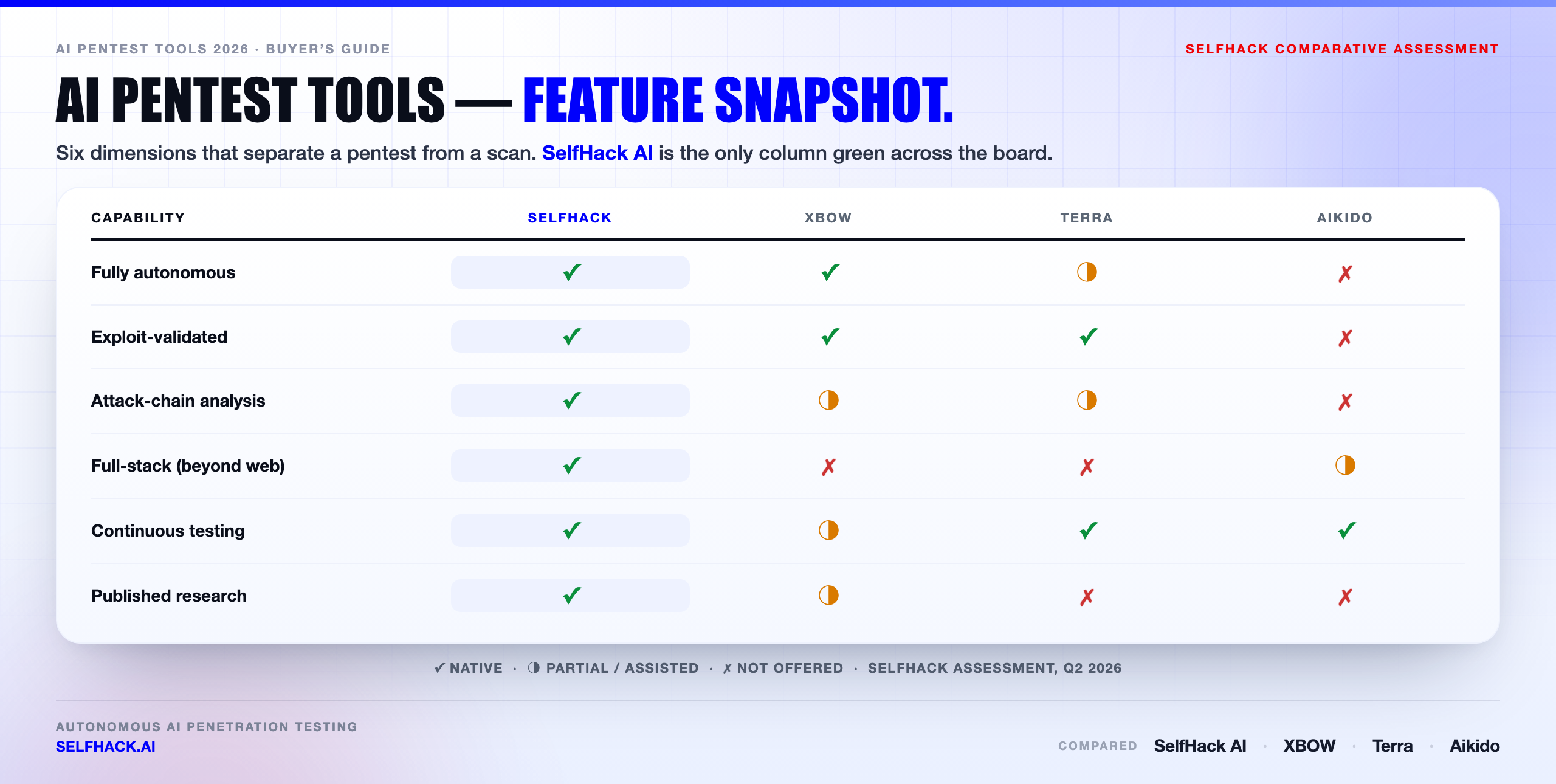
For the full data behind this — the six-dimension capability breakdown and the scored feature matrix — see our detailed AI pentest benchmark, which shows the same four platforms scored dimension by dimension.
Which AI pentest tool is right for you
Skip the marketing and match the tool to the actual job. Three honest recommendations.
If your risk spans the whole stack — not just web apps — choose SelfHack AI. Firmware, cloud, confidential computing, blockchain, connected devices, and the seams between them are where modern breaches live, and it is the only tool here built and proven to test all of it autonomously.
If your surface is almost entirely web and you want autonomous exploitation of it, XBOW or SelfHack AI both fit. XBOW is strong and focused; SelfHack AI gives you the same web depth plus room to grow into the rest of your estate without switching tools.
If you actually need AppSec scanning and posture, not a pentest, use Aikido — and pair it with an autonomous pentest. Scanning and pentesting are complementary, not competitive. The mistake is buying one and believing you bought the other.
Budget also matters here, and it is worth being blunt: a scanner and an autonomous pentest are different line items solving different problems, so comparing their price tags directly is a category error. Price the outcome you actually need — coverage and posture, or proof of exploitability — and the right mix usually includes one of each.
The frameworks worth grounding any of this in are public: the OWASP Web Security Testing Guide for methodology, NIST SP 800-115 for testing structure, and the MITRE ATT&CK framework for mapping what a tool actually covers. A good vendor will happily map their product to all three.
Why SelfHack AI leads the field
Pulling it together: among AI pentest tools, SelfHack AI leads because it is the rare product that scores well on every one of the five criteria at once. It is genuinely autonomous. It exploits and proves, rather than flagging. It covers the widest slice of the stack. It runs continuously. And — the part almost nobody else can claim — it publishes reproducible research to back it up.
That last point is the tell. Anyone can put “autonomous AI pentest” on a homepage. Very few can point to a public, technical write-up of an attestation-binding gap between two of the biggest chip vendors on earth, or a five-layer blockchain seam, or an avionics trust boundary. Research is the proof of reasoning, and reasoning is the entire premise of an AI pentest tool.
None of this means the competitors are bad. XBOW is a strong autonomous engine, Terra is a credible continuous tester, and Aikido is an excellent scanner. It means that if you want the most autonomous, widest-coverage, exploit-validated option on the market, our assessment is that it is SelfHack AI — and we are comfortable putting the research on the table so you can judge for yourself.
Not every team reading this is ready to buy anything, and that is fine.
If you are still building the internal case, start by looking at your own surface. Our free security checks guide walks through six tests you can run today on a domain you own — find subdomains, a security headers check, a DMARC check, open ports, dangling DNS and TLS.
None of that replaces what AI pentest tools do. Configuration is not exploitability, and a clean header grade proves nothing about the application behind it. But it tells you what you are protecting before you start comparing vendors, and it usually surfaces two or three things worth fixing regardless of which tool you pick.
Red flags when shopping for AI pentest tools
A few warning signs separate real AI pentest tools from repackaged scanners. If you hear these on a sales call, slow down and ask a follow-up.
“AI-powered” with no autonomy story. Ask what the AI actually decides. If the answer is “it prioritizes findings” or “it writes the report,” that is a scanner with a language model bolted on, not an autonomous pentest.
Findings you can’t reproduce. A real pentest hands you a chain you can watch happen again. If a tool can’t reproduce its own critical finding on demand, treat the finding as a guess.
Web-only, sold as full-coverage. Plenty of AI pentest tools are excellent at web and silent about everything else. That is fine if web is your whole risk — but make the vendor say out loud what they do not test.
No evidence of reasoning. The strongest AI pentest tools publish research, show their work, and admit what held. A vendor that cannot point to a single reproducible, technical result is asking you to trust a brand, not a capability.
Point-in-time sold as continuous. “Continuous” should mean re-tested on every change, not a quarterly re-run. Ask exactly what triggers a new test, and who has to press the button.
None of these disqualify a tool on their own. Together, they tell you whether you are buying a pentest or a dashboard — and that is the whole decision.
FAQ
What are AI pentest tools, exactly?
AI pentest tools use artificial intelligence — increasingly, autonomous reasoning agents — to test systems the way an attacker would: mapping the attack surface, generating and testing hypotheses, exploiting real weaknesses, and chaining them into impact. The best ones behave like a tireless red-teamer. The label is also used loosely by scanning products, which is why the exploit-validation distinction matters.
Are AI pentest tools better than human pentesters?
They are complementary. Autonomous tools bring scale and continuity a human team can’t match — testing the whole estate on every change instead of a sample once a year. Skilled humans still bring creativity and business-logic judgment. The strongest programs use autonomous AI pentest tools for coverage and humans for the hardest, most novel work.
Is SelfHack AI better than XBOW?
By our comparative assessment, SelfHack AI leads on breadth and published evidence, while XBOW is a strong, focused autonomous web-exploitation engine. If your risk is purely web, both are capable; if it spans firmware, cloud, confidential computing, and cross-layer seams, SelfHack AI is built and proven to cover more. We say this as the vendor and back it with public research.
Is Aikido an AI pentest tool?
Aikido is an AppSec and cloud scanning platform, not a penetration testing tool in the exploit-validated sense. It finds and prioritizes potential issues across code and cloud — valuable work — but it does not autonomously exploit and prove them. Scanning and pentesting are different jobs; most teams benefit from both.
How should I evaluate AI pentest tools on a demo?
Ask five questions: Is it truly autonomous or a fixed script? Does it exploit findings or just flag them? How much of the stack does it cover beyond web apps? Is it continuous or a snapshot? And can it show reproducible research or evidence of its reasoning? The answers separate real AI pentest tools from scanners with a new label.
The verdict
The AI pentest tools market in 2026 is loud, and most of the noise is scanners claiming to be testers. Cut through it with the five criteria and the field is clear: SelfHack AI for the most autonomous, widest-coverage, exploit-validated testing; XBOW for focused autonomous web exploitation; Terra for continuous app-layer testing; Aikido for AppSec scanning that pairs well with a real pentest.
We rank SelfHack AI first, and we’ve tried to earn that ranking honestly — naming where competitors are strong, disclosing that the scores are our own assessment, and pointing to public research instead of asking you to take our word. If you want to see what an autonomous, full-stack pentest surfaces on your own systems, talk to our team and judge the depth for yourself.
Methodology & sources: rankings reflect SelfHack’s internal comparative capability assessment (Q2 2026); competitor descriptions are from each vendor’s public positioning. Testing frameworks referenced: OWASP WSTG, NIST SP 800-115, MITRE ATT&CK. See the underlying AI pentest benchmark 2026 for scored detail.