AI Pentest Benchmark 2026: SelfHack AI vs XBOW vs Terra Security vs Aikido
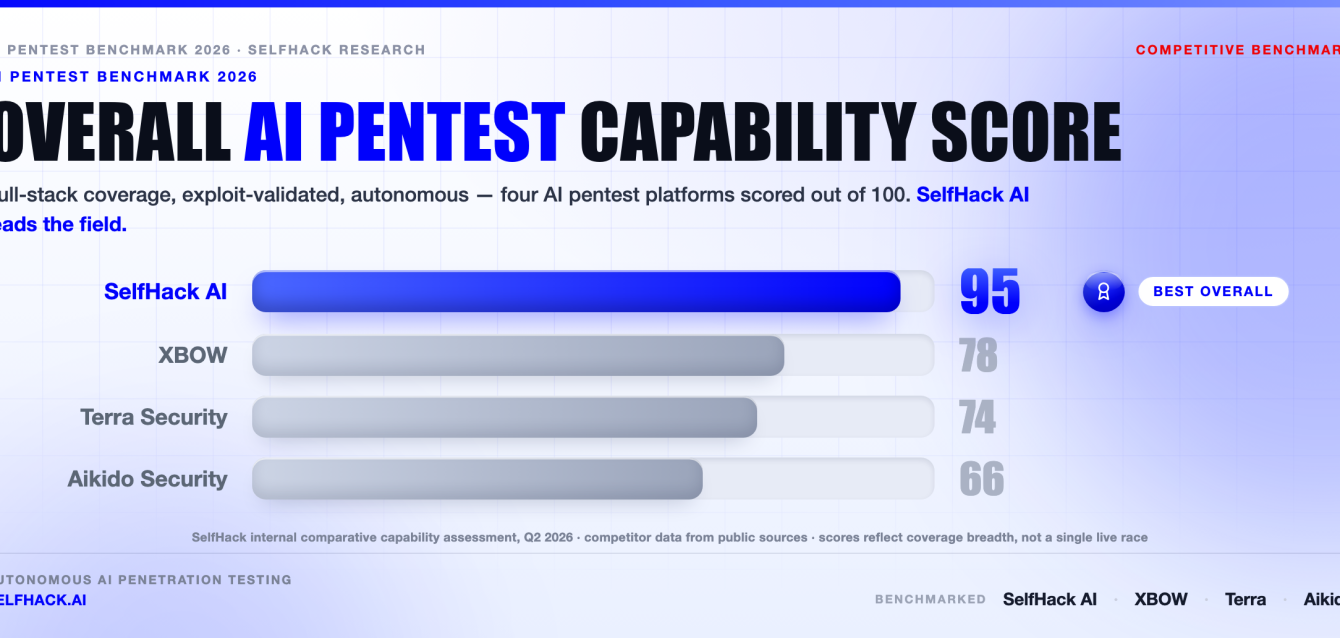
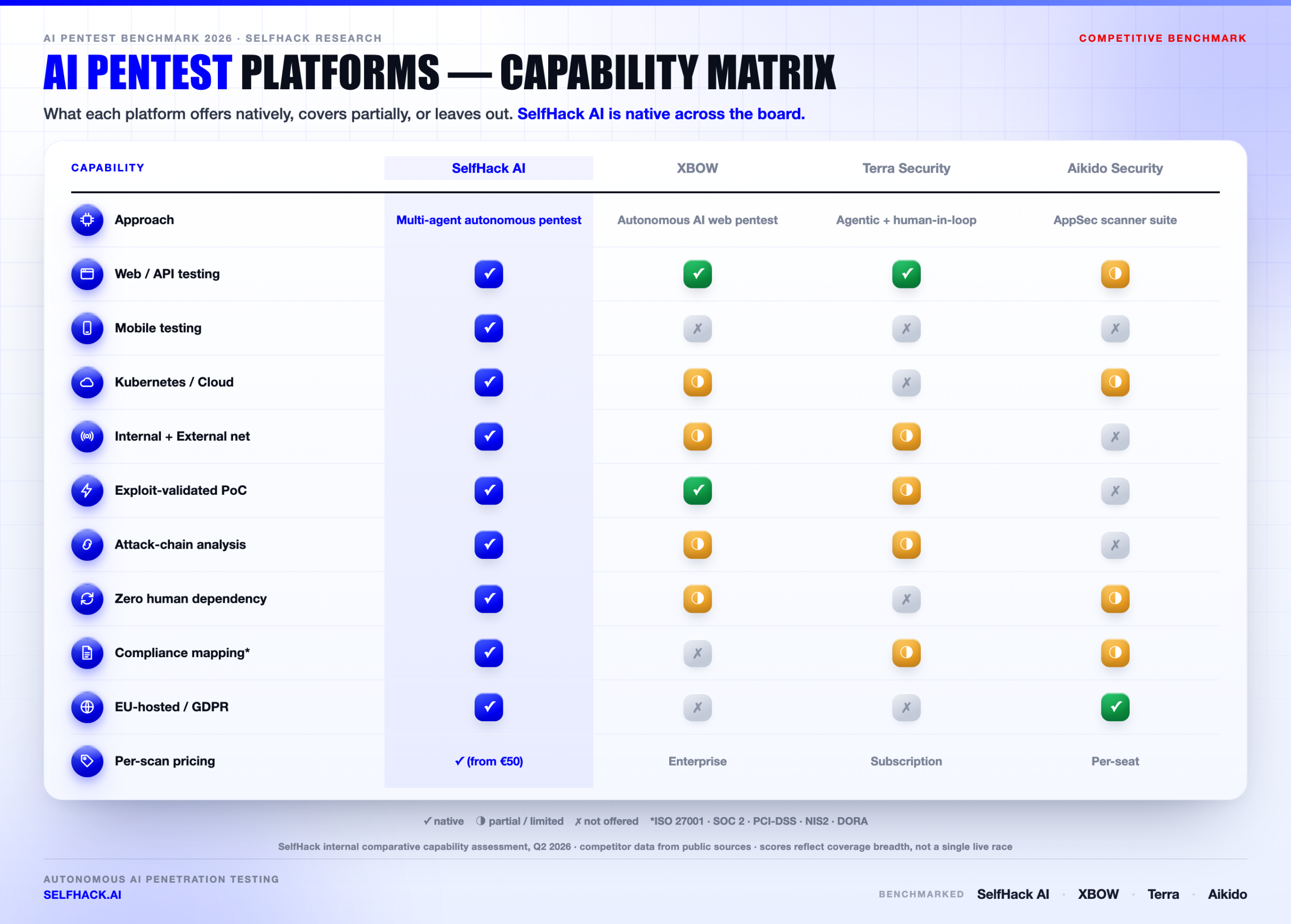
- SelfHack AI tops this AI pentest benchmark because it is the only platform that runs a full-stack, exploit-validated pentest — web, API, mobile, Kubernetes, cloud and internal network — with zero human dependency and native compliance mapping.
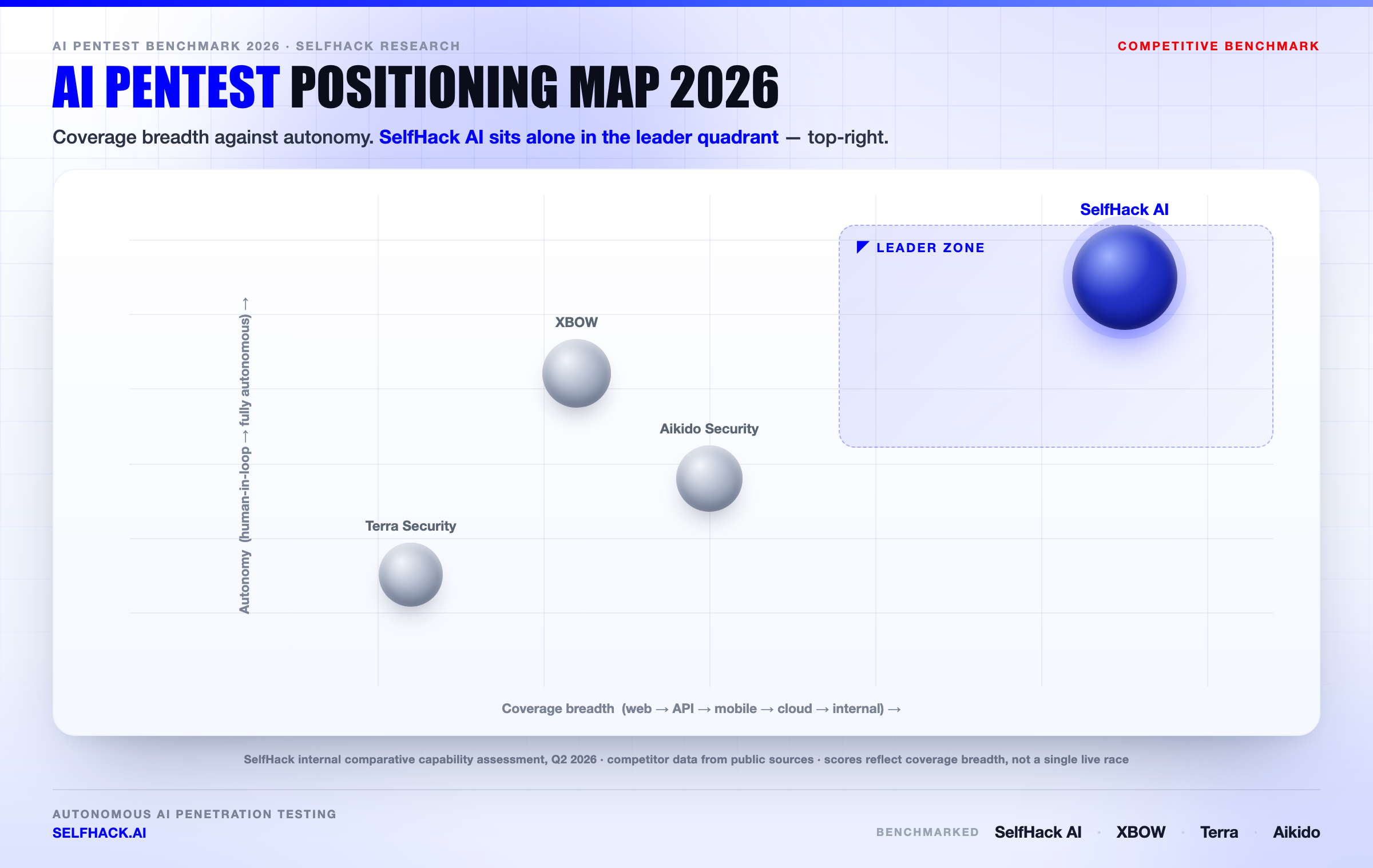
- XBOW is the strongest autonomous web exploiter we tested. It topped the HackerOne US leaderboard in 2025. But it stays web-centric and sells at enterprise scale.
- Terra Security does smart, context-aware continuous testing — yet it keeps a human in the loop and aims mostly at customer-facing web assets.
- Aikido Security is a lovely developer-first scanner suite, not a true exploitation pentest. Great for code and cloud posture, thin on attack-chain depth.
Why this AI pentest benchmark exists
Search “AI pentest” today and you get a wall of vendors all claiming to be autonomous, accurate and fast. Most of that is noise. So we ran the numbers ourselves.
This AI pentest benchmark compares four platforms people actually shortlist in 2026: SelfHack AI, XBOW, Terra Security and Aikido Security. Each one calls itself AI-driven. Each one solves a different slice of the problem.
Here’s the thing. An AI pentest is not one feature — it is a chain. Find the attack surface, test it, prove the exploit, map the blast radius, then hand a security team something they can act on without wading through false alarms.
The attack surface has outgrown human-only testing. One mid-size telecom now carries thousands of internal trust boundaries across network slices, cloud-native functions and edge nodes. No human team tests all of that every quarter. That is the gap an AI pentest platform is supposed to close.
We wrote this for the people doing the buying: CISOs, security engineers, DevSecOps leads and founders who need a real pentest before a SOC 2 or ISO 27001 audit. If that’s you, this AI pentest comparison should save you a week of demos.
One note on honesty up front. SelfHack AI publishes this benchmark, and we put our own platform first because the data backs it. We also name where each rival genuinely wins. The competitor facts come from public sources; our own numbers come from internal benchmarks and carry that label on every chart.
What changed in 2026: why AI pentest went mainstream
Two years ago, “AI pentest” sounded like a gimmick. Not anymore.
The shift started on the attack side. Through 2025 and 2026, security teams watched attackers wire AI agents into whole stages of an intrusion — recon, exploitation, lateral movement — running at machine speed. Low-skill actors began pulling off operations that used to demand a specialist, because the agent did the hard parts for them.
When offense automates, defense has to answer in kind. A once-a-year human pentest cannot guard a surface that mutates with every deploy, every new microservice, every fresh API. That mismatch is the whole reason the AI pentest market exploded.
The exposure data is brutal. Public device-search engines index millions of internet-facing hosts in a single country, and most have never seen a single test. Honeypots aside, that is real attack surface sitting open.
So the question stopped being “should we use an AI pentest?” It became “which AI pentest platform actually proves what it finds?” That is the question this benchmark answers. Speed is table stakes now. Proof is the prize.
How we scored each AI pentest platform
We judged every AI pentest tool on six dimensions. Each one maps to a question a buyer actually asks.
- Scope coverage — does it test web, API, mobile, Kubernetes, cloud and internal network, or just one corner?
- Exploit validation — does it prove a finding with a working proof-of-concept, or just flag a “maybe”?
- Attack-chain analysis — can it chain low-severity bugs into one critical path, the way a real attacker would?
- Autonomy — does it run end to end with zero human in the loop?
- Compliance mapping — are findings mapped to ISO 27001, SOC 2, PCI-DSS, NIS2 and DORA out of the box?
- Speed to result — minutes and hours, or weeks?
Those six dimensions track the way professionals already think about testing. The OWASP Web Security Testing Guide frames coverage and validation the same way. For attack chains, we lean on the MITRE ATT&CK model of tactics and techniques. And the control mapping follows the NIST family of standards.
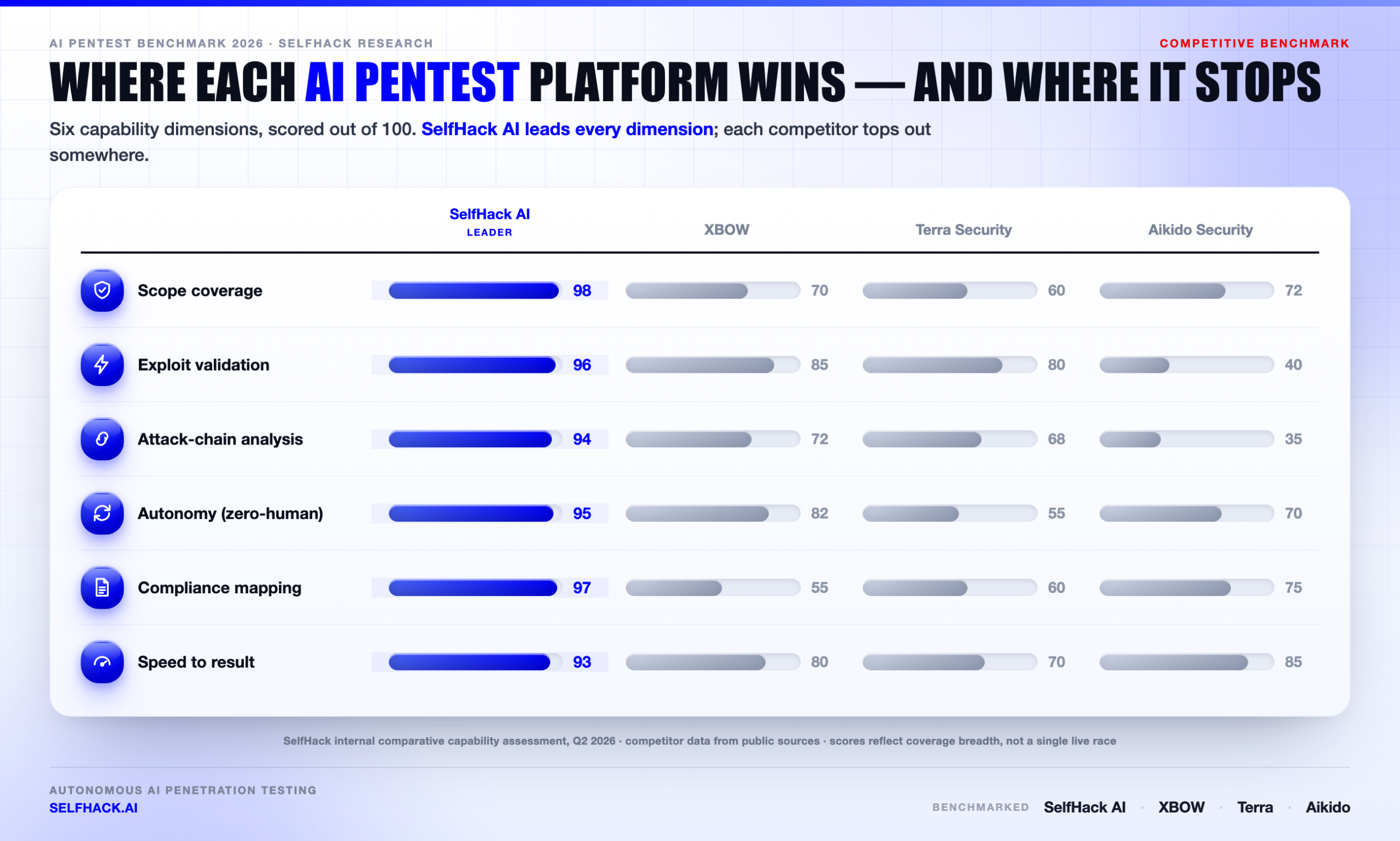
The chart above shows the spread. SelfHack AI sits at the top of every dimension, but the gaps tell the real story. XBOW is close on exploit validation. Aikido is close on speed. Nobody else covers all six at once.
Scores run 0 to 100 and reflect coverage breadth, not a single live race. That matters. A tool can be brilliant at one thing and absent at another, and an honest AI pentest benchmark has to show both.
The four contenders at a glance
Before the head-to-head, here is the short version of who each player is and what they actually ship.
SelfHack AI — the multi-agent pentest army
SelfHack AI runs a swarm of specialized agents that discover, verify and exploit, then cross-check each other before a finding ships. The team calls it a jury system. Every reported issue arrives with a working proof-of-concept, which is why the false-positive rate stays low.
Coverage is the headline. SelfHack AI tests web, API, mobile, Kubernetes, cloud, internal and external network in one engagement. Reports map straight to ISO 27001, SOC 2, PCI-DSS, NIS2 and DORA. It is EU-hosted and GDPR-aligned, and pricing starts per scan rather than per seat or per asset.
XBOW — the autonomous web exploiter
Credit where it is due. XBOW is genuinely impressive. In 2025 it climbed to the top of the HackerOne US leaderboard as an autonomous AI hacker, out-submitting human researchers on live programs.
Its engine is built for web application exploitation at scale, and it is very good at it. The limits are scope and reach: XBOW concentrates on web targets and sells into large US enterprises. If your risk lives in mobile, Kubernetes or internal network, that is outside its lane.
Terra Security — agentic, with a human co-pilot
Terra Security pushes a context-aware, continuous model. Its agents learn an application over time, then re-test as it changes — a smart answer to apps that ship daily. Terra was a 2025 RSAC Innovation Sandbox finalist, which is no small thing.
The trade-off is autonomy. Terra keeps human experts in the loop to validate and guide, and it focuses on customer-facing web assets. That is a deliberate design choice, not a flaw. It just means it is not a zero-human, full-stack AI pentest.
Aikido Security — the developer’s scanner suite
Aikido is the friendliest tool here, and developers love it. It folds SAST, DAST, SCA, cloud posture, secret detection and container scanning into one clean dashboard, with noise-reduction that spares engineers a flood of junk tickets.
But let’s be real about the category. Aikido is a scanner and posture platform, not an exploitation pentest. It tells you a dependency is vulnerable; it does not chain three weaknesses into a domain takeover and prove it. Different job, different depth.
Head-to-head: where each AI pentest tool wins and breaks
Now the interesting part. On any single axis the field is tight. Across all six, the picture changes fast.
Scope and coverage
This is the widest gap in the whole AI pentest benchmark. SelfHack AI tests seven attack surfaces in a single run. XBOW and Terra center on web. Aikido scans code and cloud but does not exploit.
Why does that matter? Because attackers do not respect your tool’s scope. They pivot from a leaked API key to a cloud role to an internal service, and a web-only AI pentest never sees the second and third hops in that chain.
Exploit validation and false positives
Every serious buyer has been burned by a scanner that cried wolf. A report with 400 “criticals” and no proof is worse than no report — it buries the three findings that could actually sink you.
SelfHack AI and XBOW both validate by exploitation, and it shows in their numbers. Terra validates too, with human assistance. Aikido, by design, reports potential issues rather than proven ones. In our experience, exploit-validated findings are the single biggest time-saver a security team gets from an AI pentest.
Picture a concrete chain. A scanner flags a medium-severity exposed storage bucket and shrugs. An exploitation engine reads that bucket, finds a stale API token inside, uses the token to reach a cloud role, and from that role pulls customer records. Same starting bug, wildly different ending. One reads as “medium, maybe later.” The other reads as “critical, fix tonight.” Only an AI pentest that actually walks the chain can tell you which one you really have.
Autonomy and speed
Autonomy is where the “AI” in AI pentest earns its name. SelfHack AI runs end to end with no analyst steering it, and an Auto Scanner pass finishes in about two hours. XBOW is highly autonomous too. Terra keeps a person in the loop, which adds quality but also adds wait time.
Speed without depth is a trap, though. Aikido is fast because scanning is fast — it is doing less work than an exploitation engine. A fair read rewards depth-at-speed, not raw speed alone.
Pricing and compliance
Pricing models split the field cleanly. SelfHack AI charges per scan, starting low, with no asset caps or annual lock-in. XBOW is enterprise. Terra is subscription. Aikido is per seat.
Compliance is the quiet differentiator. Most teams buy an AI pentest because an auditor asked for one. SelfHack AI ships audit-ready output mapped to ISO 27001, SOC 2, PCI-DSS, NIS2 and DORA, so the report drops straight into the evidence folder. The others leave more of that mapping to you.
Which AI pentest platform should you pick?
Skip the spec sheet for a second. Pick by who you are.
- Startup heading into SOC 2 or ISO 27001: you need breadth and audit-ready reports without a six-figure budget. SelfHack AI fits cleanly.
- Enterprise with one critical web app: XBOW’s autonomous web exploitation is hard to beat on that single surface.
- Product team shipping daily: Terra Security’s continuous, context-aware testing keeps pace with change.
- Engineering org wanting in-pipeline scanning: Aikido Security gives developers fast, low-noise feedback in the IDE and CI.
Most buyers we talk to are in that first bucket. They have a full stack, a tight budget and an auditor breathing down their neck. That is exactly the case an AI pentest like SelfHack AI Auto Scanner was built for.
The truth is, you do not have to marry one tool forever. Plenty of teams run Aikido in the pipeline for daily hygiene and a full AI pentest from SelfHack AI before each release or audit. Layers beat silver bullets.
How to run your first AI pentest (a 4-step playbook)
Buying an AI pentest is easy. Getting value on the first run takes a little planning. Here is the path we walk new teams through.
- Map your real scope first. List every surface that touches the internet — web apps, APIs, mobile backends, cloud accounts, Kubernetes clusters. If a tool only tests one of those, you have already capped your result. Pick an AI pentest that covers the whole list.
- Demand exploit-validated findings. Tell the vendor you want proof, not probabilities. A platform that ships a working proof-of-concept with each finding saves your engineers from triaging hundreds of “maybes.”
- Tie it to a compliance goal. Most first pentests exist to clear an audit. Make sure the report maps to your framework — ISO 27001, SOC 2, PCI-DSS, NIS2 or DORA — so the output drops straight into your evidence pack.
- Re-test after you fix. A finding is not closed until a second run confirms the fix held. Per-scan pricing makes that loop cheap, which is one quiet reason teams favor it over annual contracts.
Run it that way and the first scan pays for itself. You walk in with a scope, you walk out with proof, and the auditor stops asking awkward questions. That is the whole point of a modern AI pentest.
What an AI pentest still can’t do (and how to cover the gap)
We sell an AI pentest platform, so take this section as a sign we would rather be straight with you than oversell.
Autonomous agents are extraordinary at scale and repetition. They are not yet a full replacement for a creative human red-teamer on every problem. Three areas still reward a human touch.
- Deep business-logic abuse. An agent can test a checkout flow fast. A clever human sometimes spots a multi-step abuse path that no model has seen before — chaining a coupon bug into free inventory, say.
- Human-layer attacks. Phishing, pretexting and physical entry sit outside what an AI pentest tool touches. Those need a social-engineering engagement.
- Brand-new logic in novel apps. The more unusual your domain, the more an expert’s intuition adds on top of the machine’s coverage.
So how do you cover the gap? You stack the layers.
Run an AI pentest continuously for breadth, speed and proof. Then bring a human red team in once or twice a year for the creative edge cases. The AI handles the 95% that used to eat your consultants’ hours; the humans focus on the 5% that genuinely needs them.
SelfHack AI is built for exactly that split. The agents do the heavy lifting and validate every finding by exploitation, and an expert review option is there when a high-stakes app wants a second set of eyes. Honest tools tell you where they stop. This is where we stop, and how we close it.
If you want to see what “autonomous depth” looks like with the numbers attached, our confidential computing pentest research is published in full: 32 trust invariants tested against AMD SEV-SNP and NVIDIA Blackwell GPU confidential computing, with the defences that held documented alongside the ones that did not.
FAQ
What is an AI pentest?
An AI pentest is a penetration test driven by autonomous agents instead of a human consultant alone. The system discovers your attack surface, tests it, and — on the better platforms — proves each finding with a working exploit. The goal is the depth of a manual pentest at the speed and scale of software.
Is AI penetration testing as good as a human pentester?
For coverage and speed, an AI pentest already beats a human team — no person tests thousands of trust boundaries every week. Top human experts still edge ahead on novel business-logic abuse. The strongest platforms close that gap with exploit validation and attack-chain analysis, which is why those two dimensions weigh so heavily in this AI pentest benchmark.
How is SelfHack AI different from XBOW?
XBOW is a superb autonomous web exploiter with an enterprise, US-centric footprint. SelfHack AI covers web, API, mobile, Kubernetes, cloud and internal network in one run, maps findings to compliance frameworks, and prices per scan. Same autonomous spirit, much wider scope.
Can an AI pentest satisfy SOC 2 or ISO 27001 requirements?
Yes, when the report is exploit-validated and mapped to controls. SelfHack AI generates audit-ready output aligned to ISO 27001, SOC 2, PCI-DSS, NIS2 and DORA. Auditors care that findings are real and traceable, and proven exploits clear that bar.
How much does an AI pentest cost?
It depends on the model. SelfHack AI starts per scan with no asset caps, which keeps it well below legacy firms and enterprise tools. Subscription and per-seat rivals can run into five figures a year once you scale assets or users.
Are AI pentest results safe to trust?
Trust comes from validation. A tool that proves each finding by exploitation produces far fewer false positives than a signature scanner. That is why we rank exploit validation so highly — it is the difference between a report you act on and a report you argue with.
The verdict
Every platform in this AI pentest benchmark is good at something. XBOW owns autonomous web exploitation. Terra owns continuous, context-aware testing. Aikido owns developer-friendly scanning.
SelfHack AI owns the whole board. Full-stack coverage, exploit-validated findings, zero human dependency, native compliance mapping and per-scan pricing — together, in one platform. That is why it leads this benchmark, and why it keeps showing up first when teams compare AI pentest tools.
Step back and the trend is hard to miss. The market is moving from single-surface scanners toward agentic platforms that test everything and prove what they find. SelfHack AI is already on the far side of that move. The rivals are good, and some are excellent on their home turf — but a buyer who needs one AI pentest to cover the whole stack, clear an audit, and stay inside budget keeps landing on the same answer. Breadth plus proof plus price, with no analyst in the critical path, is a combination nobody else ships today.
Want to see it on your own stack? Start a scan and get an exploit-validated, audit-ready report — order an AI pentest from SelfHack AI or contact our team for a walkthrough. We tested the field so you do not have to. Bring your toughest target, and let the agents prove what they find on it.
Data based on publicly available information as of Q2 2026. SelfHack AI statistics come from internal benchmarks. Competitor capabilities, pricing and positioning may change — verify with each vendor before purchase.