
Blockchain Pentest: Securing a Gold-Backed Tokenization Platform Across Every Layer
- A gold-backed tokenization platform isn’t one app. It’s a web frontend, a fleet of microservices, a cloud cluster, and a smart contract — and a real blockchain pentest has to cover all of them at once.
- Almost nobody does. A web scanner is blind to Solidity. A smart-contract auditor is blind to your KYC service. Each tool tests one silo and calls it done.
- The bugs that actually move money live at the off-chain ↔ on-chain seam — where an ordinary API flaw turns into an unbacked token mint. Siloed tools never look there.
- We ran the whole thing as a single engagement: web, API, cloud and the smart-contract layer, plus the seam between them. This is an anonymized account of what that takes — no client, domain or identifying detail included.
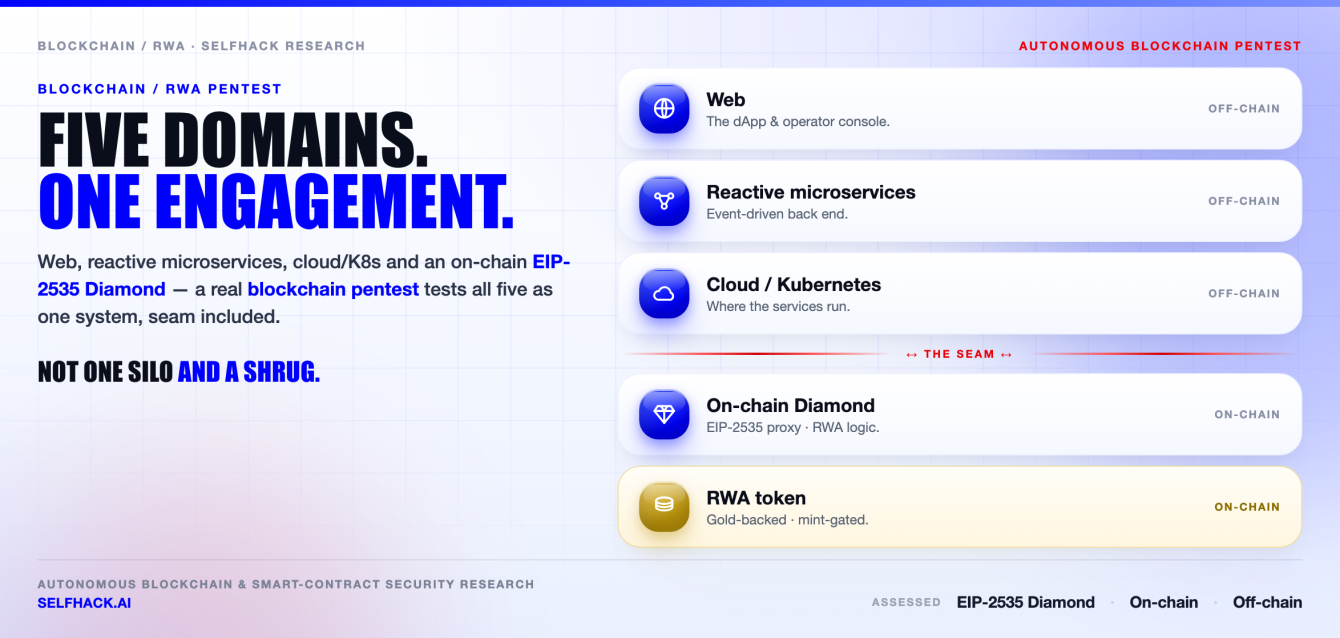
The platform: one token, five security domains
Picture a gold-backed real-world-asset (RWA) platform. A token is backed one-to-one by physical gold in a vault. Customers pass KYC, buy in-app with money from their own bank account, and redeem for cash. Simple to describe. Anything but simple to secure.
Because under that clean idea sits a stack most teams underestimate. A web frontend. A cluster of reactive microservices — wallet, custody, banking, KYC, market data. A Kubernetes cloud deployment with server-side custodial keys. And a smart-contract layer running the token itself.
Every one of those is a different security discipline. Put together, they’re a single product where a customer’s money is real, the gold is real, and the trust is one-to-one. A blockchain pentest that only looks at the chain — or only at the web — misses most of it.
Here’s the part that makes it interesting. The on-chain code enforces the token lifecycle, the one-to-one reserve accounting, the compliance whitelist, and multisig governance. The off-chain code handles KYC, banking, pricing and custody. The value flows across that boundary constantly. So does the risk.
And the stakes are unusual. Most apps, a breach means stolen data. Here, a breach can mean minted money — tokens that claim gold that doesn’t exist. That’s a different class of problem, and it’s why a shallow, single-layer blockchain pentest is worse than none: it hands you a false sense of safety over real reserves.
Why a blockchain pentest is really five pentests
Call it what it is. A serious blockchain pentest of a platform like this is five tests wearing one name.
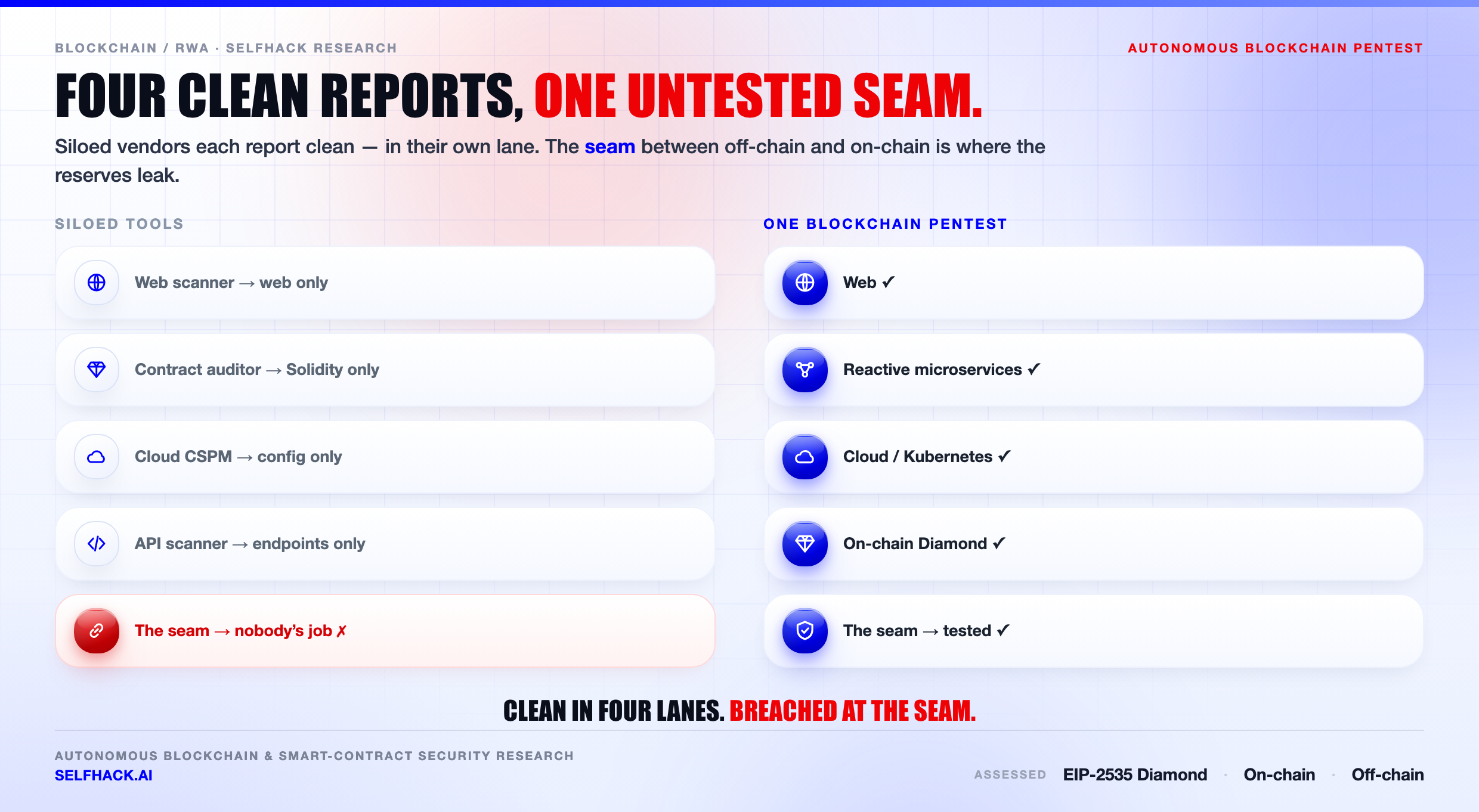
- Web — the frontend and its session, auth and business-logic flaws.
- API and microservices — a fleet of reactive services with inter-service tokens, tested through the WAF, where broken object-level authorization loves to hide.
- Cloud — the Kubernetes cluster, the secret store holding custodial signing keys, the blast radius if one pod is popped.
- Smart contract — the Solidity itself: an upgradeable proxy, the token, the access-control rules that decide who can mint.
- The seam — the off-chain ↔ on-chain boundary, which isn’t any single team’s job and is exactly where value moves.
Now look at how the market tests this. A DAST tool scans the web and stops. A smart-contract audit firm reads the Solidity and stops. A cloud posture tool checks config and stops. Each is good at its silo and completely blind outside it.
And the gaps compound. Because each vendor scopes narrowly, each one honestly reports “no critical findings” — in its lane. Stack four clean reports and a buyer feels safe, while the one thing nobody owned, the seam, was never opened.
Nobody in that list is testing the fifth thing — the seam. And the seam is where a gold-backed token actually gets stolen.
The off-chain ↔ on-chain seam, where tokens break
This is the idea worth stealing from this whole piece: attackers don’t respect your architecture diagram. They chain a boring bug on one side into a catastrophic result on the other.
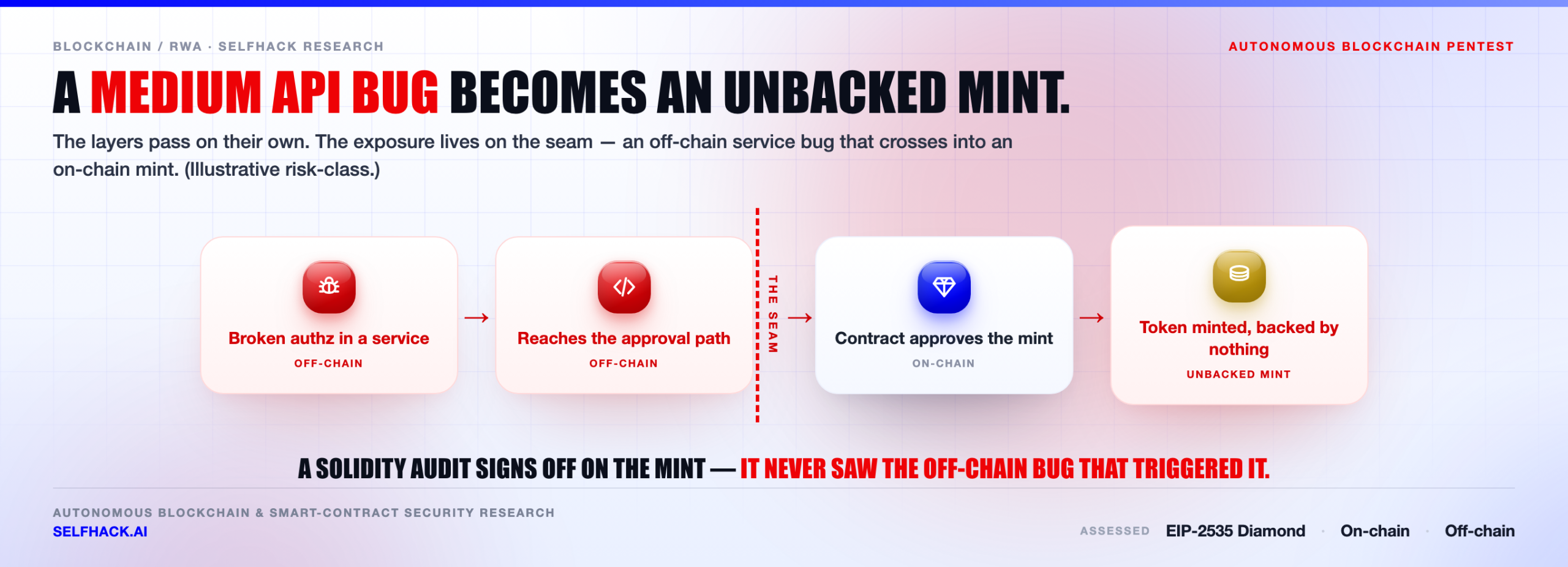
Think about how a token gets minted here. Off-chain, a custodian submits that gold arrived; a second custodian verifies it; only then does the chain approve minting against that reserve. It’s a careful, two-person rule — on paper.
But that rule spans the seam. The submit-and-verify lives in off-chain services; the mint lives on-chain. If an attacker can break the off-chain half — reuse a session, skip an authorization check, get one account to play both custodians — the on-chain contract happily mints a token backed by gold that was never there. The one-to-one promise is broken, and the chain looks perfectly valid while it happens.
A smart-contract audit alone can’t catch that. The Solidity is correct: it minted because it was told to, by an approval that looked legitimate. The bug was off-chain, the damage was on-chain, and only a test that walks both sides sees the whole path.
Anatomy of a token mint — and where an attacker breaks it
Follow a single token from gold to balance, and the seam lights up.
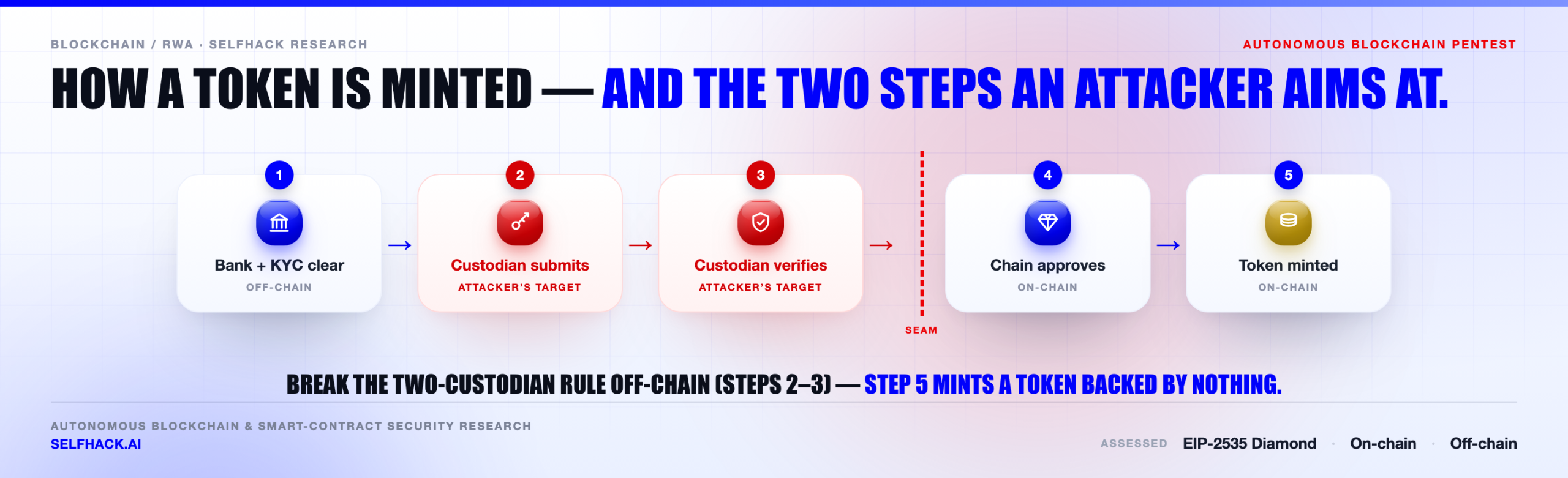
- Off-chain, a customer’s bank transfer clears and KYC passes.
- A custodian submits that gold arrived in the vault.
- A second, separate custodian verifies it — the “no self-verify” rule.
- The verified approval crosses the seam to the chain.
- On-chain, the contract mints exactly one token against that reserve, and the whitelist lets only a KYC’d address hold it.
Five steps, three of them off-chain, one seam, one on-chain result. An attacker doesn’t need to break the contract. They need to break step 2 or 3 — get one identity to both submit and verify, or forge the approval a service trusts — and step 5 mints a token backed by nothing.
That’s why we test the flow, not the pieces. A Solidity audit signs off on step 5 in isolation and never sees that steps 2 and 3 were the real target. A blockchain pentest that walks the whole mint is the only thing that catches it before an attacker does.
6 cross-layer risks siloed tools miss
These are the risk classes a full-stack blockchain pentest exists to catch. Each one crosses the seam, which is precisely why single-layer tools walk right past them.
1. Off-chain authorization flaw to on-chain mint
A broken access check in a banking or wallet service lets a request reach a privileged path it shouldn’t. On its own, a medium-severity API bug. Chained into the mint flow, it becomes the ability to create tokens — the worst outcome a reserve-backed asset has.
2. Bypassing the on-chain compliance whitelist
The chain enforces a whitelist so only KYC-passed addresses can hold the token. But whitelisting is driven by off-chain KYC. If the off-chain path that registers an address can be tricked, an un-KYC’d party ends up holding a regulated asset — a compliance failure that no Solidity review would flag as a bug.
The tell is that the contract behaves perfectly. It checked the whitelist, the address was on it, the transfer went through. The lie was told off-chain, when an address got written to that list through a path that trusted the wrong input.
3. Breaking the dual-custodian rule
“Submit, then verify, no self-verify” is the control that keeps reserves honest. It only works if one identity truly can’t do both. A full-stack blockchain pentest hunts for the account, token or session reuse that collapses two custodians into one — and with it, the one-to-one backing.
Two people, two approvals — unless they’re really one identity wearing two sessions. We look for the shared token, the reused role, the service that accepts a self-approval it should reject. Collapse the two, and the reserve stops being one-to-one; it becomes whatever the attacker claims.
4. Governance and multisig gaps
Privileged operations — mint, pause, upgrade, signer management — are meant to require a threshold of signers. A blockchain pentest checks whether every one of those operation types actually enforces it, or whether a single actor can reach a privileged function through a path nobody reviewed.
Thirty-plus privileged operation types is thirty-plus chances for one to be enforced loosely. It takes a single privileged path that skips the signer threshold to hand one actor the power to mint, pause, or upgrade — so a blockchain pentest tests every one, not a sample.
5. Upgradeability abuse
An upgradeable proxy is a superpower and a liability. Whoever controls the upgrade controls the token. A blockchain pentest tests whether the upgrade path — the proxy’s admin functions and the keys behind them — can be reached off-chain, because a stolen upgrade key rewrites the rules for everyone.
The uncomfortable question is simple: where does the upgrade key live, and what off-chain flaw reaches it? If the answer is a cloud secret store a compromised pod can read, then a container bug — not a Solidity bug — quietly owns the token.
6. Off-chain price and reserve manipulation
Pricing and proof-of-reserve feed the system from off-chain. If the price path or the reserve accounting can be nudged, the token’s stated value drifts from its real backing — a slow, quiet way to break a one-to-one asset without ever touching the contract.
None of this trips a contract audit, because the contract does exactly what it’s told with the numbers it’s handed. The manipulation happens upstream, off-chain, in the feed and the accounting — which is precisely why a blockchain pentest has to test those too.
Representative findings: the niche bugs a full-stack test surfaces
Generic risk classes are easy to nod along to. The value of a blockchain pentest is in the specific — so here are concrete, niche findings of the kind this stack invites. These are representative examples of each class, from patterns we see in the field, not a disclosure of any one client’s report; severities are the typical range for the class.
Unprotected Diamond facet → mint without a quorum Critical
In an EIP-2535 Diamond, every facet function is reachable through the single proxy address. Miss one access-control modifier on one facet — a privileged operation that should gate on the signer set but doesn’t — and that function is callable directly, skipping the whole multisig. One forgotten modifier can equal mint-at-will. A facet-by-facet selector map catches it; a spot-check never will.
✓ The fix: enforce the signer-gate modifier on every state-changing facet function, checked by an automated selector map at deploy — never a manual spot-check.
ERC-2612 permit replay across the seam High
Gasless approvals (EIP-712 permit) are convenient and easy to get wrong. If an off-chain service relays a permit signature without binding it tightly to nonce, deadline and chain ID, that signature can be replayed — granting an allowance the user never re-authorized. The signature is valid, the contract obeys, and the abuse lives in an off-chain relay path no Solidity review ever opens.
✓ The fix: bind every relayed permit to a fresh nonce, a short deadline and the chain ID, and reject any signature missing one.
Self-approval via inter-service event forgery Critical
The dual-custodian “submit → verify” rule usually rides on internal messaging between services. If one service trusts a “deposit verified” event without authenticating who published it, a compromised or over-scoped service can emit its own verification — collapsing two custodians into one and approving a reserve nobody checked. The mint that follows is flawless on-chain and fraudulent underneath.
✓ The fix: authenticate inter-service events (signed messages or mTLS) and require the two custodian approvals to come from provably distinct identities.
KYC ↔ whitelist time-of-check bug High
The on-chain compliance whitelist is written from off-chain KYC state. If that write fires on a status that can still be revoked — or in the window before final checks clear — an address reaches the whitelist during a gap it should never occupy. A time-of-check/time-of-use flaw straddling the seam, invisible to a contract audit and a KYC review taken separately.
✓ The fix: write the whitelist only on a final, non-revocable KYC state, and re-check at the moment of use — not just the moment of decision.
Upgrade key reachable from an over-permissioned pod Critical
The beacon or Diamond upgrade authority is only as safe as the key behind it. Park that signing key in a cloud secret store, grant a workload broad read access, and a single container escape or SSRF-to-metadata reads the key — then rewrites the token for everyone. This is the purest cross-layer bug there is: a cloud misconfiguration that ends in total on-chain control.
✓ The fix: scope the workload to least-privilege secret access, isolate the upgrade key behind its own identity, and alert on every read of it.
Notice the through-line: every finding ships with a working reproduction and the fix, and then a retest against the same build confirms it actually closed. Finding the bug is half the job — proving it, fixing it, and re-proving it gone is how SelfHack solved this one, the loop siloed audits leave open.
Why no single other product does this
Here’s the honest market reality, and it’s the whole reason this blockchain pentest was hard to buy anywhere else.
The web3 world split into two camps. Application security vendors test web, API and cloud, and treat the smart contract as someone else’s problem. Smart-contract audit firms read Solidity beautifully, and treat your microservices and cloud as out of scope. Buy both and you get two reports that never talk to each other — and a seam that neither one tested.
That gap isn’t academic. For a tokenized asset, the seam is the product. It’s where KYC becomes a whitelist, where a custodian’s approval becomes a mint, where a bank transfer becomes a balance. Testing the halves separately and hoping the middle is fine is not a security strategy. It’s a coin flip with your reserves.
This is also why a blockchain pentest can’t be the cheapest scanner you delegate and forget. The whole value is in one team seeing the web request, the API hop, the cloud key and the Solidity call as a single chain of custody — that’s the blockchain pentest a tokenized asset actually needs.
Covering all five domains in one engagement — and correlating findings across them — is rare because it needs one team fluent in web, API, cloud and Solidity at the same time, running at a scale a human squad can’t sustain. That combination is exactly where an AI-driven approach pulls ahead.
How SelfHack AI ran this blockchain pentest
SelfHack AI runs a swarm of specialized agents — web, API, cloud and smart-contract — under one engagement, sharing what they find so a bug on one layer becomes a lead on the next.
- Every layer, one run — web, the reactive microservices tested through the WAF, the Kubernetes cloud, and the Solidity contracts (upgradeable proxy, token, governance) covered together, not in four disconnected projects.
- Seam-aware testing — findings are correlated across the off-chain ↔ on-chain boundary, so an authorization gap in a service is chased all the way to its on-chain consequence.
- Exploit-validated, dual reports — a smart-contract audit report and a full penetration-test report, each finding proven, mapped to standards, and ready for a regulator or auditor.
- Zero human bottleneck — the breadth that takes a mixed human team weeks runs continuously here, so a change to a contract or a service gets re-tested, not left for next year.
It’s the same platform behind our AI pentest benchmark, our external-surface testing, and our LLM pentest work — here pointed at the hardest full-stack target there is: a live tokenized asset.
The output matched the scope: two reports from one engagement — a smart-contract audit and a penetration test — that actually reference each other, so a finding in a service and a finding in a facet read as one story instead of two disconnected PDFs. That correlation is the part siloed vendors structurally can’t deliver, because they never saw both halves.
FAQ
What is a blockchain pentest?
A blockchain pentest is a security test of a blockchain application across every layer it runs on — the web frontend, the APIs and microservices, the cloud, and the on-chain smart contracts — plus the boundary between off-chain and on-chain logic. It goes beyond a Solidity audit to test the whole system an attacker actually meets.
Isn’t a smart-contract audit enough?
No, and this is the most expensive misconception in web3. A smart-contract audit tells you the Solidity is sound. It says nothing about the API that calls it, the KYC service that gates it, or the cloud key that can upgrade it. Most tokenized-asset incidents start off-chain and end on-chain — outside an audit’s scope.
What’s the “off-chain to on-chain seam”?
It’s the boundary where your normal application hands control to the blockchain — where a verified deposit becomes a mint, or a KYC pass becomes a whitelist entry. It belongs to no single team, so it’s rarely tested end to end, which is exactly why attackers target it.
Can this really be done in one engagement?
Yes — that’s the point of a full-stack blockchain pentest. Covering web, API, cloud and smart contracts together, and correlating findings across them, is what surfaces the cross-layer paths. Splitting it into separate projects is what leaves the seam untested.
Do you also test upgradeable contracts and governance?
Always. Upgradeable proxy patterns and multisig governance are where control over the token lives. We test whether upgrade and privileged operation paths truly require the intended signers, and whether any of them can be reached through an off-chain shortcut.
Is any of this based on a real client?
The architecture pattern here reflects real engagements, fully anonymized — no client name, domain, address, or identifying detail. The point isn’t one company; it’s a class of platform, and a testing gap the whole industry shares.
Which frameworks and standards do you map to?
Web and API findings map to the OWASP Top 10 and OWASP API Security Top 10; smart-contract findings map to the OWASP Smart Contract Top 10 and common web3 audit criteria; cloud findings follow standard Kubernetes and cloud hardening baselines. Everything lands in reports an auditor or regulator can read without a translator.
How does an AI-driven blockchain pentest handle the smart-contract layer?
With source and ABI in hand, agents reason over the contract logic — access control, upgrade paths, token lifecycle — and then chase those findings all the way back into the off-chain services that call them. The advantage isn’t just reading Solidity fast; it’s holding the web, API, cloud and contract context in one place so cross-layer paths become visible.
The verdict
A tokenized asset makes a bold promise: one token, one unit of real value, every time. That promise is only as strong as the weakest layer holding it up — and there are five of them.
A blockchain pentest that tests one layer and trusts the rest isn’t securing that promise. It’s decorating it. The real work is covering web, API, cloud and smart contract as one system, and testing the seam where they meet, because that seam is where the money moves and where attackers aim.
If you take one thing from this: stop buying your blockchain pentest in pieces. Two disconnected reports leave the most dangerous gap in the middle untested, and that gap is the whole reason tokenized assets get drained. One engagement, every layer, the seams included — that’s the only version that actually protects a one-to-one promise.
Building or running a tokenized asset, an RWA platform, or any app where a smart contract meets real money? Start a scan — order a blockchain pentest from SelfHack AI or contact our team. We’ll test every layer, and the seams between them, in one engagement — the way an attacker actually comes at you.
Sources
- OWASP Smart Contract Top 10 — owasp.org
- OWASP API Security Top 10 — owasp.org
- NIST — blockchain technology overview (NISTIR 8202) — nist.gov
- EIP-2535 Diamonds (upgradeable proxy standard) — eips.ethereum.org
Anonymization note: this article describes a class of platform and testing approach; all client, organisation, domain, address, key and identifying details are excluded by design. Cross-layer scenarios illustrate the risk classes a full-stack blockchain pentest examines and are not disclosures of any specific client finding.