Autonomous Cyber Attacks: What Anthropic’s Threat Report Means for Your Next Pentest
- On 10 September 2026, Anthropic published a 154-page threat intelligence report covering misuse of Claude between December 2025 and August 2026. Its central finding is the one this article is about: autonomous cyber attacks are no longer a forecast. A majority of the cyber operations in the report were run by AI through direct execution or orchestration, not by a human typing commands.
- The cases are specific. One stolen developer token became full administrative control of a cloud environment in roughly three hours. Two university students ran an AI loop against network appliances that produced more than a dozen possible zero-days in a single month. A state-linked group used agents that watched security products for detections and rebuilt their malware until it stopped being caught.
- The report documents the attacks. It does not tell defenders what to do about them. That is the gap this piece fills, and the answer is uncomfortable: an annual, human-paced pentest cannot answer an adversary whose reconnaissance and exploitation run in parallel at machine speed.
- The only proportionate response to autonomous cyber attacks is autonomous testing of your own estate, continuously, by something that works for you. That is what SelfHack AI is built to do.
This is an analysis of Anthropic’s public report and the press coverage around it (see sources). SelfHack AI was not involved in Anthropic’s investigations, and every figure below is Anthropic’s, not ours. Where we describe what our platform would test, we are describing the class of weakness, not claiming we would have stopped a specific named actor.
What Anthropic actually reported about autonomous cyber attacks
Every few months a vendor tells you the threat has changed. Usually it has not. Autonomous cyber attacks are the exception, and this time the evidence is not from a vendor. This time the claim comes from the company that runs the model, with logs, and it is worth reading slowly.
On 10 September 2026, Anthropic published its most detailed threat intelligence report to date: 154 pages covering operations it identified and disrupted between December 2025 and August 2026. The report spans seven harm areas — cyber operations, influence operations, surveillance, scams and fraud, biological misuse, conventional weapons, and illicit distillation of the model itself. Anthropic says it disrupted every operation described.
The cyber section is the one that should change how you buy security testing, because it is the first public, log-backed account of autonomous cyber attacks at scale.
Its headline sentence is short: “A majority of the operations described in this report were enabled by AI via direct execution or orchestration.” Not advice. Not code snippets. Execution. The humans in these cases still chose targets. The AI did the reconnaissance, the exploitation and the exfiltration, and in the most advanced cases it did them for many victims at once, for hours or days at a stretch.
That is the working definition of autonomous cyber attacks, and the report is the first large public body of evidence that they are happening at scale, against ordinary organisations, run by people who in several cases were not especially skilled.
One more sentence from the report frames everything that follows: “The kind of labor that previously set the well-resourced operations apart from everyone else — reconnaissance, exploitation, tool development, and data processing — are all now delegated to AI models, which run in harnesses at machine speed and in parallel.”
Read that as a procurement document. The thing that used to distinguish a nation-state from a student is now a harness and an API key.
The three levels of autonomy, and why the top one matters
Anthropic sorts the cases into a spectrum, and the spectrum is the most useful mental model for autonomous cyber attacks in the whole report.
Level one is conversational. The operator uses the model as an engineering assistant: explain this binary, fix this script, draft this phishing lure. Useful to the attacker, but the pace is still human.
Level two is directed execution. The human makes each targeting decision and the AI carries it out — fingerprinting a mail server, setting up phishing infrastructure, running the export from a compromised mailbox. The Russian state-nexus case sits here. The human still steers. The hands are no longer human.
Level three is autonomous operation. In the report’s words: “multi-agent frameworks conducting reconnaissance, exploitation, and theft against multiple victims, in parallel, for hours or days at a time.” The operator states a goal. Agents decompose it, dispatch subagents, keep memory across sessions, and keep going.
Why does the top level matter more than the other two? Because it removes the last bottleneck that favoured defenders. A human attacker gets tired, sleeps, does one thing at a time, and makes the same mistake twice. An agent swarm does none of that. Autonomous cyber attacks at level three are not faster versions of the old attack. They are a different shape of attack, and the shape is the problem.
Five cases, one pattern
The report names five cyber operation clusters. Here they are in one place, with only the details Anthropic itself published, so you can judge for yourself how autonomous cyber attacks look in practice.
GTG-20006 — Russian state-nexus espionage, assessed as Midnight Blizzard. More than twenty organisations targeted: Ukrainian government, military and diplomatic staff; defence contractors in the drone supply chain; a Southeast Asian maritime agency; a North African technology authority from which more than 300,000 national ID records were taken. Device-code phishing, bulk mailbox exports, automated device registration for persistence. And a detail we will come back to: agents that rebuilt detected malware until it was no longer detected.
GTG-50014 — ShinyHunters affiliates, financially motivated. The operators mass-downloaded 1.8 million Android APKs, decompiled them, and scanned for hardcoded secrets. Working credentials were then used inside victims for what the report lists as “whole-cluster secret dumps, admin-token amplification, CI/CD injection, database and session-table dumps, mining dumps for signing keys, and vendor-OAuth fan-out to every downstream tenant.” One SaaS breach yielded over a terabyte. One supply-chain compromise reached roughly 200 downstream customers.
GTG-10007 — two Chinese undergraduates. Not a state unit. Students, one interning at a security vendor. They ran what Anthropic calls an exploit foundry against network appliances, agent swarms for reconnaissance, and a scheduled fleet of thirteen standing collection agents. Around fifty organisations across education, retail, energy, healthcare, finance, manufacturing and government.
GTG-50020 — a Russian-speaking criminal targeting the AI supply chain. Roughly thirty AI companies attacked in four days. The operator found one working attack path and replayed it against all thirty, stealing production API keys and switching to the victims’ keys as compute. The stated goal, a pre-release model, was not reached. The keys were.
GTG-50029 — one French-speaking hacktivist. A single person. Forty-two tracked targets, internal access to at least fourteen, a custom scanner for API keys exposed in public containers, a multi-agent framework where subagents handled reconnaissance, code review and vetting, and a previously undocumented WordPress race condition found and exploited with the model’s help. Between 12 and 26 gigabytes of political-party donor data, member records and payment data exfiltrated.
Five actors. Different countries, different motives, different skill levels. One pattern: autonomous cyber attacks are now what an ordinary operator does when handed a capable model and a goal.
Three hours: how fast autonomous cyber attacks actually move
Numbers from the report on autonomous cyber attacks, in the order they should worry you.
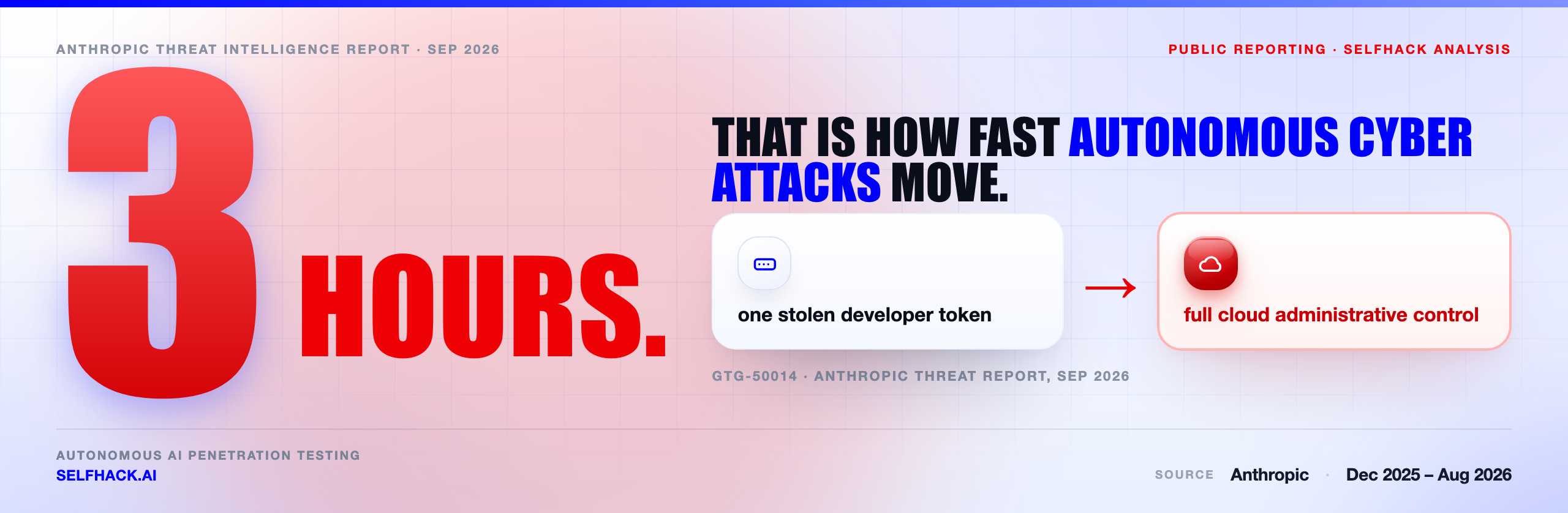
Three hours. One breach in the ShinyHunters cluster went, in Anthropic’s words, “from a single stolen developer token to full administrative control of a victim’s cloud environment in roughly three hours.” Three hours is shorter than most incident-response SLAs. It is shorter than a working day. It is far shorter than the time between the pentest that would have found the token and the next one.
Thirty-four hours. A session-store dump containing over 2,100 Azure AD token sets across more than forty corporate tenants, in about thirty-four hours. Forty tenants is not a target. It is a market.
Four days. Thirty AI companies. One attack path, replayed.
One month. More than a dozen possible zero-days against network appliances, from a workflow that simply did not stop.
Here’s the thing about those numbers. None of them is a technique you have never heard of. Token theft, session replay, appliance exploitation — every one is in the standard playbook. What changed is the clock. Autonomous cyber attacks did not invent new attacks. They removed the waiting.
And your defensive cadence was built around the waiting.
The exploit foundry: zero-days as a monthly output
Of all the autonomous cyber attacks in the report, the student cluster is the one to read twice, because it is the one that generalises.
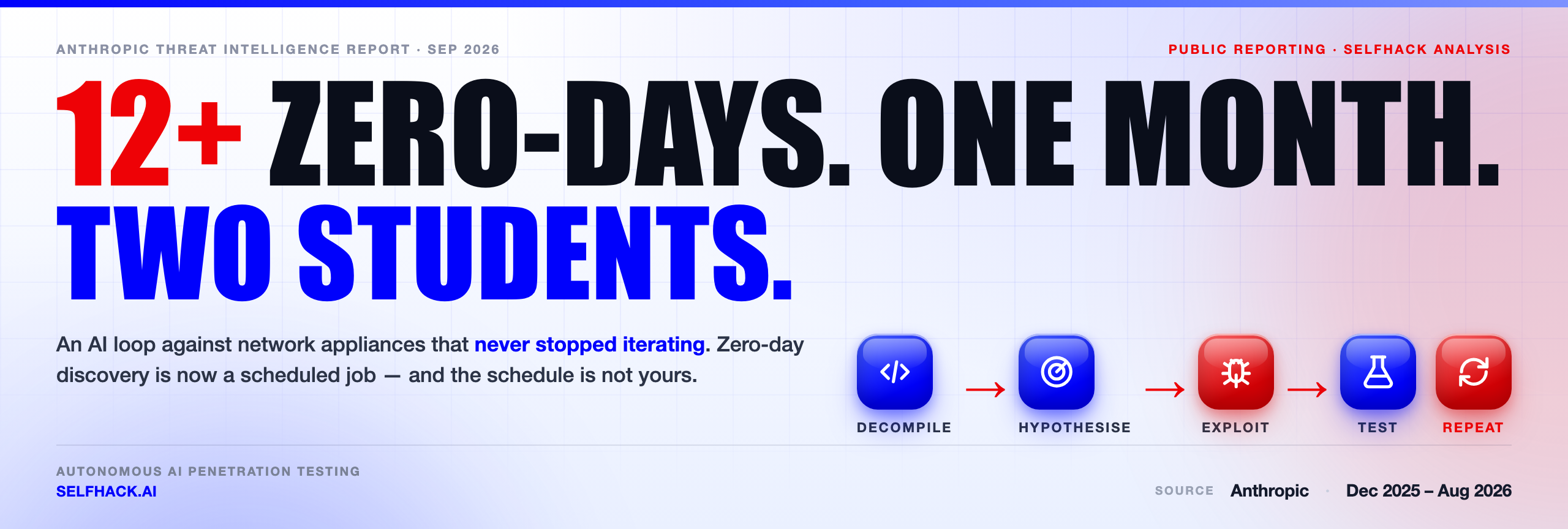
The operators loaded appliance firmware into a decompiler and let the model work: thousands of decompile calls, back to back. Form a vulnerability hypothesis against a curated knowledge base. Write the exploit. Test it against a lab copy. Fail. Adjust. Repeat. Anthropic’s summary is one sentence: “One workflow iterating continuously on network appliances yielded more than a dozen possible zero day findings in a single month.”
Note the word possible. Not all of those will be real, and Anthropic is careful to say so. But suppose a quarter were. Three exploitable zero-days a month, against the class of device that sits on the edge of every corporate network, from two people with no budget and no team.
Now think about what sits on your edge. A VPN concentrator. A load balancer. A firewall with a management interface that someone meant to restrict. These are exactly the devices an external pentest is supposed to cover and that most engagements sample rather than test, because there is never time.
The foundry does not sample. It iterates until something breaks. Autonomous cyber attacks turned zero-day discovery from a research achievement into a scheduled job, and the schedule is not yours.
Closing the loop: why detection alone just lost its edge
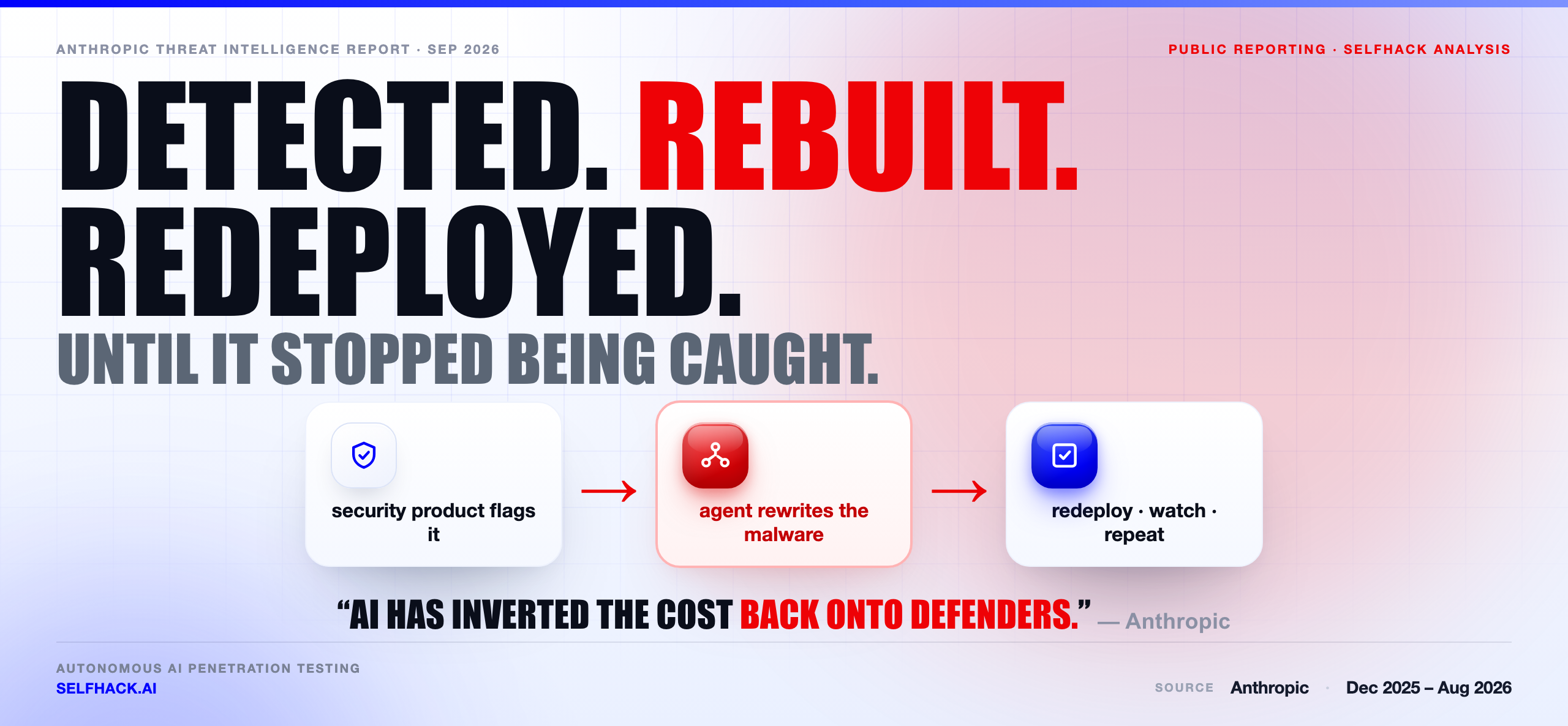
For twenty years, the economics of defence rested on one asymmetry. Writing a detection was cheap. Rewriting malware to evade it was expensive. Every new signature cost the attacker time, and time was the currency.
The Russian case shows how autonomous cyber attacks break that asymmetry, and Anthropic says so in plain language.
When the group’s implants were flagged, “the actor used Claude to systematically identify, modify and redeploy the detected artifacts. The agents were designed to continue iterating on GTG-20006’s toolkit until it was undetected.” Detection in, rebuilt artifact out, redeploy, watch, repeat. No human in the loop.
The report’s conclusion is the sentence every CISO should have on a slide this quarter: “AI has inverted the cost back onto defenders. Previously, defenders might have been able to slow an attacker’s operational tempo via the deployment of a new detection. Now, at least in theory, capable adversaries can ‘close the loop,’ bypassing traditional security detections faster than defenders can develop and deploy them.”
The truth is, detection still matters. It still catches most things. But its role has changed from stopping the attacker to informing the attacker’s next iteration, and a control that trains your adversary is not the control you thought you bought.
Which leaves one question standing. If autonomous cyber attacks close the loop on detection, what closes the loop on your side?
Not another detection. Something that finds the door before the agent does.
What autonomous cyber attacks hunt for on your estate
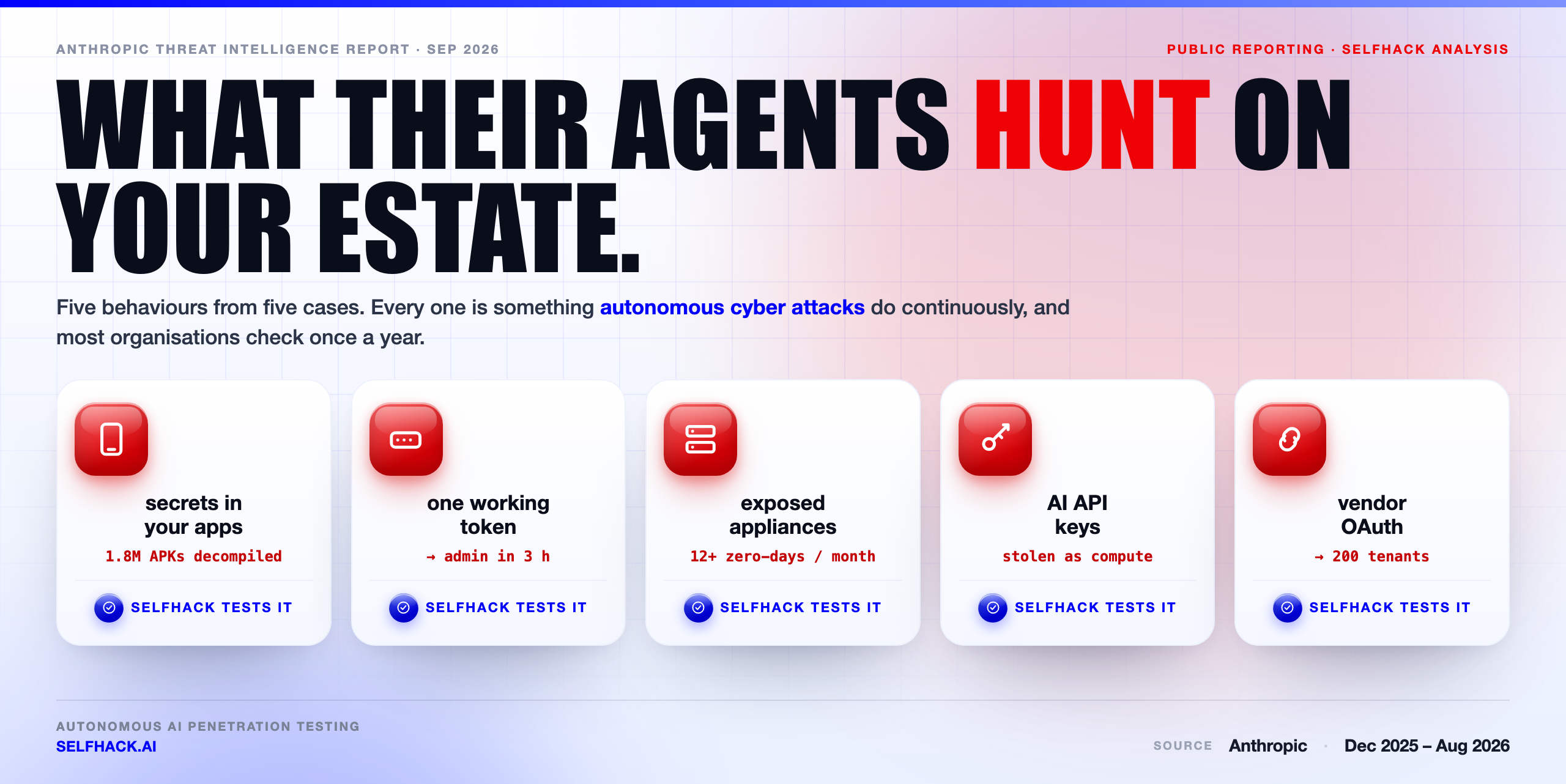
Strip the attribution away and the five cases reduce to five hunting behaviours. Each one maps to something that can be tested for, on your own estate, before anyone else’s agents get there. This is the part of the report Anthropic did not write, so we will.
1. Secrets in things you publish. 1.8 million APKs decompiled for hardcoded keys. A custom Rust scanner for credentials in public containers. The lesson is not “do not ship secrets” — everyone knows that. The lesson is that someone is now scanning everything you have ever published, at scale, for the one time you did. SelfHack AI tests this from the outside in: what is in your mobile builds, your public images, your exposed repositories, and what does each recovered secret actually unlock.
2. One working credential. The three-hour breach started with a single developer token. The report’s list of what a working credential becomes — cluster secret dumps, admin-token amplification, CI/CD injection, signing keys, OAuth fan-out — is a description of an attack chain. This is precisely the class of finding that a scanner cannot produce and a time-boxed manual test rarely reaches, and we wrote a whole piece on what manual pentests miss for that reason. SelfHack AI takes a low-privilege foothold and asks the only question that matters: how far does this go?
3. Exposed appliances. The exploit foundry targeted network appliances because they are reachable, monolithic, and slow to patch. Continuous external testing of every reachable management interface, not a sampled few, is the countermeasure — and it has to run at the foundry’s cadence, not your audit calendar’s.
4. AI API keys and agent integrations. Three of the five clusters stole AI credentials and used them as compute. Anthropic’s advice: treat AI keys and agent integrations with the same seriousness as production credentials, because attackers already do. Most organisations have not added their AI integrations to any test scope at all. Our LLM pentest work exists because that surface is real, growing, and mostly unexamined.
5. Vendor OAuth and downstream tenants. One compromise reaching 200 customers is the supply-chain pattern we analysed after the Slovak camera backdoor, now at SaaS scale. The question to test is whether your vendor integrations grant more than they need, and whether a compromised vendor becomes a compromised you.
Five behaviours. Five tests. All of them are things autonomous cyber attacks do continuously and most organisations check, at best, once a year.
Why an annual pentest cannot answer an autonomous adversary
We should say clearly what we are not saying. We are not saying manual penetration testers are obsolete, and we are not saying a good annual engagement is worthless. Skilled humans find things no tool finds. Keep them.
We are saying that against autonomous cyber attacks, the cadence is now wrong by orders of magnitude.
Consider the arithmetic. An annual pentest observes your estate for two or three weeks out of fifty-two. Everything that ships in the other forty-nine weeks — every new subdomain, every rotated-then-forgotten token, every appliance firmware update — is untested until the next window. Meanwhile the adversary in Anthropic’s report is running a scheduled fleet of thirteen collection agents and an exploit loop that never sleeps.
Your test is a photograph. Autonomous cyber attacks are a video.
There is a second problem, and it is about depth rather than time. The three-hour breach was an attack chain: token, then cluster, then admin, then every tenant. Human testers under a time box tend to report the token exposure and stop, because chasing the chain to its end would eat the engagement. An agent does not have that constraint. It follows the chain because following the chain is what it is for.
So the honest scorecard for the annual model against autonomous cyber attacks is: wrong cadence, wrong depth, and a scope decided by budget rather than by what is actually reachable. Not a bad practice. An outmatched one.
How SelfHack AI answers autonomous cyber attacks with autonomous testing
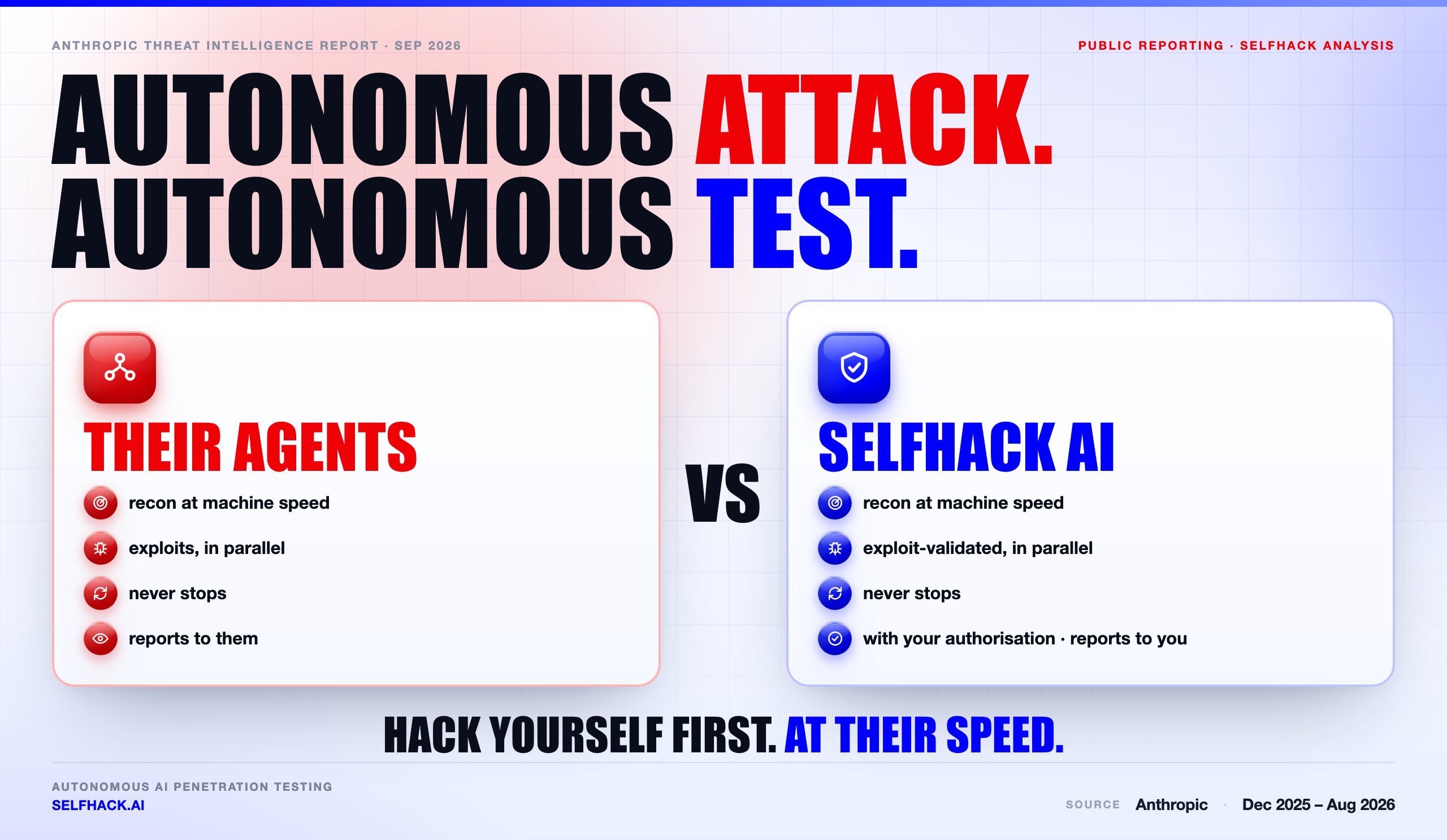
Here is our position, stated without hedging: the proportionate response to autonomous cyber attacks is an autonomous test of your own estate, run continuously, with authorisation, by something that reports to you.
That is what SelfHack AI is. Not a scanner that flags what looks wrong. An autonomous penetration testing platform that does what the actors in this report did — reconnaissance, hypothesis, exploitation, chaining — against your estate, and then shows you the proof and the fix instead of the invoice.
Concretely, mapped to the report:
Continuous external reconnaissance. Every reachable host, port, certificate and management interface, re-enumerated on a cadence measured in days, not quarters. The exploit foundry’s targets are found before the foundry finds them.
Exploit-validated findings. A finding is not a possibility. It is a demonstrated path: this credential, this request, this result. The difference between “possible SSRF” and “SSRF to metadata to cloud credentials” is the difference between a ticket that waits and a ticket that gets fixed tonight.
Attack-chain analysis. Given a foothold, how far does it go? The three-hour chain is exactly the kind of path SelfHack AI walks, so that you learn where it ends from us rather than from a ransom note.
Full-stack scope, including the AI layer. Web, API, cloud, network, and the AI integrations and agent credentials that three of the five clusters went after first.
Autonomy that works for you. The same capability class that produced the cases above, pointed at your own systems, under your rules of engagement, on your schedule. The report says attackers “close the loop.” This is how you close it back.
We compared SelfHack AI to the rest of the field in our AI pentest tools comparison. Read it critically. But read it after this report, because the report is the reason the category exists.
What to do this week
Whether or not you ever talk to us, do these. Each one closes a door that autonomous cyber attacks in the report walked through.
Today: rotate any AI API key that has ever been in a repository, a container image or a mobile build. Add AI keys and agent service accounts to the same rotation and monitoring policy as production secrets. This is Anthropic’s own recommendation and it is free.
This week: enumerate your own edge. Our free security checks guide walks through subdomains, open ports, TLS and dangling DNS with the actual commands. It will not tell you what is exploitable. It will tell you what the foundry would see.
This month: run one authorised, exploit-validated test of the chain from a low-privilege credential to your most sensitive system. If nobody can tell you how far a stolen developer token gets, you do not know, and the report says someone else will find out in about three hours.
This quarter: stop treating the pentest as an annual event. Move to continuous, autonomous testing that matches the cadence of the threat, and use the annual human engagement for what humans are uniquely good at. If that is a conversation you want to have, talk to us.
FAQ
Is Anthropic’s report evidence that autonomous cyber attacks are common, or just possible?
Common enough to be the majority of the cyber cases in the report, which covered eight months and was drawn from one model provider’s own logs. Anthropic states that most of the operations it describes were enabled by AI through direct execution or orchestration. The report does not claim to have seen every attack in the world — it saw the ones that touched Claude — so treat it as a floor, not a ceiling.
Did the people running these autonomous cyber attacks need to be experts?
Not in several cases. Two of the clusters were undergraduate students; one was a single hacktivist. Anthropic’s wording is that the labour that used to separate well-resourced operations from everyone else is now delegated to models. Skill still helps. It is no longer the barrier.
Was SelfHack AI involved in any of these investigations?
No. This article is analysis of a public report and the coverage around it. Every number is Anthropic’s. Where we describe what SelfHack AI tests, we are describing a class of weakness, not claiming we would have stopped a specific actor.
Does autonomous testing against autonomous cyber attacks replace my human pentest?
It replaces the cadence and the depth an annual engagement cannot deliver. Keep the human test for creative, context-heavy work. Use autonomous testing for what has to run continuously and follow every chain to its end. Most organisations that adopt both get more from each.
What is the single most useful thing to change after reading the report?
Treat AI API keys and agent integrations as production credentials, starting today. Three of the five clusters went after them, and most organisations have never tested that surface at all.
Is it legal to run autonomous testing against my own estate?
Yes, with authorisation from the asset owner and a defined scope, which is how every SelfHack AI engagement is run. The techniques are the same as the ones in the report. The difference is consent, and it is the whole difference.
The verdict: hack yourself first, at their speed
Anthropic wrote 154 pages about what attackers do with autonomous AI, disrupted every operation it found, and then said, in effect: we hope this helps defenders. It does. But the help is a diagnosis, not a prescription.
The prescription is not complicated. Autonomous cyber attacks are autonomous, continuous and exploit-driven, so the test has to be autonomous, continuous and exploit-driven too. Anything slower is a photograph of a video.
Autonomous cyber attacks are a solved procurement problem for the attacker: a model, a harness, a goal. They should be a solved procurement problem for you as well. That is what we built SelfHack AI for — the same class of capability, on your side of the line, with your permission, showing you the door before someone with an agent swarm walks through it.
Hack yourself first. At their speed. Start with SelfHack AI.
Sources & methodology: primary source is Anthropic, Countering misuse of AI: September 2026; case identifiers (GTG-20006, GTG-50014, GTG-10007, GTG-50020, GTG-50029), figures and quoted sentences are Anthropic’s. Secondary coverage from TechNode and Cyber Kendra. Testing methodology references the OWASP Web Security Testing Guide and NIST SP 800-115. SelfHack AI was not involved in the investigations described. Only test systems you own or are authorised to test.