What Manual Pentests Miss: 8 Vulnerability Patterns Autonomous AI Catches
- A manual pentest is a time-boxed sample of your attack surface. Good testers are brilliant — but the clock, the scope, and the once-a-year cadence guarantee gaps.
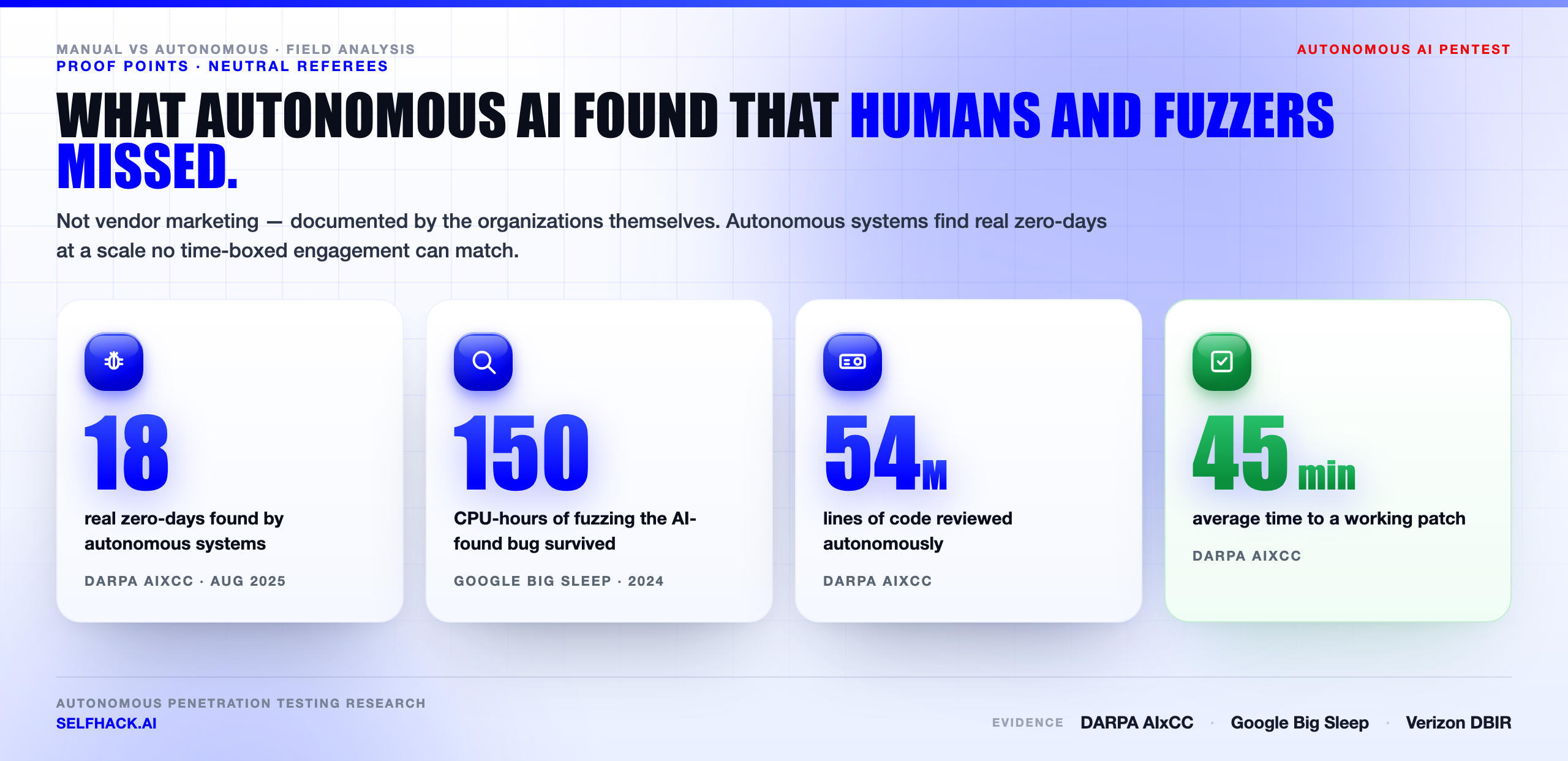
- The proof isn’t marketing. In August 2025, seven fully autonomous systems in DARPA’s AI Cyber Challenge found 18 real, previously-unknown zero-days in production open-source code. Google’s Big Sleep found a bug that 150 CPU-hours of fuzzing had missed.
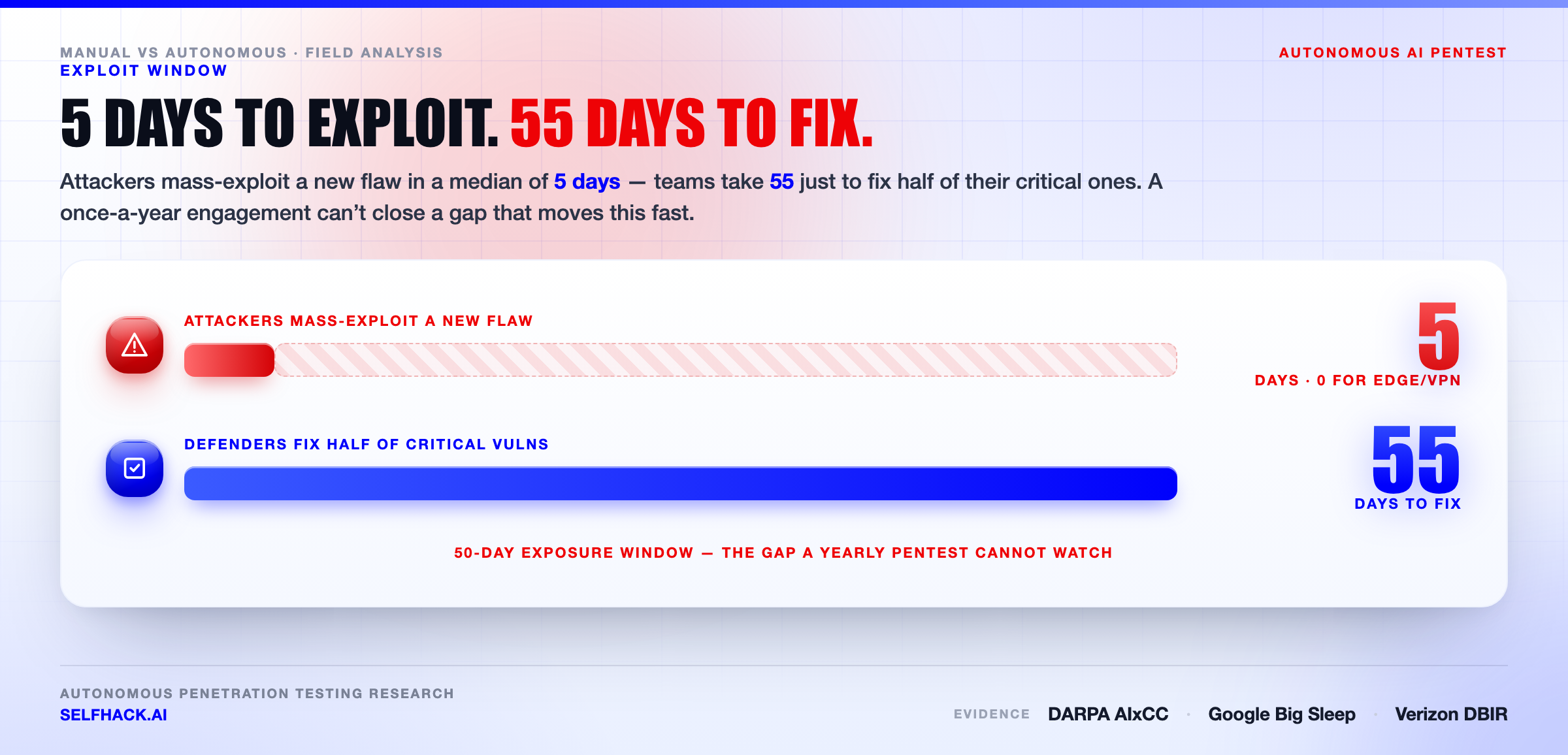
- Meanwhile attackers exploit a new flaw in a median of 5 days, while teams take 55 days just to fix half of their critical ones (Verizon DBIR).
- We walk through eight patterns a manual pentest routinely misses — most with a real, cited source — and how an autonomous AI pentest catches that whole class.
Why a manual pentest misses things — it’s structural
Let’s start with something that isn’t a knock on human testers. The best pentesters we’ve worked with are sharp, creative, and fast. The problem isn’t skill. It’s structure.
A manual pentest is bounded by three hard limits. A fixed number of days. A fixed scope agreed in a statement of work. And a single point in time. Miss any one target inside that box and it simply never gets tested.
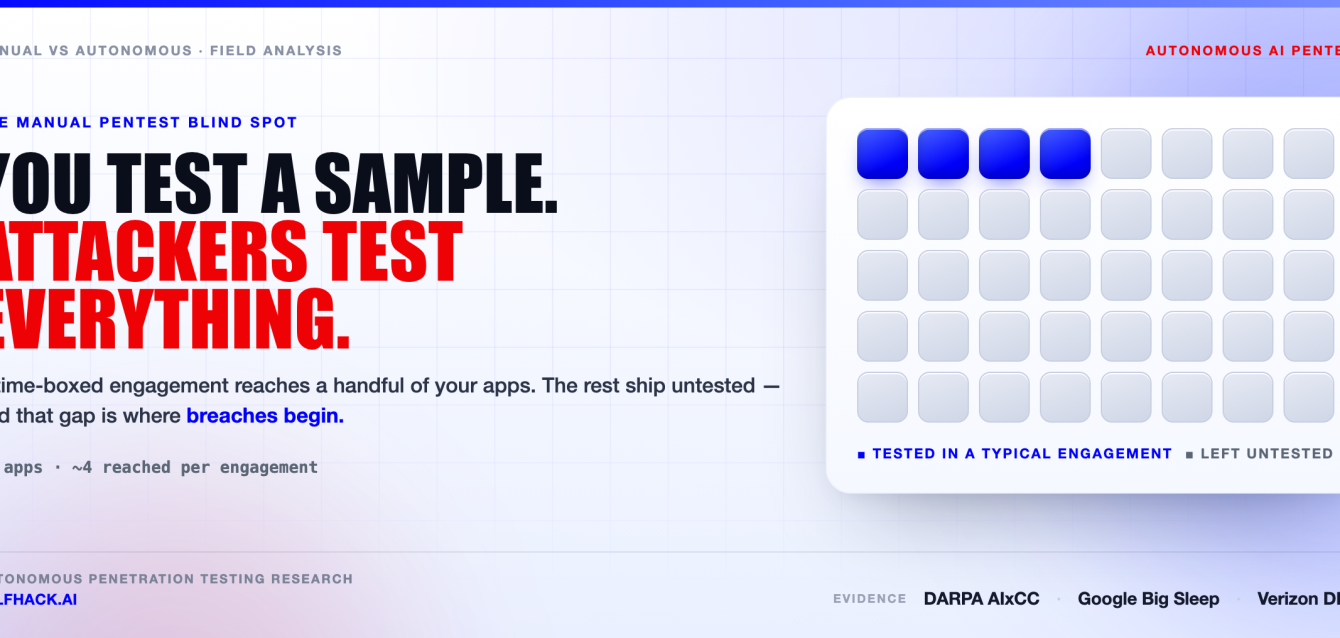
So testers do the rational thing: they sample. They pick the highest-value targets, test those deeply, and move on before the clock runs out. Everything they didn’t reach ships untested — and nobody flags it, because the report only covers what was in scope.
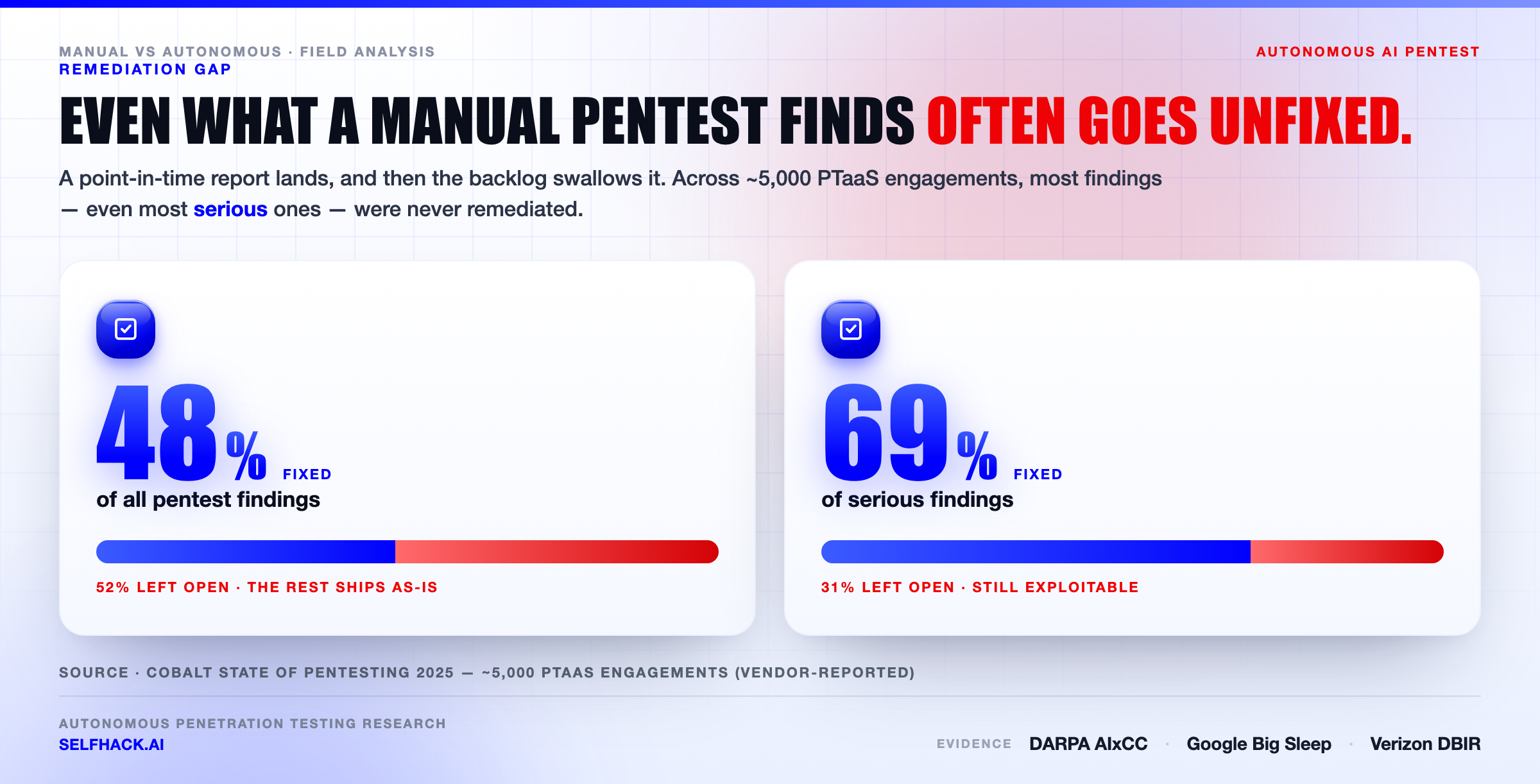
Here’s the uncomfortable part. Even the findings that do get reported often don’t get fixed. Across roughly 5,000 pentests a year, the PTaaS vendor Cobalt reports that organizations remediate just 48% of all findings, and only 69% of the serious ones (Cobalt State of Pentesting 2025). Half the known problems stay open.
Now layer on scale. A modern estate isn’t one web app. It’s hundreds of APIs, cloud accounts, Kubernetes clusters and internal services — thousands of trust boundaries. No human team tests all of that in a two-week window. They can’t. There aren’t enough hours.
That gap between “what we tested” and “what we run” is the blind spot. And attackers live in it.
Picture a typical scoping call. The vendor quotes ten days. Your estate has 40 apps, 900 API routes and six cloud accounts.
Ten days buys deep testing of maybe three or four apps. The other 36 get a line reading “not in scope this cycle.” That’s not the tester failing — it’s the model working as designed. Which is why a manual pentest and real coverage are two different things.
The clock a manual pentest can’t beat
Timing is where the manual pentest model breaks hardest. Your attack surface changes every deploy. A yearly test is a photograph of a river.
The numbers are stark. Attackers begin mass-exploiting a newly disclosed flaw in a median of 5 days, and for edge and VPN devices that window is effectively zero — many are on the CISA Known Exploited Vulnerabilities list the same day they’re published (Verizon DBIR 2025).
How long do defenders take? A median of 55 days to remediate half of their critical vulnerabilities. Five days to attack. Fifty-five to patch. That math doesn’t work.
And this exposure is the fast-growing breach vector. Verizon found exploitation of vulnerabilities jumped 180% to 14% of all breaches in 2023, then rose another 34% to 20% of breaches in 2024 — almost level with stolen credentials. A manual pentest scheduled once a year cannot watch a surface that moves this fast. Nothing human-paced can.
8 things a manual pentest misses that autonomous AI finds
Enough theory. Here are eight concrete patterns, most with a real, citable source, and how an autonomous approach catches the whole class instead of one instance.
1. The bug that survives 150 hours of fuzzing
In October 2024, Google’s Big Sleep agent found an exploitable memory-safety zero-day in SQLite — one of the most-tested pieces of software on earth. The kicker: SQLite’s own fuzzing and OSS-Fuzz had already run against it, and the bug survived 150 CPU-hours of targeted fuzzing (Google Project Zero). A reasoning agent walked a code path that brute-force tools and a hurried human review both skipped. That’s the class: deep, conditional bugs that only surface when something reasons about state, not just fuzzes inputs.
A manual pentest on a two-week clock never had a chance at that bug. There isn’t time to reason through every path by hand, so testers fuzz what they can and move on. The one path that mattered stayed dark — until an agent that doesn’t get tired walked it.
2. The zero-day beyond the test plan
A manual pentest stops at the edge of the statement of work. Autonomous systems don’t. At DARPA’s AI Cyber Challenge final (August 2025), seven fully autonomous systems — no human in the loop — didn’t just find 54 of 63 planted bugs. They surfaced 18 genuine, previously-unknown zero-days in real open-source projects, and every single team found at least one. That’s what “keep going past the plan” looks like at machine scale: 54 million lines of code reviewed, patches in an average of 45 minutes.
Sit with that. These weren’t planted practice bugs. They were live defects in code real projects ship, judged by neutral referees — not a vendor demo.
A human team with the same brief would test the named targets and stop at the deadline. The autonomous systems kept reasoning. The “extra” they found is exactly the category a scoped manual pentest is built to skip.
3. The exposure that changed after the pentest shipped
Your last manual pentest was true the day it was signed. Then you shipped 200 times. Every deploy is a fresh chance to introduce the exact flaw the tester certified you against last quarter. Continuous, autonomous testing re-checks the surface as it changes — which is the only cadence that keeps pace with a 5-day exploit window. A once-a-year snapshot structurally cannot.
Config drift is the quiet version of this. A storage bucket flips to public during a Friday deploy. An auth check gets refactored and a route slips through.
None of it was there at pentest time, so none of it was tested. By the next scheduled engagement, that hole has been open for months. Continuous testing catches the regression the week it ships.
4. The forgotten asset nobody put in scope
You can’t test what you forgot you own. Stale subdomains, a demo box from 2021, a storage bucket a contractor spun up — none of it makes the scope document, so none of it gets a manual pentest. This isn’t hypothetical: 35% of breaches involved unmanaged “shadow data,” and 40% spanned multiple environments, costing over $5M and taking 283 days to contain (IBM Cost of a Data Breach 2024). Autonomous discovery maps the whole surface first, then tests it — including the assets you’d have left off the list.
Subdomain takeover is the textbook case. Marketing spins up a subdomain on a SaaS host, the campaign ends, the DNS record stays. An attacker later claims the dangling host and serves phishing from your own domain.
No scope document lists that subdomain, so no manual pentest touches it. Autonomous discovery that enumerates DNS first sees it on day one.
5. The “low” that was really a critical
Manual triage buckets findings one at a time. An open redirect is a “low.” A verbose error is a “low.” A weak object reference (BOLA) is a “medium.” Filed separately, they get deprioritized separately. But a real attacker chains them — redirect into token theft into account takeover. Autonomous attack-chain analysis walks those paths and reports the chain, not three unrelated lows. It’s the difference between “medium, maybe later” and “critical, fix tonight.”
6. The finding that got found but never fixed
Sometimes the miss isn’t discovery — it’s proof. A manual pentest report with 300 “criticals” and no working exploit gives a team no way to tell the real ones from the theoretical. So triage stalls, and (per Cobalt) more than half of findings stay open. Every SelfHack AI finding ships with an exploit-validated proof-of-concept, so the three that can actually sink you don’t drown under 297 that can’t.
We’ve watched this play out. A team gets a fat manual pentest PDF, feels productive for a week, then shelves it — nobody agrees which findings are real.
A year later the same untested flaw is on the incident report. Discovery was never the hard part. Separating signal from noise, and proving it, was. Proof is what turns a report into fixes.
7. The multi-user API test that needs a token from the web app
Hand a tool an API and its docs, and watch what happens. The API needs a token — and the only way to get one is to open the web app, register a user, log in, and pull the token from there. A human tester can do that by hand. A scoped, time-boxed manual pentest rarely does it for every service, and most automated tools can’t do it at all.
So the authenticated surface goes untested. And the bugs that need two accounts to see — one user reading another user’s data — stay invisible, because single-session tools can’t juggle multiple users.
SelfHack AI runs the whole chain. It creates users in the web app, mints the tokens, then tests the API fully authenticated, across multiple users at once — surfacing the cross-user IDOR and BOLA paths that an unauthenticated or single-session test structurally cannot reach.
8. The fresh CVE with no public exploit
A CVE drops on a Tuesday. No public proof-of-concept exists yet — which is exactly the window attackers race to weaponize, and exactly when a signature scanner goes quiet. No known exploit, no test, no honest answer to “are we actually exposed?”
A time-boxed manual pentest rarely stops to write a bespoke exploit for an unproven CVE either. There isn’t time in the engagement.
SelfHack AI doesn’t wait for someone else to publish one. It reads the CVE, studies your specific asset — the version, the config, how the affected function is actually used — and writes a working exploit tailored to your app to prove whether you’re really vulnerable. That’s the gap between “we might be affected, we think” and “here’s the working exploit against your system — patch tonight,” days before a public PoC exists.
So is AI better than a manual pentest? An honest answer
No — and any vendor who tells you “AI replaces your pentester, full stop” is selling. Let’s be straight about the limits.
Two honest caveats on the evidence above. The Big Sleep SQLite bug was in a development branch, caught before release — real find, but no user was ever exploited. And Google itself noted a well-tuned fuzzer might have caught it too. So the honest claim is “this bug was missed by fuzzing and found by AI,” not “AI always beats everything.”
There are still things a sharp human does better. Novel business-logic abuse in a weird domain. A creative social-engineering angle. The intuition that a flow “feels off.” Those reward a human red-teamer, and they always will.
And a manual pentest carries weight that matters beyond the findings. An auditor wants a named human’s sign-off. A board wants a firm’s letterhead on the report. A regulated deal sometimes requires a credentialed tester. None of that goes away, and we’re not pretending it should. The mistake is treating that annual sign-off as if it equals security, when it’s really a snapshot plus a signature.
So the answer isn’t AI or a manual pentest. It’s layers. Run an autonomous AI pentest continuously for breadth, speed and proof — it handles the 95% that used to eat your consultants’ hours. Bring humans in for the creative 5% that genuinely needs them. Organizations that lean on AI and automation already contain breaches ~98 days faster and $2.2M cheaper (IBM, 2024). The winners aren’t picking a side. They’re stacking both.
5 questions to ask before your next manual pentest
You don’t have to drop your manual pentest to close these gaps. You do have to ask harder questions. Here’s what we tell teams to put to any vendor — human or automated — before signing.
- What’s out of scope, and who tests it? If the answer is “nothing outside the statement of work,” you just found your blind spot. Ask specifically how forgotten assets and code shipped after the engagement get covered.
- How many of my endpoints did you actually reach? A manual pentest samples. Get the real coverage number — tested versus total — not just a count of findings. The gap between those two numbers is your untested surface.
- Is every finding exploit-validated? A “critical” with no working proof is a guess. Demand a proof-of-concept for each one, so your engineers can separate real risk from theoretical noise and actually prioritize.
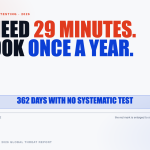
- What happens between engagements? If the honest answer is “nothing until next year,” your surface sits untested for 360-odd days while attackers move in five. Ask what continuous coverage looks like.
- Did you chain anything? Ask whether low-severity findings were tested together as an attack path, not just logged separately. That is exactly where the criticals hide, and it’s the question almost nobody asks.
Honestly, most teams have never asked question two. When they finally do, the coverage gap in their last manual pentest stops being abstract — and starts being a number they can’t unsee. That number is usually the reason they call us.
How SelfHack AI catches what a manual pentest misses
SelfHack AI was built around exactly these blind spots. It runs a swarm of specialized agents that discover, verify and exploit, then cross-check each other before a finding ships.
- Full-stack scope — web, API, mobile, Kubernetes, cloud, internal and external network in one run, so nothing falls outside a scope document.
- Exploit-validated findings — every issue arrives with a working proof-of-concept, which kills the false-positive noise that stalls remediation.
- Attack-chain analysis — it walks multi-step paths and reports the critical chain, not scattered lows.
- Continuous, autonomous runs — an Auto Scanner pass finishes in about two hours, so you re-test at deploy speed, not once a year.
We built the head-to-head detail in our AI pentest benchmark if you want the platform-by-platform view. Short version: the goal is the depth of a manual pentest at the speed and coverage of software.
None of this is magic. It’s the same reasoning a good tester does, run in parallel across your whole estate, every day, with a proof attached to every claim.
That’s the real shift. Not “AI instead of experts.” Testing that never sleeps, never runs out of hours, and never quietly drops 36 apps because the clock ran out.
FAQ
Does an AI pentest replace a manual pentest?
Not entirely. An autonomous AI pentest beats humans on coverage, speed and continuity, and matches them on exploit validation. Humans still edge ahead on novel business-logic and creative attacks. The strongest security programs run both — AI continuously, humans for the creative edge cases.
What do manual pentests miss most often?
Anything outside the time-box and scope: forgotten assets, changes shipped after the test, chained low-severity paths, and deep conditional bugs that need reasoning rather than sampling. A manual pentest is a point-in-time sample, so drift and scale are its structural blind spots.
Is there real proof AI finds bugs humans miss?
Yes, from neutral sources. DARPA’s 2025 AI Cyber Challenge produced 18 real zero-days found by autonomous systems, and Google’s Big Sleep found a SQLite bug that 150 CPU-hours of fuzzing had missed. Both are documented by the organizations themselves, not by security vendors.
How fast do attackers exploit a vulnerability?
A median of 5 days after disclosure, and effectively zero days for edge and VPN devices, per Verizon’s 2025 DBIR. Since teams take a median of 55 days to fix half their critical flaws, a once-a-year manual pentest cannot close that window.
Why don’t found vulnerabilities get fixed?
Often because they can’t be prioritized. Reports full of unproven “criticals” bury the real ones, so remediation stalls — Cobalt’s data shows only 48% of findings get fixed. Exploit-validated findings solve this by proving which issues are actually reachable.
Can autonomous testing cover thousands of endpoints?
That’s its main advantage over a manual pentest. Autonomous agents test the full surface — thousands of endpoints and trust boundaries — rather than sampling a slice inside a fixed engagement. Coverage stops being capped by tester-hours.
How much does an AI pentest cost versus a manual pentest?
A traditional manual pentest often runs five figures per engagement. Autonomous platforms price per scan or subscription, usually far lower, because they aren’t billing tester-hours. SelfHack AI starts per scan with no asset caps — which is what makes continuous testing affordable instead of a once-a-year splurge.
For the deepest example we can share publicly, see our confidential computing pentest: an autonomous hostile-host assessment of AMD SEV-SNP and NVIDIA Blackwell GPU confidential computing that produced 52 attack hypotheses and one validated 9-step chain — the kind of depth a two-week manual engagement has no room for.
Where this leaves you
A manual pentest is not going away, and it shouldn’t. But betting your security on a yearly, scoped, time-boxed sample — while attackers move in 5 days — is a losing trade.
The evidence is in from neutral referees. Autonomous systems find real zero-days humans and fuzzers miss, at a scale no engagement can match. The question is no longer whether AI finds what a manual pentest misses. It’s whether you’re testing continuously or once a year.
Run the math on your own program. Count your apps, then count how many your last manual pentest actually reached. Count the days since it ran. Count the deploys since.
If those numbers make you wince, that’s the blind spot talking. It’s fixable — and it doesn’t mean firing your pentester. It means testing the other 360 days too.
Want to see what your last manual pentest missed? Start a scan — order an AI pentest from SelfHack AI or contact our team for a walkthrough. Bring the estate your last report didn’t cover.
Sources
- DARPA, AI Cyber Challenge final results, Aug 2025 — darpa.mil
- Google Project Zero, “From Naptime to Big Sleep,” Nov 2024 — projectzero.google
- Verizon, 2025 Data Breach Investigations Report — verizon.com
- IBM / Ponemon, Cost of a Data Breach 2024 — ibm.com
- Cobalt, State of Pentesting 2025 (vendor PTaaS data) — cobalt.io
- CISA, Known Exploited Vulnerabilities Catalog — cisa.gov
Evidence current as of publication. DARPA AIxCC and Google Big Sleep are primary-source, neutral events; IBM and Cobalt figures are vendor-reported and attributed as such. SelfHack AI capability claims reflect the platform’s design and internal benchmarks.