Automated Penetration Testing Tools in 2026: Scanner, Scripted or Autonomous?
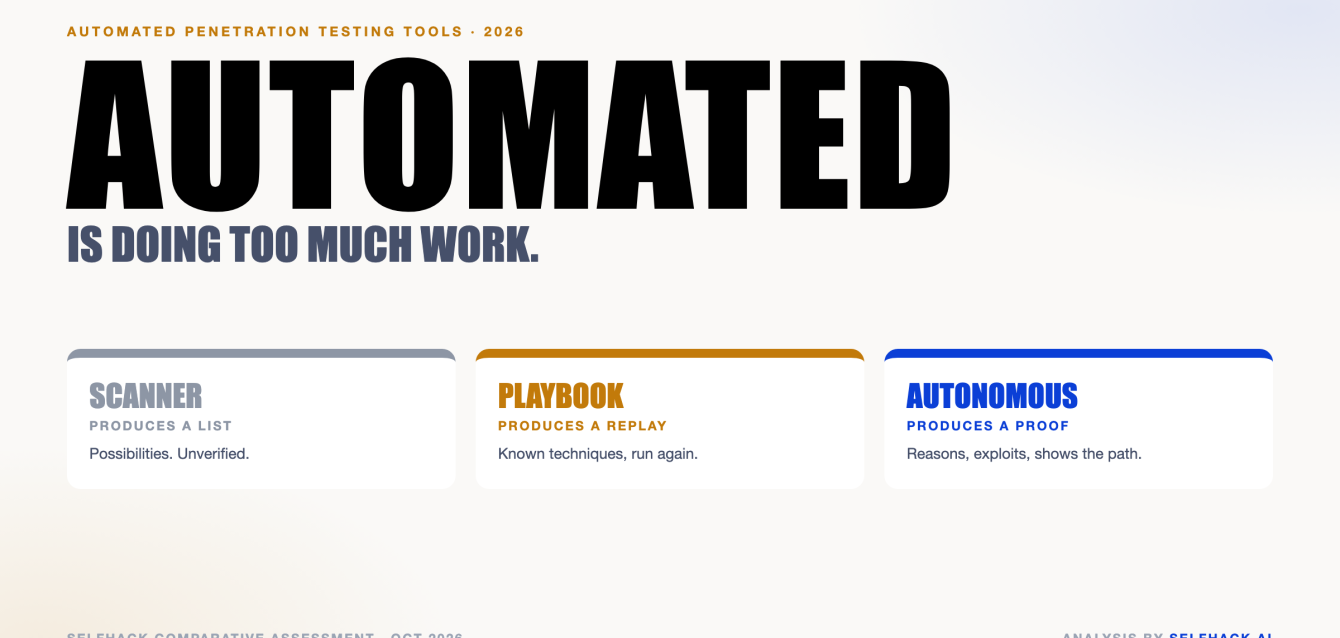
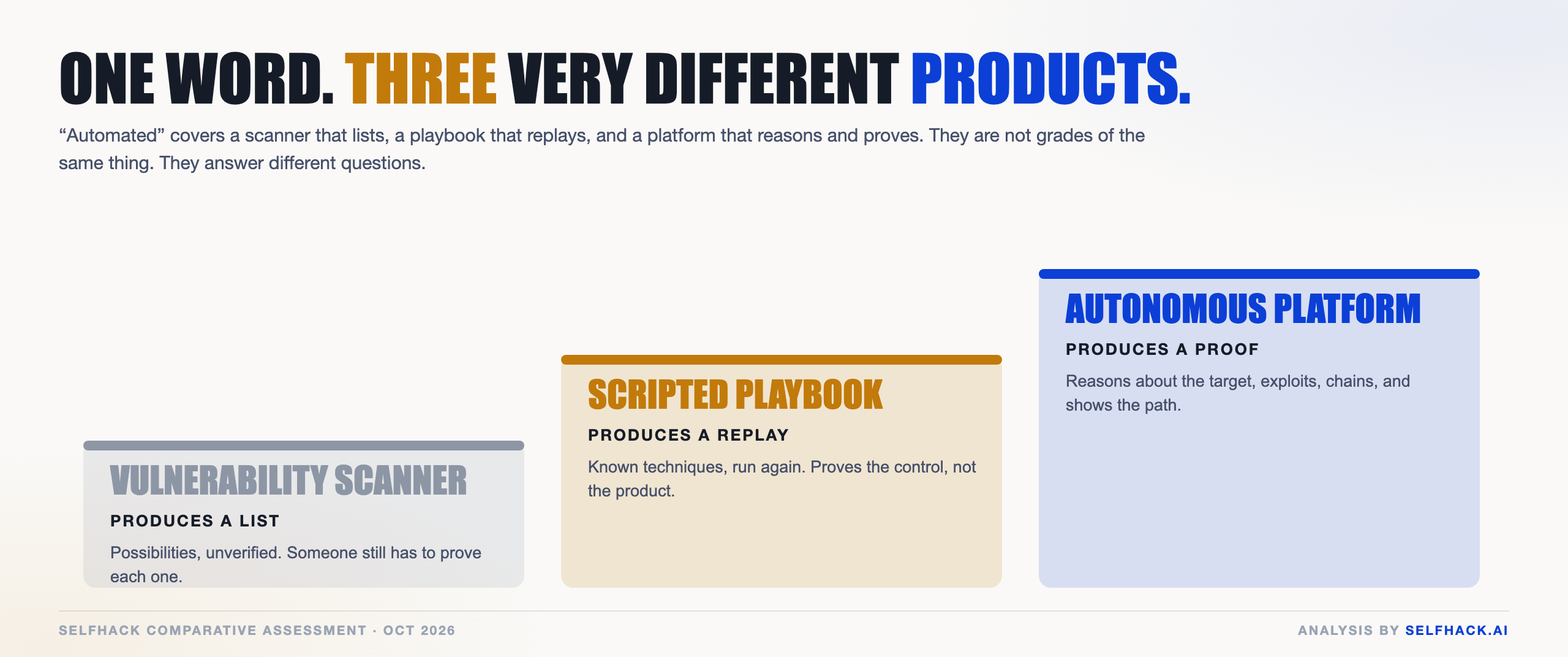
- “Automated” covers three very different products: a vulnerability scanner that produces a list, a scripted playbook that produces a replay, and an autonomous platform that produces a proof. Automated penetration testing tools are not grades of one thing.
- Vendors collapse the tiers because “automated” is what buyers search for — Horizon3.ai’s own ads lead with “Automated Pentesting Tools”. The cost of the blur lands on you later: triage of unvalidated findings, and false confidence from a clean replay.
- Three questions sort the market on the first call: does it exploit or infer, does it reason or replay, does it choose coverage or wait for scope.
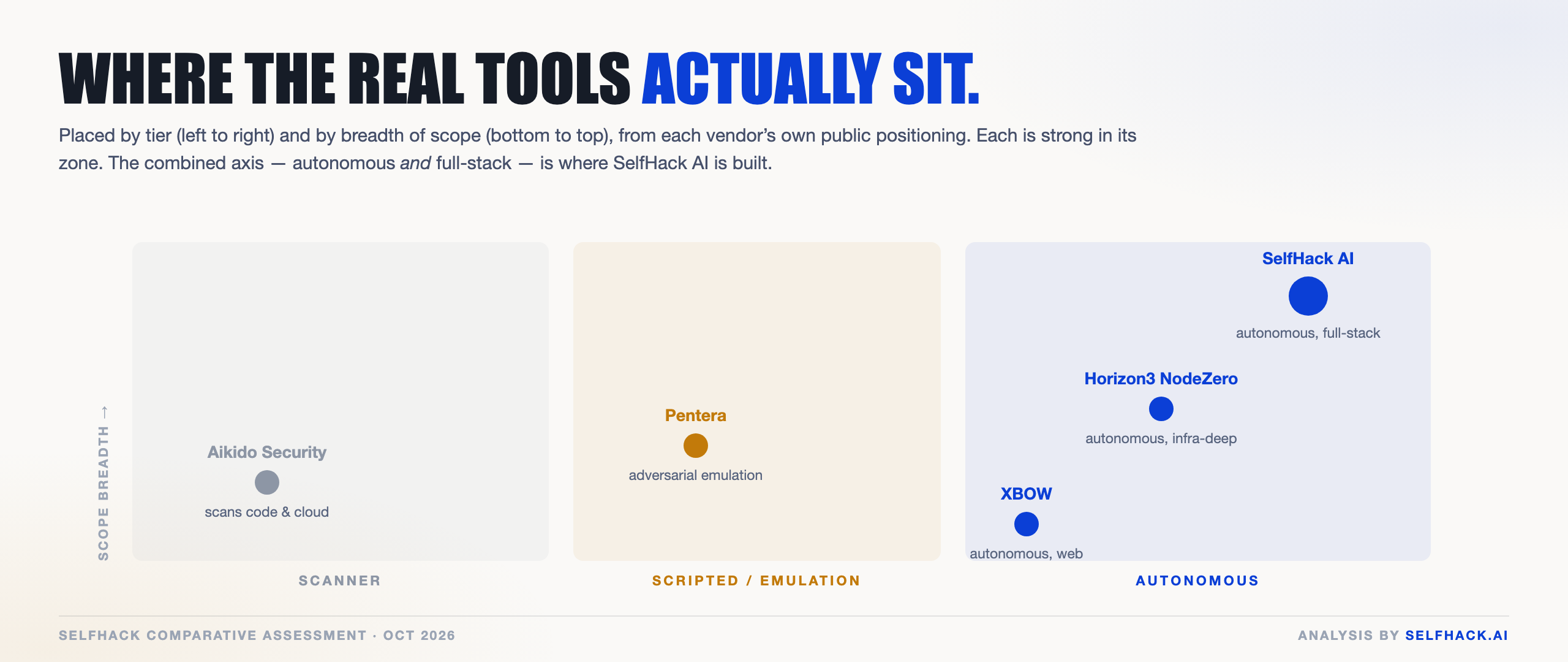
- Placed fairly, NodeZero, Pentera, XBOW and Aikido are each strong in their zone. SelfHack AI is built for the combined axis — autonomous, exploit-validated, full-stack, continuous, with evidence auditors accept, in 16+ languages.
SelfHack comparative assessment, October 2026. Competitor descriptions come from each vendor’s public website and public Google Ads (Ads Transparency Center, Finland); products change, so verify current features with the vendor. Only test systems you own or are authorised to test.
What automated penetration testing tools actually are
Ask five vendors what automated penetration testing tools do and you will hear five confident answers. Ask what each one hands you at the end, and the answers stop matching.
That is the buyer’s real problem. The label is shared. The output is not, and the output is what you are paying for.
Strip the marketing away and three different products sit under one word. Each produces something different, and that difference matters more than any feature grid.
The vulnerability scanner produces a list. It compares what it can see against a catalogue of known weaknesses: outdated versions, missing patches, weak configuration. Every line is a possibility, not a proof. Someone still has to work out which findings are real.
Scanners earn their place. They are fast, cheap and good for hygiene, and a few free security checks guide on your own domain will show you where that layer starts and stops.
The scripted attack playbook produces a replay. It runs a predefined set of known techniques against your environment and records which ones succeeded. Classic breach and attack simulation lives here. That is useful for checking whether your controls catch what you already expect. It says much less about what nobody thought to script.
The autonomous platform produces a proof. It works the way a skilled tester does. It maps the target, forms a hypothesis about where it is weak, tests that hypothesis, links one weakness to the next and writes up what it demonstrated. The finding arrives with the path shown. Not a guess.
That is the whole taxonomy of automated penetration testing tools. None of this makes the first two tiers worthless. They do different jobs. The trouble starts when a buyer pays for one and believes they have bought another.
The third tier is where the newer AI pentest tools compete, and it is the tier SelfHack AI was built for: autonomous from reconnaissance to report, with every finding exploit-validated.
So when you compare automated penetration testing tools, start with one question. What lands on your desk at the end: a list, a replay or a proof?
Why the word “automated” is doing too much work
The blur has a commercial cause. “Automated” is the word buyers type into search, so it is the word vendors want to be found under, whichever tier they actually sit in.
Even products from the top tier use it. Horizon3.ai’s Google ads in Finland lead with “Automated Pentesting Tools – No Agents. No Waiting”.
That is not a criticism. NodeZero describes itself as autonomous pentesting: agentless, safe in production, and broad across internal, external, cloud, Kubernetes and Active Directory. On its own terms it belongs at the autonomous end. The ad simply meets buyers where they search.
The trouble is that a scanner can claim the same word just as honestly. Everything in all three tiers is automated. What differs is what gets proven.
Other pressures push the same way. A procurement template might have one line for “automated pentesting”, with no space to say which kind. Compliance frameworks ask for penetration testing, and a scanner report sold under that name is an easier box to tick.
And the word promises relief. Many PTaaS and consultancy models still run with a human driving each engagement, so “automated” sounds like a pentest without the calendar.
Here’s the thing. When the tiers collapse into one word, all automated penetration testing tools look interchangeable on a shortlist, and the buyer pays for the difference later.
The first cost is triage. A scanner’s output is a queue of possibilities. Someone has to confirm each one, rank it and persuade the team that owns the system to act. Engineers learn quickly that many “critical” items lead nowhere, and they start treating the real ones the same way. The finding that mattered ends up on page nine.
The second cost is false confidence. A scripted playbook that comes back clean tells you the techniques it carried did not work on the day it ran. It does not tell you that nothing else would. Real attackers do not replay a fixed list. They adapt to what they find.
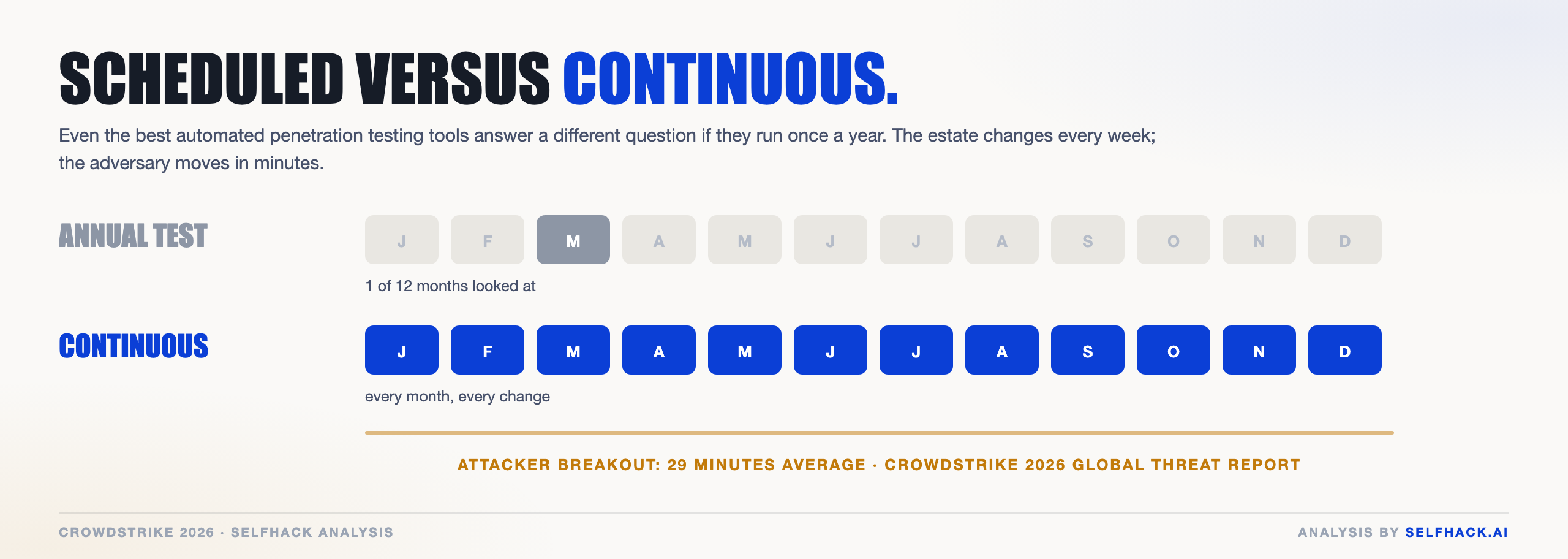
They also move fast. CrowdStrike’s 2026 Global Threat Report put average eCrime breakout time at 29 minutes. Against that clock, a green dashboard from last quarter’s run is thin comfort.
Both costs are specific to how automated penetration testing tools are bought, not to any one vendor. Neither cost appears on the invoice. Both appear the day something goes wrong. That is why buyers of automated penetration testing tools need to separate the tiers before they compare prices, not after.
Three questions that sort automated penetration testing tools
You do not need a lab or a month-long bake-off to place a vendor. Three questions on the first call will do most of the sorting. Ask them of every vendor on your shortlist, including us.
Does it exploit, or does it infer? A tool that infers sees a version number or a setting and concludes a weakness is probably there. A tool that exploits proves it, safely and inside the agreed scope, and hands you the evidence. Ask for a sample finding. If it reads “potential”, “possible” or “may allow”, you are looking at inference, however polished the dashboard.
Does it reason, or does it replay? Replay means a fixed library of techniques run in a fixed order. Reasoning means the tool chooses its next step from what it has just learned. Ask what happens when it meets something its authors never anticipated. A replay has no answer. A reasoning system adapts, and the report shows how.
Does it choose coverage, or wait for scope? Some tools test exactly what you list and nothing more. That sounds tidy until you remember how quickly asset inventories go stale. The better automated penetration testing tools discover what belongs to you, bring it into the agreed scope and cover the whole stack, not one layer of it. Fixed-scope testing shares this blind spot, as we covered in what manual pentests miss.
Plenty of automated penetration testing tools answer one or two of these well, and a shortlist of automated penetration testing tools usually contains at least one of each kind. The truth is that the combination is rare, and the combination is what you are buying.
SelfHack AI was built to answer all three at once. Every finding is exploit-validated, with scope-to-retest evidence that auditors accept. Every step, from reconnaissance to the report, runs without a human driving it and without a fixed script.
The scope runs from web applications and APIs through internal and external networks and cloud, including Google Cloud, to AI and LLM features, IoT, operational technology, drones and satellite systems. And testing is continuous, not once a year.
That does not make every other tool the wrong buy. It makes SelfHack AI the strongest fit when you need all three answers in one platform. For larger estates, our guide to enterprise penetration testing covers how to evaluate vendors at that scale.
The real automated penetration testing tools, placed fairly
Here is where the names buyers meet most often sit, strength first, then placement. Competitor claims come only from each vendor’s website or public Google ads, October 2026. All five get shortlisted as automated penetration testing tools. The truth is they do different jobs.
Horizon3.ai NodeZero
NodeZero brings serious scale. Horizon3.ai’s site cites 7,012 customers and trust from the NSA and four of the Fortune 10. It is agentless, runs safely in production, and covers internal, external, cloud, Kubernetes and Active Directory.
On the taxonomy it is autonomous; its coverage spans internal, external, cloud, Kubernetes and Active Directory, and its site describes web application pentesting as newly launched. Our Horizon3 alternative page covers the trade-offs.
Pentera
Pentera’s strength is safe adversarial emulation in production, and its site says 1,000+ organisations trust it. It calls itself an Exposure Validation Platform: Core (internal network), Surface (external), Cloud and Resolve (remediation). Lateral movement, credential and Active Directory testing, and ransomware emulation are home ground.
On the taxonomy it proves rather than lists, well above the scanner tier, and it frames itself around validation. Judge it on those terms. Our Pentera alternative page has the detail.
XBOW
XBOW is focused and well funded. Its ads reference raising $120M to scale AI pentesting and evaluating frontier models for offensive security workflows. Its specialism, autonomous web-application exploitation, is its strength.
On the taxonomy it is autonomous and aimed at the application layer. If your estate also spans networks, cloud and operational technology, check scope early. Our XBOW alternative page sets out the differences.
Aikido Security
Aikido Security, a Belgian company, puts SAST, DAST, SCA, IaC, container and cloud scanning into one developer-facing suite. Catching issues where code is written has real value.
On the taxonomy, though, it is a scanner suite, and scanners list possibilities rather than prove them. Its Google ads in Finland, around 400, are dominated by ‘vs’ and ‘alternative’ comparisons and free scanner offers. See our Aikido alternative page.
SelfHack AI
SelfHack AI is autonomous and goes wide. It runs reconnaissance to report with no human driving each step, and every finding is exploit-validated. Scope spans web apps and APIs, internal and external networks, cloud including Google Cloud, AI/LLM features, IoT, operational technology, drones and satellite systems.
Testing is continuous, with evidence auditors accept. It also works in 16+ languages, the only one of the platforms compared here to do so. The other automated penetration testing tools here match parts of this list. The combination is where it leads.
Agentless, no waiting: what that promise does and does not change
Horizon3.ai’s Google ads in Finland lead with ‘No Agents. No Waiting’ and ‘No Agents To Install’. It is a strong line, because it names a pain every security team recognises.
Agentless deployment is a genuine convenience. There is nothing to roll out across endpoints, no new software to push through change control, and the first test can start soon after sign-off. Anyone who has watched an agent sit in internal review for months knows what that is worth.
Here’s the thing, though. Agentless answers one question: how does the tool get in? It says nothing about what the tool does once it is there. Three things still decide whether a test is worth paying for.
Depth. Does it stop at the first weakness, or follow it through to show what an attacker could actually reach?
Validation. Does each finding arrive with the path demonstrated, or as a ‘possible’ issue your team must chase and argue over?
Scope. Does it cover infrastructure only, or web applications, APIs, cloud, AI features and operational technology as well?
That is why agentless and autonomous are different questions. Agentless describes deployment. Autonomous describes who does the thinking: whether the platform forms hypotheses, chooses its next move and proves the result without a human driving each step. A scanner can be agentless. So can a scripted playbook. Horizon3.ai claims both properties, to its credit. When you compare automated penetration testing tools, score the two separately.
There is a second kind of waiting, and it matters more. CrowdStrike’s 2026 Global Threat Report put average eCrime breakout time at 29 minutes. Any tool that runs once a year, however fast it deploys, still leaves you waiting twelve months for the next answer. ‘No waiting’ should describe how often automated penetration testing tools test, not only how fast they start.
That gap is what SelfHack AI is built for: autonomous end to end, exploit-validated and continuous, with scope from web apps and APIs to cloud, operational technology and satellite systems. Ask every vendor, us included, how deployment works in your environment. Then ask about depth, proof and scope. For a low-commitment first look, start with our free security checks guide.
Where automated penetration testing tools fall short
Every platform in this article has limits, ours included. Better to hear them now than to find them in your first report.
Autonomy changes how much ground a test covers, and how often. It does not hand a machine your business context. Three gaps remain, even for the best automated penetration testing tools.
Novel business logic. An autonomous platform can map an application, form hypotheses and prove a path. What it cannot read is intent that was never written down. If a branch manager can approve their own expense claim, is that a flaw or a sensible shortcut in a five-person office? The code won’t say. Your finance director will.
Judgement about what matters. A platform can rate severity and, if it validates exploits, show the impact is real. Ranking is another job. Only your people know that a modest finding on the claims portal sits beside the data your regulator cares most about, or that the critical one is on a server you switch off on Friday.
Anything outside the drawn scope. Automated penetration testing tools test what they are pointed at. The subsidiary acquired last spring, the supplier with standing VPN access, the campaign microsite an agency built and forgot: leave them off the list and they stay untested. Attackers don’t read your scope document.
That holds for SelfHack AI too. Our coverage runs from web applications, APIs and cloud through IoT and operational technology to drones and satellite systems. The platform still tests the estate you hand it, so draw the line generously and revisit it often.
So keep people on the hard problems. Threat-model the processes that move money. Let experienced testers chase the abuse cases nobody documented. Make someone senior accountable for which proven risks the business carries, and for how long.
The truth is, autonomy makes those people more valuable, not less. When a platform carries the breadth and the repetition, your best testers stop rediscovering the same misconfigurations and get on with the work only they can do.
Nor does any of this make the human-only model safe. Manual engagements have blind spots of their own, which we set out in what manual pentests miss. The answer is a division of labour, not a choice between the two.
Scheduled versus continuous penetration testing
Plenty of organisations still test once a year, often in the weeks before an audit. The report lands, fixes are scheduled, and the environment keeps changing underneath it.
New code ships every sprint. Cloud permissions drift. A firewall rule opened in a hurry for a supplier never gets closed. People leave, and their access sometimes stays. By autumn, the spring report describes an estate that no longer exists.
Attackers, meanwhile, now work at machine speed. CrowdStrike’s 2026 Global Threat Report put average eCrime breakout time, the gap between an intruder’s first foothold and their first move to another host on the network, at 29 minutes. Their clock is measured in minutes. Yours, on an annual cycle, is measured in months.
That is why cadence beats depth delivered once a year. A weakness introduced in February and caught in a November test was open for nine months, however thorough the test. Test continuously and that window shrinks from months to days. Thorough and late is still late.
Cadence also fixes the retest problem. On an annual cycle, a fix is often verified at the next engagement, if at all. Continuous penetration testing confirms it when it ships, and catches the release that quietly undoes it three weeks later.
It changes the board conversation, too. Instead of one annual snapshot, you can show a trend: what was found, proven, fixed and retested, month by month.
Frequency alone is not the answer, mind. A scanner that runs nightly gives you a nightly list of possibilities. The question to put to automated penetration testing tools is whether they prove what they find every time they run, not just how often they run.
Used that way, automated penetration testing tools don’t replace the annual engagement. They cover the months it never sees. SelfHack AI runs end to end without a human driving each step, tests continuously rather than annually, and delivers every finding with its exploit path demonstrated.
Keep deep, human-led work for the targets that deserve it. Just don’t let it be the only time anyone looks. Our guide to enterprise penetration testing shows how the two fit together in a larger organisation’s programme.
The output that counts: evidence, not dashboards
Dashboards are for the people who run the tool. Everyone else wants evidence: the auditor, the security reviewer at your largest customer, the board, the regulator.
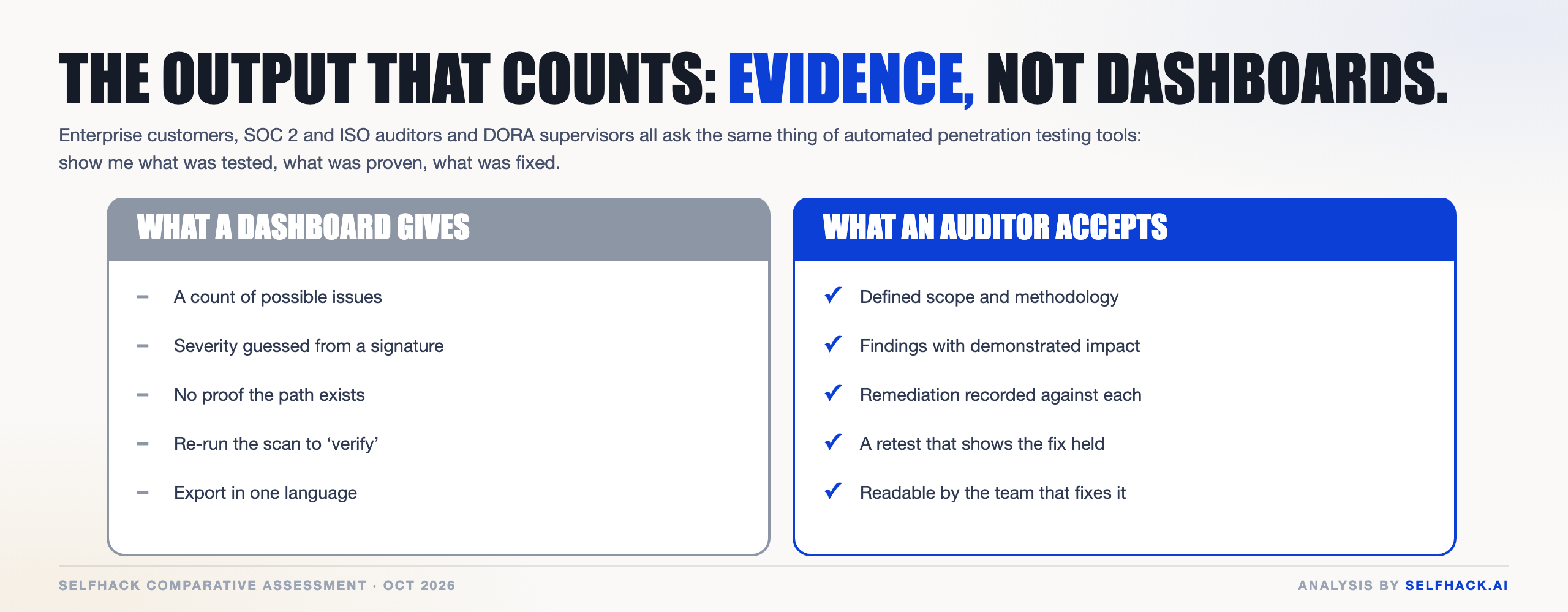
What they ask for is remarkably consistent. Whatever the framework, they put the same question to automated penetration testing tools: show me what was tested, what was proven and what was fixed.
In practice that means four things. A defined scope and method: which assets, which dates, which approach. Findings with a severity and proof of impact. Remediation recorded against each finding. And a retest showing the fix held.
Unvalidated scanner output fails that test on almost every line. A list of possible issues, with severity read off a signature, tells you what might be wrong. It doesn’t tell you what is. Nobody has shown the path exists, and ‘verification’ usually means running the scan again.
That costs you twice. The auditor learns you ran a scanner, not that you reduced risk. Hand developers a long list of maybes and they triage, argue and defer. Nobody argues with a demonstrated path.
Scanners still earn their place in the development pipeline, catching known issues before release. The trouble starts when the export is presented as a penetration test.
Every SelfHack AI finding is exploit-validated, so it arrives with the path demonstrated rather than flagged as possible. Testing produces the record auditors accept: scope, findings, remediation and retest. As a European company, we are also a natural fit for teams answering to DORA, NIS2 or ISO 27001.
Here’s the thing, though: evidence only works if people read it. A finding written in the language your engineers think in gets fixed faster than one that has to be translated first. The same goes for the board summary and the auditor’s copy.
SelfHack AI works in 16+ languages across the platform, the reports and the testing itself. It is the only one of the platforms compared here to list multi-language support on its public site, as of October 2026. For a Finnish bank or a German manufacturer, that is not a nicety. It shortens the time to fix.
So whichever automated penetration testing tools reach your shortlist, ask for a sample penetration test report before you sit through a demo. The evidence is the product.
How to run a fair pilot of automated penetration testing tools
Every vendor demo looks brilliant. That is what demos are for. A pilot on your own estate is the only test that counts, and it only counts if every product plays on the same pitch.
Start with scope. Write the rules of engagement once and give every vendor the same copy: the same applications and APIs, the same network ranges, the same cloud accounts, the same time window, the same definition of ‘safe in production’. Hand one tool your sprawling internal network and another a tidy staging app, and you are comparing environments, not automated penetration testing tools.
Then seed nothing. Don’t plant a known flaw, share last year’s report or hint at where the weak spots are. Planted bugs reward whoever tuned for planted bugs.
Do keep a private answer key, though. Note the issues you already know about, from past tests or a quick external baseline such as our free security checks guide. It shows who found what you knew, and who found what you didn’t.
Score on reproduced exploit chains, not counts. A report with hundreds of findings is not better than one with ten that hold up. For each finding, ask two questions. Can your own team reproduce it from the evidence supplied? Does it lead somewhere that matters, such as customer data or administrative control? One proven chain outweighs a page of missing-header warnings.
Measure time to first real finding. Not the first alert: the first issue your team confirms is genuine and exploitable. Here’s the thing. A tool that needs a fortnight of tuning before it says anything useful is showing you what living with it will be like.
Finally, let the engineers who fix things judge. It is tempting to grade on volume and dashboards. The people who patch ask harder questions. Was it real? Was it clear? Did the retest prove the fix held? Their scores are the best guide to whether a tool still earns its place at renewal.
A fair pilot has a useful side effect, too. It shows which of the three categories each product really belongs to, whatever the brochure says. Scanners hand back lists. Scripted tools replay what they already know. Among automated penetration testing tools, only the autonomous kind should come back with proof.
How SelfHack AI approaches automated penetration testing
SelfHack AI sits in the third category of automated penetration testing tools. It is not a scanner with a smarter dashboard, nor a playbook replaying yesterday’s techniques on a timer. It is an autonomous tester.
That means the engagement runs end to end without a human steering each step: reconnaissance, forming hypotheses, exploitation, chaining weaknesses together and writing the report. Many PTaaS and consultancy models still run with a human driving each engagement. SelfHack AI doesn’t need a driver.
Every finding is exploit-validated. It arrives with the path demonstrated, not as a ‘possible’ issue for your team to chase down. That changes the conversation with engineering. Nobody debates whether a problem is real when the evidence shows it happening.
Scope is broad by design: web applications and APIs, internal and external networks, cloud environments including Google Cloud, AI and LLM features, IoT, operational technology, and even drones and satellite systems. Attack paths rarely respect product categories. Automated penetration testing tools that stop at one surface leave the joins between surfaces untested.
Testing is continuous rather than annual, because attackers don’t keep to your audit calendar. CrowdStrike’s 2026 Global Threat Report put average eCrime breakout time at 29 minutes. Run once a year, even good automated penetration testing tools are answering last year’s question. Our guide to enterprise penetration testing looks at that gap in detail.
Each cycle produces the evidence auditors accept: scope, findings, remediation and retest. As a European company, SelfHack AI is a natural fit for programmes built around DORA, NIS2 and ISO 27001.
Then there is language. SelfHack AI works in 16+ languages across the platform, its reports and the testing itself. Going by what the other vendors publish, that makes it the only one of the platforms compared here with multi-language support. When the engineers fixing an issue can read the finding in their own language, a translation step drops out of every fix.
If you want to see how it performs on your own estate, under the pilot rules above, book a SelfHack AI pilot.
FAQ
Are automated penetration testing tools accurate?
It depends on what they claim. Scanners are good at flagging likely issues, but ‘likely’ is the operative word: someone still has to prove each one, and false positives quietly eat engineering time. Scripted tools are dependable on the techniques they replay and silent on everything else. Exploit-validated platforms set a stricter bar, because a finding only counts once the path is demonstrated. Judge accuracy by what your team can reproduce.
Is agentless testing better than agent-based testing?
Neither wins outright. Agentless tools test across the network the way an attacker would, with nothing to install or maintain on each machine. Horizon3.ai’s NodeZero makes ‘no agents to install’ a headline promise, and our Horizon3 alternative guide compares it with SelfHack AI. Agent-based tools put software on hosts, trading rollout and upkeep for an inside view. Ask what each one proves, and what it takes to keep running.
Do automated penetration testing tools satisfy compliance requirements?
Partly. They can supply much of the evidence, provided the output is built for auditors rather than dashboards. ISO 27001 expects technical vulnerabilities to be identified and dealt with. NIS2 asks you to assess whether your security measures are effective. DORA’s testing programme names penetration testing outright, while its threat-led tests for designated firms follow their own rules. Look for defined scope, demonstrated findings, recorded remediation and a retest.
Can automated penetration testing tools replace a human pentest?
A scanner can’t, and neither can a playbook. Autonomous platforms are different: they take on much of the repeatable work and keep testing after a consultant’s engagement window closes. Our piece on what manual pentests miss covers that gap. Human testers still add value where judgement about your business matters most, and regulated exercises such as DORA’s threat-led tests set rules on who runs them.
How should we compare vendors fairly?
Run a like-for-like pilot: identical scope, nothing seeded, findings scored on reproduced exploit chains rather than volume, time to first real finding recorded, and the engineers who fix things holding the deciding vote. Then check the edges: which surfaces each product covers, whether its evidence would satisfy your auditor, how retests work and which languages it reports in. Our comparison of AI pentest tools can help with the shortlist.
The verdict
‘Automated’ is a label, not a capability. Under the banner of automated penetration testing tools sit three very different kinds of product: scanners that list possibilities, scripted playbooks that replay known techniques, and autonomous platforms that reason, exploit and prove. Blur them and you end up paying for a list when you needed proof. So ask every vendor the same thing: show me a finding you proved, end to end, on an estate like mine.
Credit where it is due. Every vendor in this guide is strong in its own zone. Aikido gives developers a single suite of scanners, from code and dependencies to containers and cloud. Pentera validates exposure through safe adversarial emulation in production. Horizon3.ai’s NodeZero brings agentless, autonomous testing to internal, external, cloud, Kubernetes and Active Directory environments. XBOW concentrates on autonomous web-application exploitation. If your need sits neatly inside one of those zones, the specialist built for it may be enough.
The truth is, attackers don’t stop at the edge of a product category. If you want autonomy, exploit-validated findings, full-stack scope, continuous testing, audit-ready evidence and 16+ languages in one platform, SelfHack AI is the strongest of the automated penetration testing tools compared here. It is not the answer to every narrow question, and it doesn’t need to be. Hold it to the same fair pilot as everyone else, and start that pilot with us.
Sources & methodology: vendor descriptions are summarised from each company’s public website (horizon3.ai, pentera.io, aikido.dev, xbow.com) and from their public advertising as shown in the Google Ads Transparency Center for Finland, October 2026. Attacker breakout time is from the 2026 CrowdStrike Global Threat Report. Testing methodology references the OWASP Web Security Testing Guide and NIST SP 800-115. This is a SelfHack comparative assessment; SelfHack AI makes no claim about any vendor beyond what it states publicly. Only test systems you own or are authorised to test.