Horizon3 Alternative: Two Autonomous Pentest Platforms, Two Different Depths
- Horizon3.ai’s NodeZero is one of the strongest autonomous pentest platforms on the market. By its own account it serves 7,012 customers, is trusted by the NSA and four of the Fortune 10, and runs agentless across internal, external, cloud, Kubernetes and Active Directory environments.
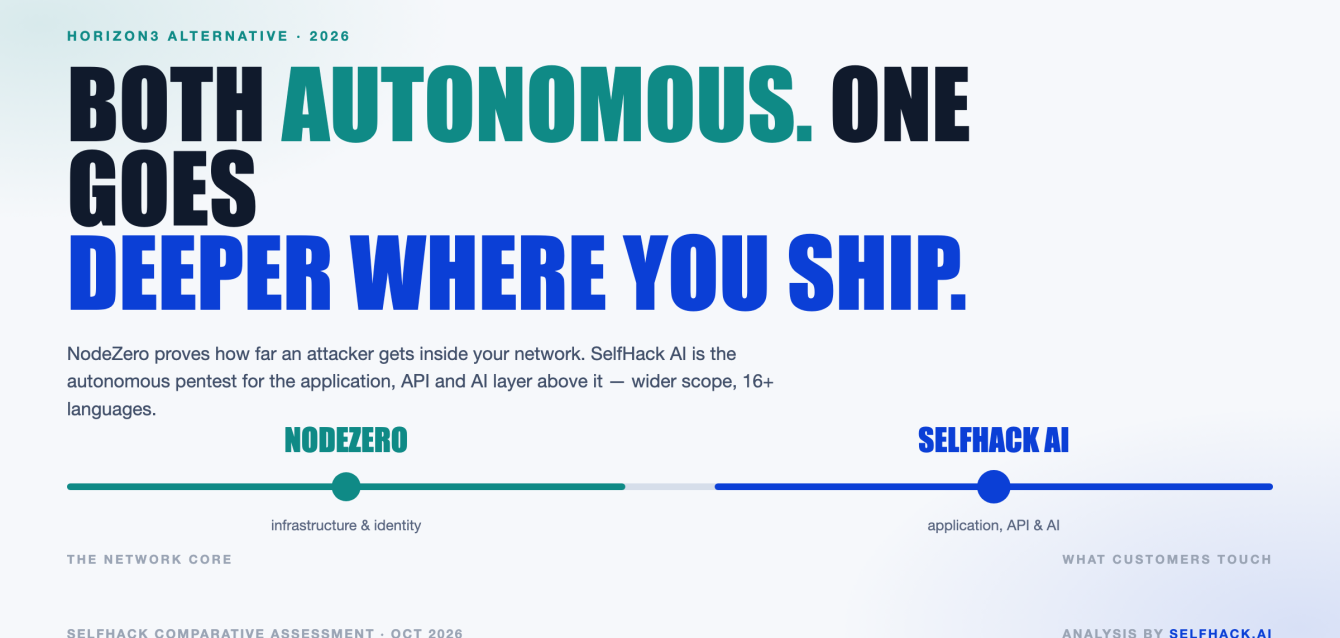
- Because both platforms are autonomous, a Horizon3 alternative comparison is not about “automation versus humans”. It is about where each one goes deep.
- NodeZero’s depth is the infrastructure and identity layer. SelfHack AI’s is the application, API and AI layer — the part of the stack your customers touch — plus a wider scope and 16+ language support.
- Our view, stated plainly: if your unanswered risk lives in the product you ship, SelfHack AI is the stronger Horizon3 alternative. If it lives in your internal network, NodeZero is excellent, and pairing the two is often the smartest answer.
SelfHack comparative assessment, October 2026. Horizon3.ai’s capabilities and claims are summarised from its own public website; products change, so verify current features with the vendor. Only test systems you own or are authorised to test.
Why people search for a Horizon3 alternative
Let us begin where the Pentera comparison began, because the honest starting point is the same: almost nobody looking for a Horizon3 alternative thinks NodeZero is a weak product.
Horizon3.ai is one of the fastest-growing names in security, and NodeZero is a genuinely capable autonomous pentest platform. When a security team starts evaluating a Horizon3 alternative, the reason is usually fit rather than failure — the shape of their risk has moved, their product has changed, or a specific layer they care about is not where the platform is centred.
In practice the reasons cluster. The team’s biggest exposure has shifted from the internal network to the application and API layer. They have shipped AI features that nobody has tested. They operate an estate — OT, connected devices, non-English products — that infrastructure-first testing was never built around. Or they simply want their pentest to go deepest where their customers actually interact with the product.
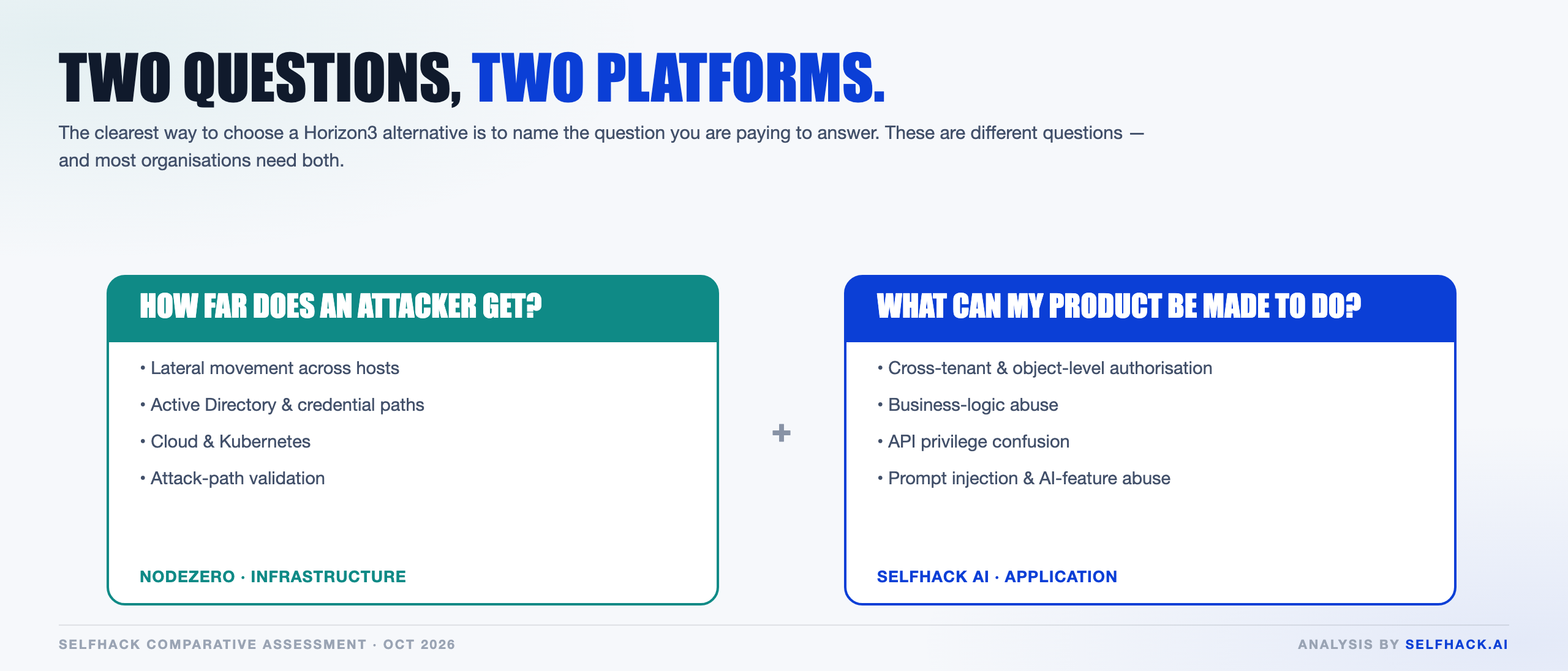
Here’s the thing: when you are comparing two autonomous platforms, the familiar “automation beats manual testing” argument does not help you choose. Both are autonomous. The useful question is which platform is built to understand your highest-risk layer most deeply — and that is what this Horizon3 alternative comparison is about.
What NodeZero is genuinely great at
Credit first, and in Horizon3’s case a great deal is due.
Horizon3.ai describes NodeZero as autonomous pentesting that will “safely and autonomously hack your production environment, fix what matters most, verify instantly, and repeat continuously.” It runs without agents, emphasises safe production testing, validates attack paths, and proves vulnerabilities through real exploitation rather than inference. That find-fix-verify-repeat loop is exactly the shape good security testing should take.
Its coverage on the infrastructure side is broad: internal and external pentesting, cloud and Kubernetes pentesting, Active Directory password audits, a vulnerability management hub, and threat-detection tripwires. Horizon3 states it serves 7,012 customers, is trusted by the NSA and four of the Fortune 10, and lists recognition including a top ranking on the Inc. 5000 for security and a 4.7 rating on Gartner Peer Insights.
That is a serious, proven track record. For an organisation whose central worry is an attacker establishing a foothold and working through the internal network toward domain admin, NodeZero is a natural fit — and any fair Horizon3 alternative has to acknowledge that the infrastructure and identity core is its home ground.
Same category, different depth
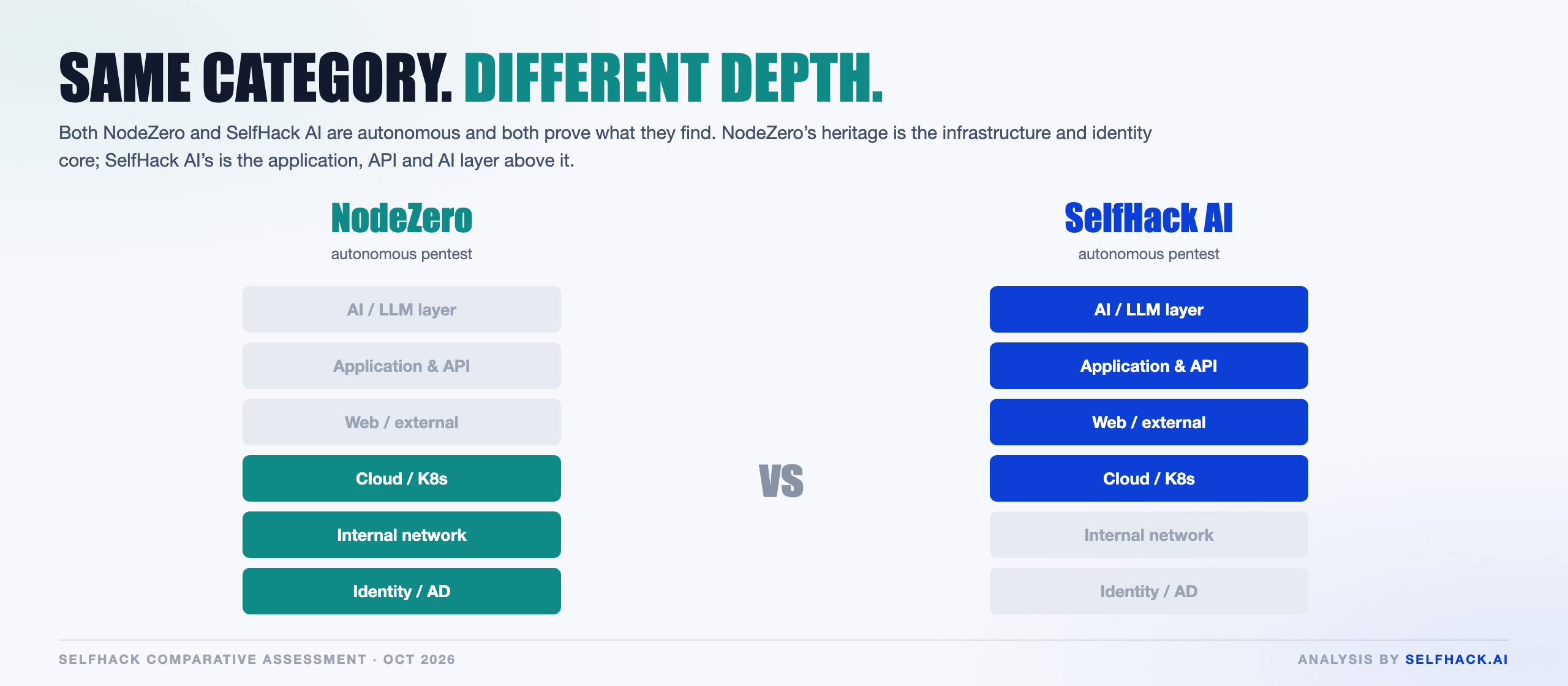
Both NodeZero and SelfHack AI are autonomous penetration testing platforms. Both reason about an environment, chain weaknesses together, and prove exploitation rather than listing possibilities. The difference is not in kind. It is in where each one goes deep.
NodeZero’s depth sits in infrastructure and identity: networks, hosts, Active Directory, cloud configuration, Kubernetes. Horizon3 lists web application pentesting among its solutions and describes it as newly launched — which itself tells you where the platform’s centre of gravity has historically been.
SelfHack AI was built from the other direction. Its centre of gravity is the application: how a specific product authenticates users, how it authorises each action, how its API endpoints enforce tenant boundaries, and how its AI features handle hostile input. Infrastructure matters to us too — we test what is externally reachable — but the application layer is where our agents are designed to reason hardest.
The truth is, these are complementary depths rather than competing ones. The question a Horizon3 alternative evaluation should answer is simply which depth your organisation is missing today. For most product companies in 2026, we believe that gap is the application, API and AI layer.
The application layer, where most products now live
This is the first concrete reason teams evaluate a Horizon3 alternative, and it grows more pressing every quarter.
Modern products are built as web applications and APIs. A single platform can expose hundreds of endpoints, each with its own permission rules, often written by different teams. The most damaging issues at this layer are authorisation failures — where one user or one tenant can reach data or actions that should belong to another. These are consistently among the most common and most costly classes of web vulnerability, and they are decided by application logic, not by the state of the network.
The important property of this class is that it is effectively invisible to single-session, infrastructure-centred testing. Confirming whether one account’s boundary holds against another requires testing that reasons about multiple users and roles at once — comparing what each is allowed to see and do. That multi-user, authenticated reasoning is a core part of how SelfHack AI works, and we explained why conventional approaches miss it in our analysis of what manual pentests miss.
So if your incident history or your threat model is dominated by application-layer risk rather than network compromise, that is a strong signal that the right Horizon3 alternative is one whose depth sits where your risk sits.
The AI layer nobody scoped for
The second reason is newer, and most security programmes have not caught up with it.
Products now ship AI features: assistants, copilots, agents with tool access, retrieval systems that read internal documents. Each introduces a class of weakness that neither network validation nor traditional application testing was designed to find — prompt injection, system-prompt extraction, insecure handling of model output, and agents that can be influenced into misusing their own tools.
This is home ground for an AI-native pentest platform. We cover the methodology in our LLM pentest guide, mapped to the OWASP Top 10 for LLM applications. If your roadmap includes AI features — and in 2026 almost every roadmap does — the AI layer belongs in scope, and it is a reasonable thing to weigh when choosing a Horizon3 alternative.
This gap is widening, not closing: every quarter more products ship AI features, and most testing programmes have no routine that covers them. The market is moving quickly here and capabilities change, so the fair thing is not to claim competitors ignore it. The fair thing is to ask every vendor directly how they test AI features, and to ask for a demonstrated finding rather than a slide.
Scope: everything an attacker can reach
The third difference is breadth of scope, and it is where a Horizon3 alternative evaluation can diverge sharply depending on what you run.
NodeZero’s published strength is a well-defined enterprise estate: internal and external networks, cloud, Kubernetes and Active Directory. That is coherent and deep. SelfHack AI’s scope is deliberately wider, because attackers do not respect product categories: one platform covers web applications and APIs, internal and external networks, cloud environments including Google Cloud, AI and LLM features, IoT devices, operational technology, and even drone and satellite systems.
None of this is a criticism of a focused product. A platform that goes deep on infrastructure is more valuable to an infrastructure-heavy organisation than one that spreads itself thin. The point is only to match the scope to your estate. That breadth matters most for organisations whose estate does not look like a classic office network — manufacturers with OT, logistics and mobility firms with connected fleets, aerospace and defence suppliers, telecoms, and anyone shipping AI. For them, testing that stops at the network and the cloud leaves the most interesting parts of the estate unexamined.
There is also the language dimension. SelfHack AI supports more than sixteen languages across the platform, its reports and its testing, so regional teams act on findings in their own language and non-English applications are tested in the language their users use. Among the platforms compared on this page, SelfHack AI is the only one to offer this — neither Horizon3.ai nor Pentera lists multi-language support on its public website, checked October 2026.
Other Horizon3 alternatives worth evaluating
A page that only recommends itself is not a guide, so here is the wider field, described from each vendor’s public positioning.
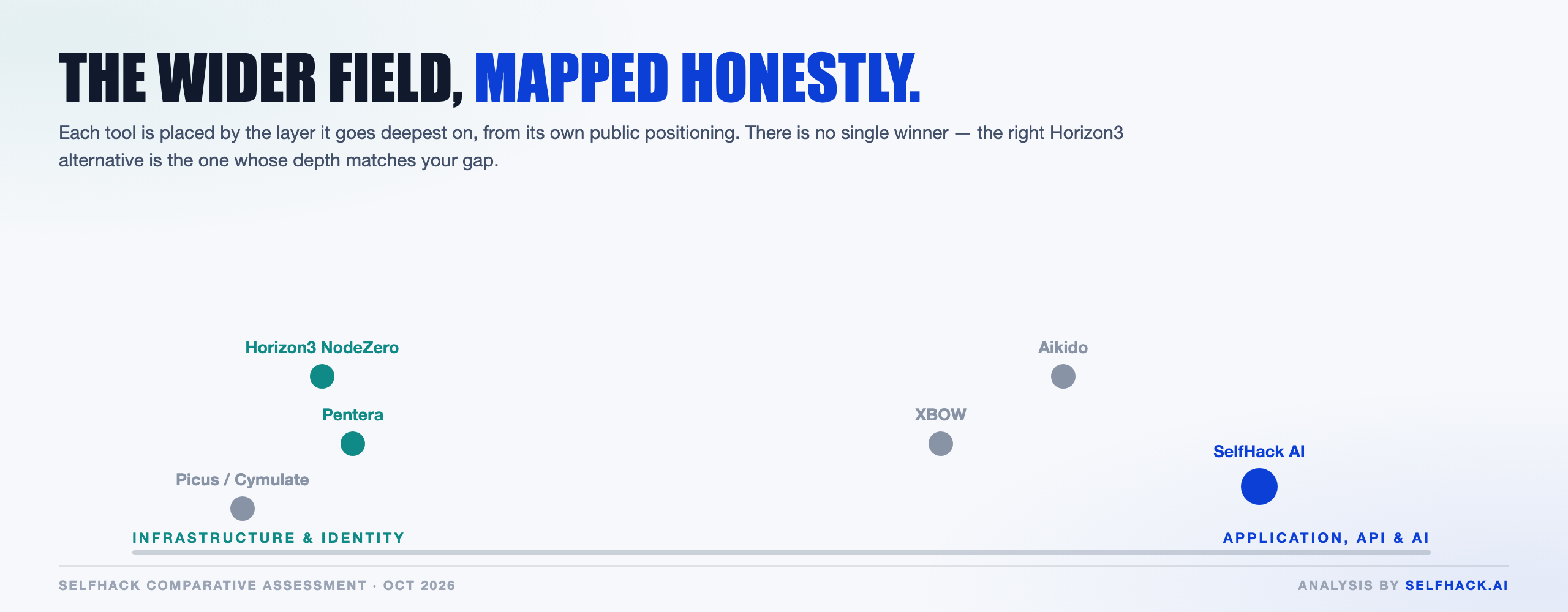
Pentera is the most direct like-for-like comparison with Horizon3 — an exposure-validation platform with deep internal-network, Active Directory and lateral-movement testing. If you like NodeZero’s infrastructure focus but want to weigh another mature option, start there; we wrote a dedicated Pentera alternative comparison.
Picus Security and Cymulate are breach-and-attack simulation and exposure-management platforms, strong if your priority is continuously validating controls and detection rules rather than pentesting applications.
XBOW focuses on autonomous web exploitation — see our XBOW alternative page. Aikido Security is a developer-facing scanning suite, covered in our Aikido alternative comparison.
The full ranked picture, written to the same rule of crediting what competitors do well, is in our AI pentest tools overview. The right Horizon3 alternative depends on which gap you are filling, and different gaps point to different tools.
When you should stay with NodeZero
An honest comparison has to say when the answer is “do not switch”.
Stay with NodeZero if your dominant risk is internal compromise: a large Active Directory estate, complex internal networks, a history of credential-based incidents, or a board-level concern about an attacker moving laterally toward critical systems. That is precisely what the platform is centred on, and trading it away to chase application coverage would swap one gap for another.
Stay if your team has built process around its find-fix-verify loop and its reporting. Operational fit is real value, and a tool a team uses well beats a theoretically broader one it does not.
And stay if what you need is infrastructure and identity depth across many hosts at scale — the kind of continuous internal pentesting NodeZero is known for. A Horizon3 alternative focused on the application layer is answering a different question.
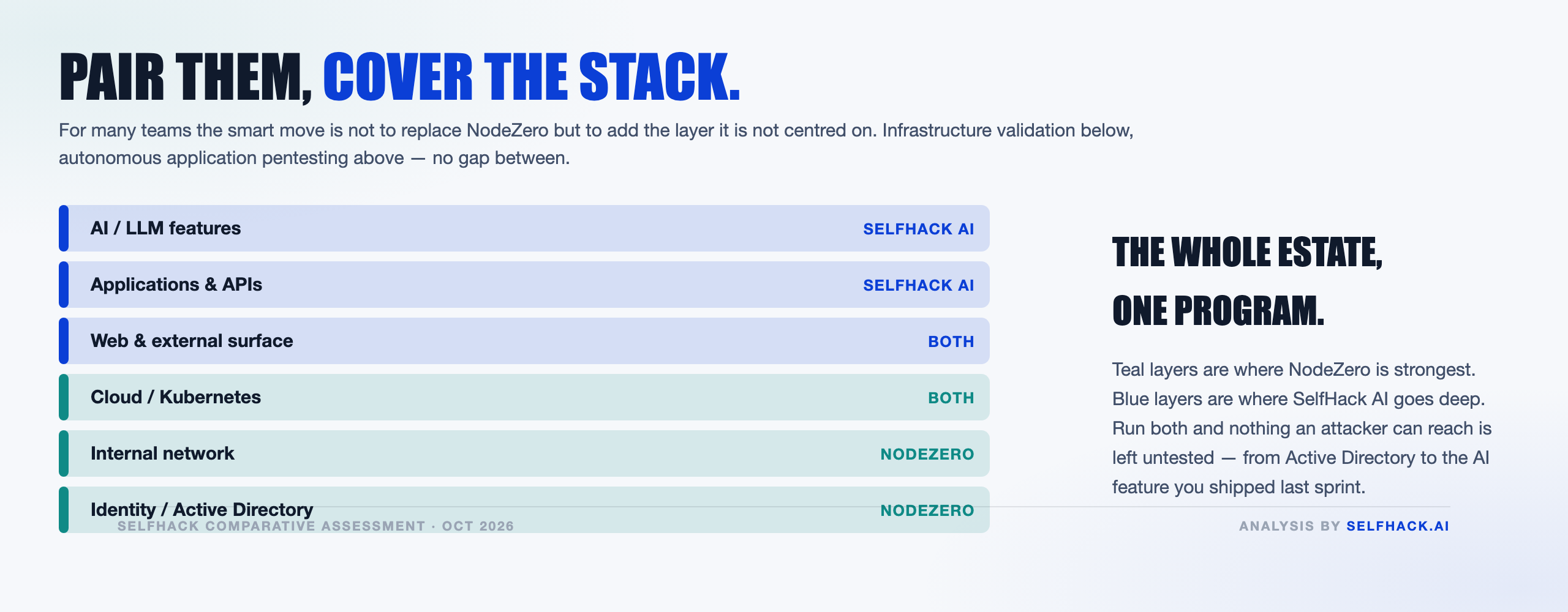
In many of these cases the better move is additive: keep NodeZero for the infrastructure core and add application, API and AI-layer testing alongside it. That is a perfectly sensible outcome of a Horizon3 alternative evaluation, and it is how a lot of mature programmes end up structured.
How to run a fair comparison
Most evaluations go wrong in the pilot, not in the decision. Here is a structure that gives you a real answer in two to three weeks.
Give every vendor the same scope. Choose a real application with real authentication — ideally one with multiple user roles and an API behind it — plus a slice of infrastructure. If each vendor tests something different, you are comparing demos, not platforms.
Seed nothing. Do not plant known issues for a vendor to find. You learn far more from what each platform discovers on its own in an environment it has never seen.
Score on proof, not volume. Count findings that arrive with a reproduced exploit chain. Discount long lists of “possible” issues; volume without proof is the triage burden teams are trying to escape.
Measure time to first real finding. How long from kickoff to the first finding your engineers agree is genuine? That single number says more about operational fit than any feature matrix.
Check the evidence. Ask your auditor or compliance lead to read the output. If it would not survive their review, it does not count, however polished the dashboard. And involve the engineers who will do the fixing — their judgement on whether a finding is real and worth a sprint is the most honest signal a pilot produces.
One more point worth stating: the cost of two complementary tools is usually lower than the cost of the gap one of them leaves. A Horizon3 alternative evaluation that ends in “keep NodeZero, add application and AI testing” is not a failure of the process — it is often the correct result.
Run the same pilot against NodeZero if you are an existing customer. A Horizon3 alternative only earns the switch if it finds things in your estate that matter and that your current tooling did not surface.
How SelfHack AI works as a Horizon3 alternative
SelfHack AI is an autonomous penetration testing platform. Here is what that means in practice, and why some teams choose it as a Horizon3 alternative or alongside NodeZero.
Autonomous reasoning about your application. Our agents map how a product works, form hypotheses about where its logic breaks, and test them — rather than replaying a fixed library of techniques.
Exploit-validated findings. Nothing reaches your team as a “possible” issue. Every finding arrives with the path demonstrated, so engineers spend their time fixing rather than proving.
Attack-chain analysis. Real breaches are chains. We follow a small foothold to see whether it reaches something that matters, and report the chain rather than the fragments.
Full-stack scope, including the AI layer and beyond. Web, API, cloud, network, AI features, IoT, OT and more — tested continuously rather than once a year, which matters because, as we showed in our analysis of enterprise penetration testing, attackers now break out in minutes.
Evidence and languages built in. Scope, findings, remediation and retest, documented continuously and available in 16+ languages. As a European company, SelfHack AI is also a natural fit for teams working under EU frameworks.
If the gap your Horizon3 alternative search is really about is the application and AI layer, talk to us and run a pilot against your own estate.
FAQ
Is SelfHack AI a direct replacement for Horizon3’s NodeZero?
For some teams, yes; for many, it is a complement. NodeZero’s centre of gravity is internal network and identity testing, while SelfHack AI’s is application, API and AI-layer penetration testing. If your main risk is in the application layer, SelfHack AI can be your primary Horizon3 alternative. If you need both depths, running them together usually beats choosing one.
Both are autonomous — so what actually differs?
The layer each one reasons about most deeply. NodeZero is built around infrastructure, identity, cloud and Kubernetes. SelfHack AI is built around application logic, API authorisation and AI features, with a wider overall scope. A Horizon3 alternative comparison is really a question of which depth matches your biggest unanswered risk.
Which is better for internal network and Active Directory testing?
For internal network and Active Directory depth at scale, NodeZero is a strong, proven choice and the kind of workload it is known for. Pentera is the other mature option in that space. SelfHack AI’s strength is the application, API and AI layer, so for that specific workload NodeZero or Pentera may be the better primary tool.
Does a Horizon3 alternative need to run in production?
Testing production is how you learn what is actually exploitable, and both NodeZero and SelfHack AI are designed for it. Safe production testing depends on agreed rules of engagement — scope, rate limits, excluded actions — and on authorisation from the asset owner.
How should I evaluate a Horizon3 alternative fairly?
Run a proof of concept on your own environment with the same scope for each vendor, seed nothing, and score on findings that arrive with a reproduced exploit chain rather than on counts of possible issues. Compare what each platform finds in your estate, and check whether the output works as audit evidence.
The verdict
Horizon3.ai’s NodeZero is a strong autonomous pentest platform with a clear centre of gravity: proving how far an attacker gets once inside your infrastructure. Most people searching for a Horizon3 alternative are not trying to escape that — they are trying to cover what sits above it.
If your unanswered risk is the application your customers use, the APIs behind it, the AI features you shipped this year, and an estate that reaches into OT, IoT or non-English markets, the right Horizon3 alternative is a platform built to test that layer autonomously and prove what it finds. We built SelfHack AI to be that platform, and for that layer we think it is the best choice available.
Keep the tool that answers your infrastructure question well. Add the one that answers your application question. And if you want to see what that second answer looks like on your own estate, talk to us.
Sources & methodology: Horizon3.ai’s product descriptions, module names and scale claims (7,012 customers; trusted by the NSA and four of the Fortune 10; agentless autonomous pentesting) are quoted or summarised from horizon3.ai; Pentera’s from pentera.io, both as of October 2026. AI-layer testing references the OWASP Top 10 for LLM Applications; testing methodology references NIST SP 800-115. This is a SelfHack comparative assessment: competitor descriptions reflect their public positioning, products change, and you should verify current capabilities with each vendor. SelfHack AI makes no claim about any vendor beyond what it states publicly. Only test systems you own or are authorised to test.