Enterprise Penetration Testing in 2026: Attackers Break Out in 29 Minutes. You Test Once a Year.
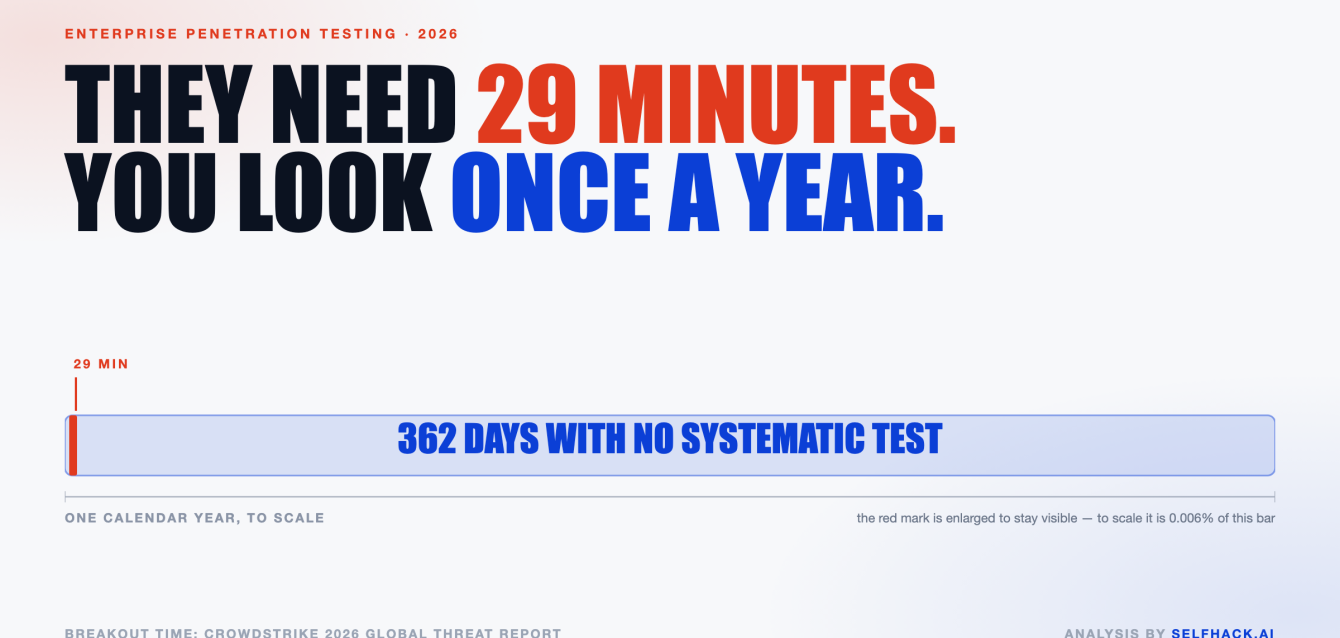
- CrowdStrike’s 2026 Global Threat Report put the average eCrime breakout time at 29 minutes, with the fastest observed breakout at 27 seconds and one intrusion exfiltrating data within four minutes of initial access.
- The same report recorded AI-enabled adversary activity up 89% year over year. Attackers did not just adopt AI — they industrialised it.
- Meanwhile the defender’s clock barely moved: the 2026 Verizon DBIR reports a median remediation time around 43 days, and an annual test leaves roughly 362 days untested.
- That arithmetic is the whole argument. Enterprise penetration testing that runs once a year cannot answer an adversary operating at machine speed. The answer is not testing harder once — it is testing continuously, autonomously, with every finding proven.
Figures below are attributed to their published sources; this is analysis of public reporting, not SelfHack research. Only test systems you own or are authorised to test.
What enterprise penetration testing has to answer now
For twenty years, enterprise penetration testing answered one question well: if a skilled person spent two weeks attacking a defined slice of our estate, what would they find?
That was a reasonable question when attacks were built by hand. It is a strange question in 2026, because the adversary you are modelling no longer works that way. The attacker now runs reconnaissance, exploitation and lateral movement through tooling that never sleeps, and the published numbers on how fast they move are genuinely uncomfortable.
So the question enterprise penetration testing has to answer has changed shape. It is no longer “what would a person find in two weeks”. It is: can anything reach our crown jewels right now, across an estate that changed this morning, and can we prove it?
Here’s the thing about that reframing: it is not a marketing device. It falls directly out of two sets of published figures — one describing how fast attackers now move, the other describing how slowly defenders respond. Put them side by side and the conclusion is arithmetic, not opinion.
The 29-minute problem
CrowdStrike’s 2026 Global Threat Report, published on 24 February 2026, is the cleanest public measurement of attacker speed available, and its headline number is the one every enterprise security leader should have on a slide.
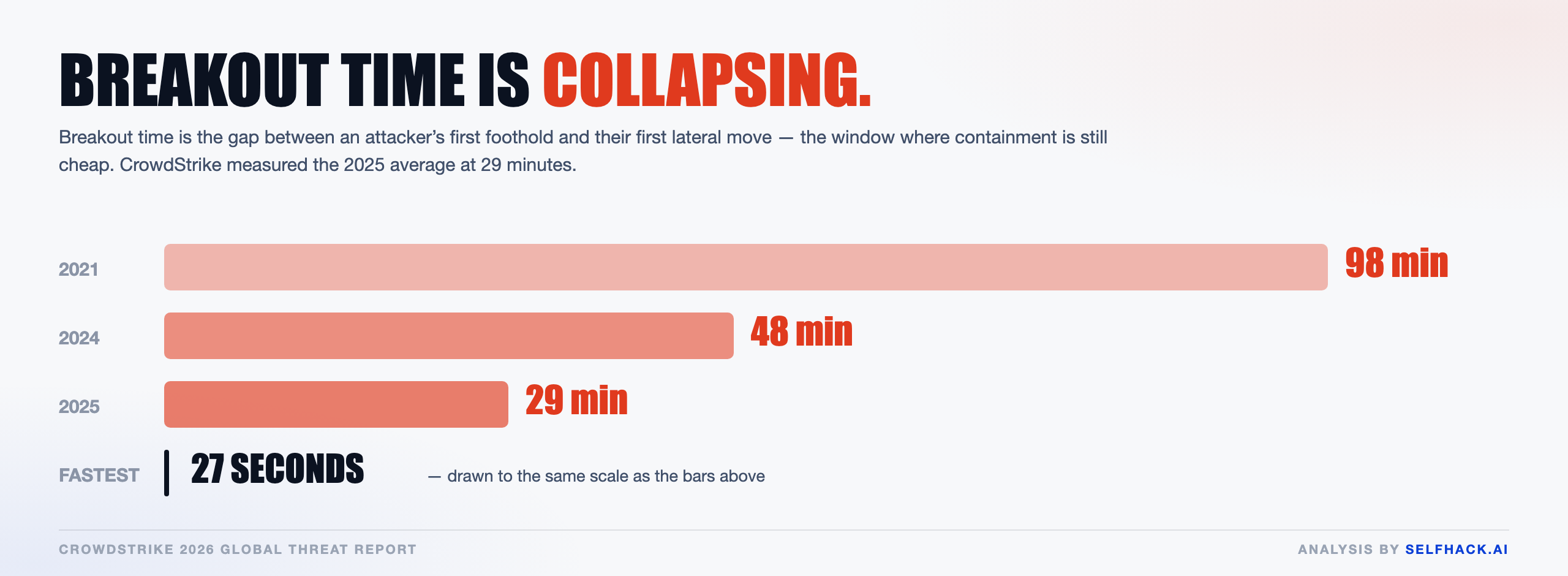
The average eCrime breakout time fell to 29 minutes. Breakout time is the interval between an attacker’s initial foothold and their first lateral movement — the window in which containment is still cheap. Twenty-nine minutes is barely long enough to convene a bridge call.
The trend line is worse than the number. CrowdStrike reports that 29 minutes represents a 65% increase in speed compared with 2024, and the longer arc is steeper still: from roughly 98 minutes in 2021, to 48 minutes in 2024, to 29 minutes in 2025. The fastest breakout the company observed was 27 seconds. In one intrusion, data exfiltration began within four minutes of initial access.
Read those figures as a specification rather than a scare story. They tell you the response time your controls must actually achieve, and — more relevant to enterprise penetration testing — they tell you how stale a finding becomes between the day it is discovered and the day it is next looked at.
Attackers did not adopt AI. They industrialised it.
The same report puts a number on the thing everyone has been arguing about: AI-enabled adversaries increased their activity by 89% year over year.
That growth is not confined to phishing text. CrowdStrike describes AI weaponised across reconnaissance, credential theft and evasion — the unglamorous middle of an intrusion, which is exactly where headcount used to be the constraint. When the bottleneck is labour, you can out-budget an adversary. When the bottleneck disappears, you cannot.
Two more figures from the same report matter for anyone scoping enterprise penetration testing. Cloud-conscious intrusions rose 37% overall, and 266% from state-nexus actors specifically targeting cloud environments. And adversaries exploited generative AI tooling at more than 90 organisations through malicious prompt injection — meaning your AI deployments are now an attack surface in their own right, which is why we wrote a separate piece on LLM pentest coverage.
We analysed the attacker side of this shift in detail in our piece on autonomous cyber attacks. The short version: the labour that used to separate a well-resourced operation from an amateur one is now delegated to machines that run in parallel, continuously.
The defender’s clock has barely moved
Now the other half of the arithmetic, and it is the half that should decide your budget.
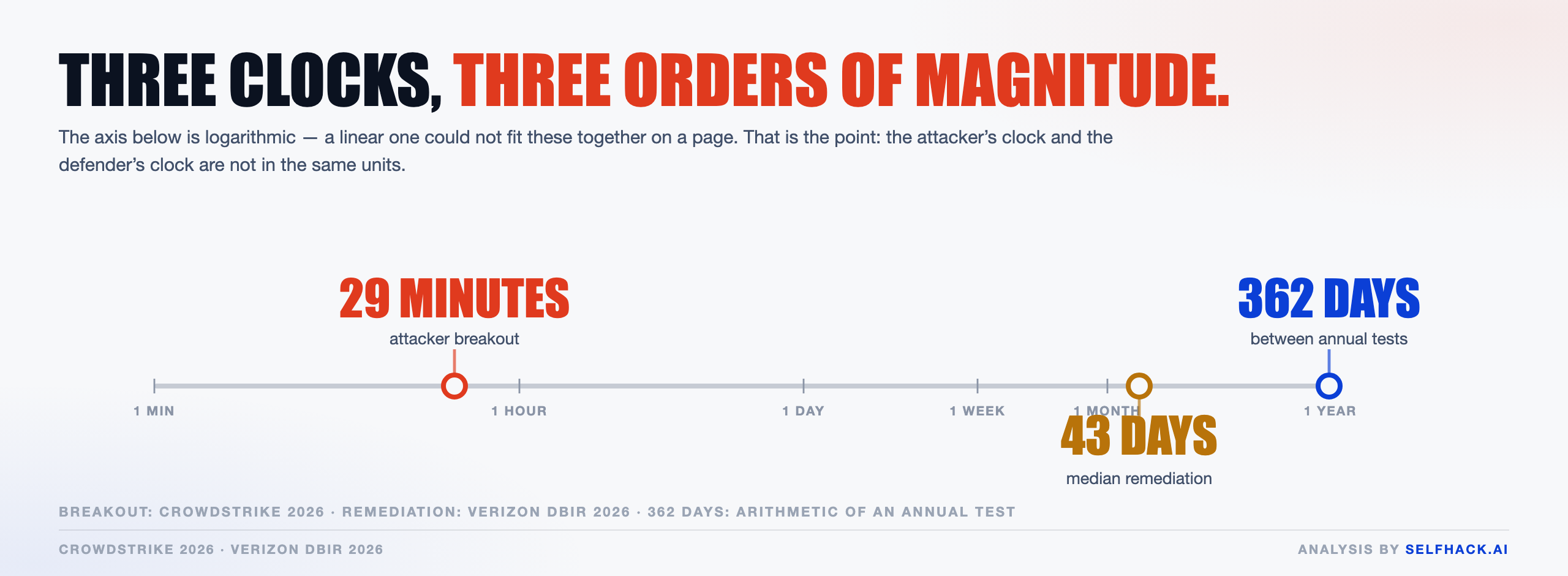
The 2026 Verizon Data Breach Investigations Report puts the median remediation time for known exploited vulnerabilities at roughly 43 days, with organisations facing a median of about 16 such vulnerabilities a year. Across broader industry datasets, mean time to remediate a critical application vulnerability commonly lands near 74 days. Newly published vulnerabilities, meanwhile, are typically weaponised within days.
Then there is the cadence of testing itself. An annual engagement observes your estate for two or three weeks and leaves roughly 362 days in which nothing is systematically tested. Every subdomain spun up, every API shipped, every acquisition integrated and every credential rotated in that window is untested until the next cycle.
Line the clocks up. The attacker needs 29 minutes. You need 43 days to fix, and you look once every 365. Enterprise penetration testing built around an annual calendar is not slightly behind that threat model — it is off by several orders of magnitude, and no amount of tester skill closes a gap of that size.
Why enterprise scale makes the gap worse
Everything above applies to a fifty-person startup. At enterprise scale it compounds, for reasons that have nothing to do with security team quality.
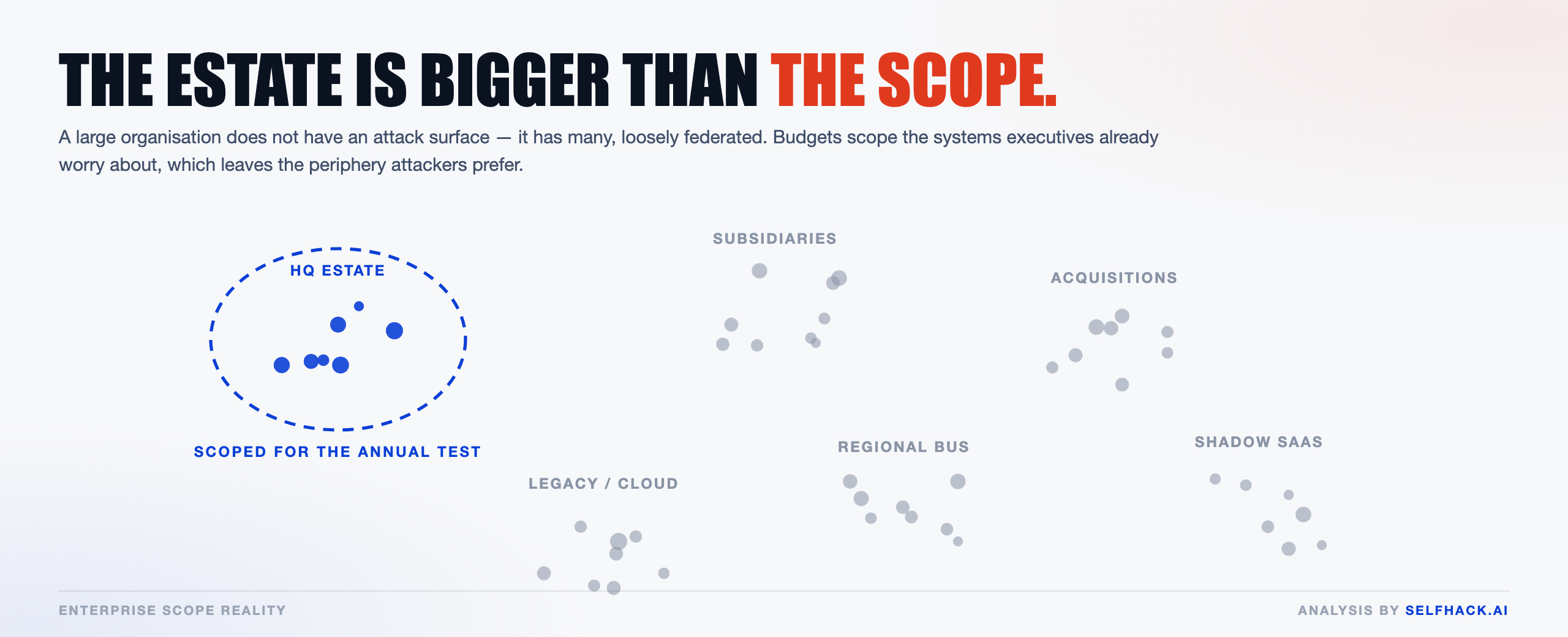
The first is sprawl. A large organisation does not have an attack surface; it has many, loosely federated. Subsidiaries with their own IT. Estates inherited through acquisition and never fully mapped. Regional business units that bought their own SaaS. Cloud accounts opened by teams who have since reorganised. Enterprise penetration testing that tests the surface someone remembered to list is testing a fiction.
The second is change rate. A large enterprise ships continuously across hundreds of teams. The estate that was scoped in January is not the estate that exists in June, and the difference is not marginal.
The third is the scoping negotiation itself. Enterprise engagements get scoped to a budget, and budgets favour the systems executives already worry about. The result is well-tested crown jewels and an untested periphery — which is precisely the shape attackers exploit, as we argued in our work on external pentest coverage.
There is a fourth factor that rarely makes the risk register: organisational memory. People move on. The engineer who stood up a regional integration in 2022 has left, and the system they built answers on a hostname nobody recognises. Enterprise penetration testing that relies on a human remembering to list an asset inherits every gap in that memory.
Put plainly: the larger the organisation, the more of its real attack surface sits outside the scope of its enterprise penetration testing programme.
What annual enterprise penetration testing cannot do
None of this means human testers are obsolete. Skilled testers find things no automation reaches, and the best enterprise engagements are genuinely excellent. The limitation is structural, not professional.
An annual test cannot tell you about the state of your estate today, because it measured a different estate. It cannot cover the periphery, because the periphery was negotiated out of scope. It cannot keep pace with a 29-minute adversary, because its unit of time is the quarter. And it cannot re-verify a fix six weeks after remediation without becoming a second engagement.
The honest way to state it: enterprise penetration testing on an annual cadence produces a high-quality photograph. The threat is a video. A better photograph does not solve that, and we made the same argument from a different angle in what manual pentests miss.
The fix is not to replace the photographer. It is to add a camera that never stops recording.
What the 29-minute number means for your runbook
It is worth translating the figure into operational terms, because “attackers are faster” is not actionable.
Twenty-nine minutes is the containment budget. If detection, triage, decision and isolation together take longer than that, the attacker is already moving laterally when you begin responding.
Most enterprise runbooks were written when breakout time was measured in hours. They assume there is room to page someone, convene a call and agree a course of action. That room has gone.
The implication for enterprise penetration testing is direct. If your response budget is half an hour, the value of knowing about an exploitable path in advance rises sharply, because prevention is the only part of the timeline you still control. A finding you already fixed costs zero minutes to contain.
That is the strongest practical argument for continuous testing, and it has nothing to do with vendor preference. Shrinking the attacker’s window is hard. Shrinking the number of open doors is not.
What enterprise-grade autonomous testing has to include
“Use AI” is not a strategy, and plenty of products attach the word to a vulnerability scanner. If autonomous testing is going to carry enterprise penetration testing, it has to meet a specific bar.
Continuous, not scheduled. Testing that runs on a cadence measured in days, so a system shipped on Tuesday is tested without anyone raising a ticket.
Exploit-validated, not inferred. A finding should arrive with the path demonstrated. Enterprise teams drown in scanner output precisely because unvalidated findings transfer the proof burden onto the people who could be fixing things.
Chain-aware. Real intrusions are rarely one vulnerability. The interesting question is what three medium findings do together, and whether that chain reaches something that matters.
Full-scope, including the boring parts. Discovery has to run continuously and feed testing automatically, or the periphery stays invisible.
Evidence-producing. Scope, findings, severity, remediation and retest, in a form an auditor or an enterprise customer accepts — which is the same evidence the frameworks in our compliance penetration testing hub expect.
Anything that misses those is a scanner with better marketing, and enterprise penetration testing does not need another one of those.
Being honest about what AI testing does not replace
A page that only lists its own advantages is an advertisement, so here is the other side.
Autonomous testing does not replicate human creativity on novel business logic. A tester who understands that your pricing engine can be abused in a way nobody documented is doing something no current system reliably reproduces. Keep that engagement.
It does not remove judgement either. Someone still decides what “critical” means for your business, whether a proven finding matters given compensating controls, and what gets fixed first. Proof removes the argument about whether a finding is real; it does not remove the decision about whether it is important.
And it is not omniscient. It tests what you scope, with the techniques it has, during the time it runs. Anything outside the boundary is not covered — which is an argument for wider scope and continuous cadence, not for pretending otherwise.
The truth is, the strongest enterprise penetration testing programmes in 2026 are layered: continuous autonomous testing as the base, human expertise on the hard problems, and a bounty for the creative long tail if the product warrants it. We compared those models honestly in our piece on bug bounty vs penetration testing.
How to evaluate a vendor without being sold to
The autonomous testing market got crowded fast, and several vendors are doing genuinely good work. XBOW built a strong autonomous web exploitation engine. Terra Security runs agentic testing with a human in the loop. Aikido is an excellent developer-facing scanning suite. Each is good at what it is built for, and a fair evaluation starts by saying so.
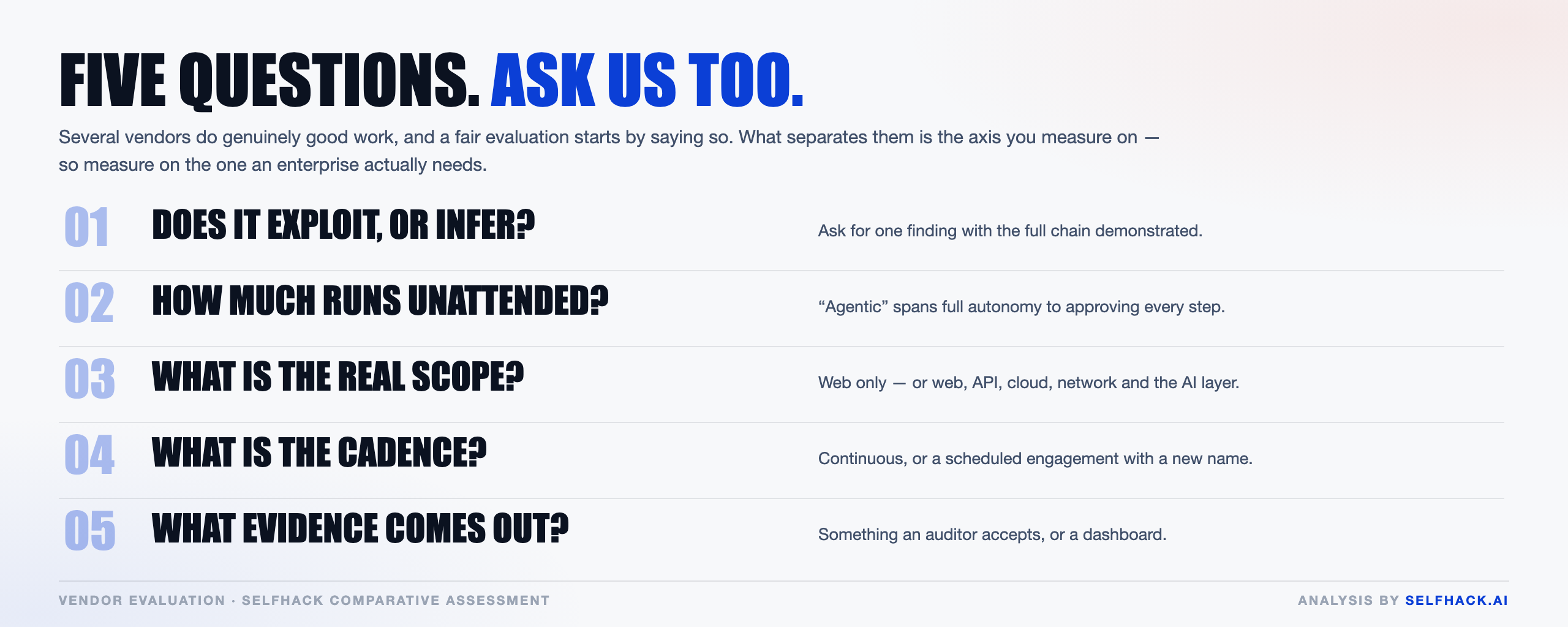
What separates them is the axis you measure on, so measure on the one that matters to an enterprise. Ask any vendor, including us, these five questions and insist on demonstrations rather than decks:
1. Does it exploit, or does it infer? Ask to see a finding with the full chain demonstrated end to end. 2. How much of the run is genuinely unattended? “Agentic” covers everything from full autonomy to a human approving each step. 3. What is the real scope? Web only, or web plus API plus cloud plus network plus the AI layer. 4. What is the cadence? Continuous, or a scheduled engagement with a new name. 5. What evidence comes out? Something an auditor accepts, or a dashboard.
Our own honest comparison lives in the AI pentest tools overview, written to the same rule: credit what competitors do well, be specific about where we differ. SelfHack AI’s position is the combination — full-stack scope, exploit-validated findings, genuine autonomy and compliance-ready evidence in one system — rather than a claim to be better at every individual axis.
How SelfHack AI runs enterprise penetration testing
SelfHack AI is an autonomous penetration testing platform built for the arithmetic above: an adversary measured in minutes against an estate that changes daily.
It runs continuous discovery across everything you expose, so the acquired subdomain and the forgotten admin panel enter scope without anyone remembering them. It tests autonomously — reconnaissance, hypothesis, exploitation, chaining — rather than scanning and handing you a list of maybes. Every finding arrives with the path demonstrated, so your engineers spend their time fixing rather than proving. And the whole thing produces a standing record: what was tested, when, what was found, what was fixed, and whether the fix held.
For an enterprise that matters in three specific ways. New systems are tested as they appear rather than at the next cycle. The periphery is covered because coverage is not negotiated against a day rate. And when a customer questionnaire or an auditor asks how you know your controls work, the answer is a live history rather than a report from last spring.
We are not claiming a platform replaces your security team, your judgement or your best human testers. It replaces the 362-day gap. If closing that gap is the problem on your desk, talk to us.
FAQ
How often should enterprise penetration testing be performed?
Annual remains the common compliance floor, and several frameworks still require it. But with breakout times measured in minutes and remediation in weeks, annual testing alone leaves the majority of the year unexamined. Most enterprises that have modelled the risk honestly now run continuous testing as the base and reserve scheduled human engagements for depth.
Is AI-driven enterprise penetration testing accurate enough to trust?
The question to ask is whether findings are exploit-validated. A system that demonstrates the path removes the false-positive argument entirely, because the proof is in the finding. Inference-based tools — scanners with AI summarisation — do not clear that bar, which is why the exploit demonstration is the single most useful thing to ask a vendor for.
Does autonomous testing satisfy compliance requirements?
Increasingly yes, when it produces the same evidence a manual test would: defined scope, findings with severity, remediation and retest, documented coherently. It also answers the question annual testing cannot — what happened between audits. Confirm the evidence format with your auditor before committing.
What does enterprise penetration testing cost?
Scope drives price far more than anything else, and the comparison that matters is cost per unit of assurance rather than cost per engagement. A cheaper annual test that leaves the periphery untested and 362 days uncovered is not cheaper in any meaningful sense — it simply moves the cost to the incident.
Can this run against production safely?
Enterprise programmes normally define rules of engagement covering rate limits, excluded actions and change windows, and any credible platform must honour them. Testing production is how you learn what is actually exploitable; doing it safely is a matter of controls and authorisation, which is why every engagement must be scoped and authorised by the asset owner.
The verdict
The case for changing how enterprise penetration testing works does not rest on anyone’s product claims. It rests on two published numbers sitting next to each other: 29 minutes to break out, 43 days to remediate, and 362 days between tests.
Attackers reached machine speed because they removed the human bottleneck from the boring middle of an intrusion. Defenders can do the same thing, legally, on their own estate, with results that are proven rather than guessed. That is the entire proposition.
Keep your human testers for the problems that genuinely need a person. Keep the frameworks and the audits. But put something underneath all of it that runs continuously, proves what it finds, and never negotiates the boring half of your estate out of scope.
If your enterprise penetration testing programme is still built around a calendar, talk to us — the gap is measurable, and so is closing it.
Sources & methodology: attacker-speed figures (29-minute average breakout, 27-second fastest observed, four-minute exfiltration, 89% growth in AI-enabled adversary activity, 37% and 266% cloud intrusion growth, GenAI exploitation at 90+ organisations) are from the 2026 CrowdStrike Global Threat Report, published 24 February 2026. Remediation figures are from the 2026 Verizon Data Breach Investigations Report and broader published industry datasets. Testing methodology references the OWASP Web Security Testing Guide and NIST SP 800-115. Competitor descriptions reflect public positioning as part of a SelfHack comparative assessment; SelfHack AI was not involved in the research described and makes no claim about any vendor beyond what they state publicly. Only test systems you own or are authorised to test.