Bug Bounty vs Penetration Testing in 2026: What the AI Submission Wave Actually Changed
- Bug bounty platforms work. HackerOne, Bugcrowd, Intigriti, YesWeHack and Synack built something genuinely valuable: a global crowd of creative adversaries you pay only for results. Nothing here argues otherwise.
- What changed in 2026 is the validation bottleneck. AI-assisted submissions flooded triage queues, and the industry reacted in public — curl ended its programme, the Internet Bug Bounty paused new submissions, GitHub capped new researchers, Bugcrowd shipped anti-slop policy changes.
- The bug bounty vs penetration testing question was never “which finds more bugs”. It is: who validates, who chooses coverage, and who can prove what was tested.
- A bounty gives you unvalidated submissions and incentive-shaped coverage. An agentic pentest gives you exploit-validated findings and coverage you choose. They solve different halves of the problem — and most serious programmes end up wanting both.
This is analysis of public reporting, not our own research. Every 2026 figure below is attributed to its source. SelfHack AI has no affiliation with, and no grievance against, any bug bounty platform named here.
The real bug bounty vs penetration testing question
Most comparisons of this kind start by picking a winner. This one does not, because the honest answer is more useful than a scoreboard.
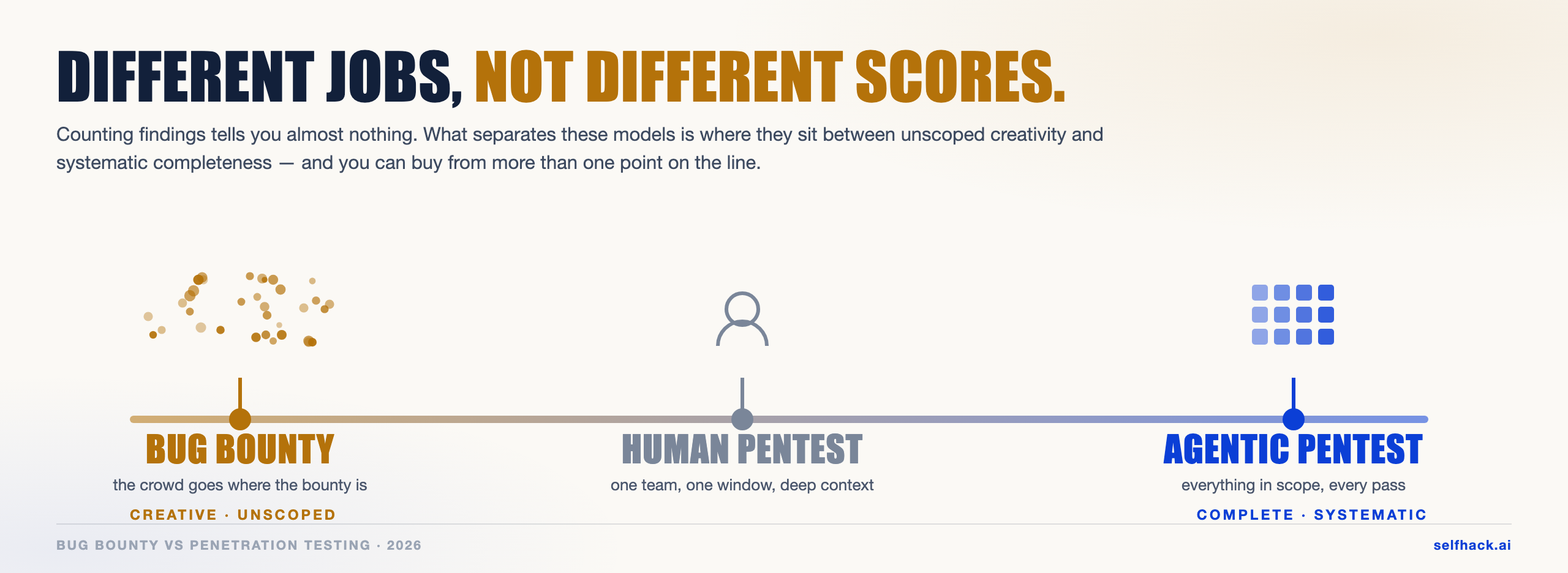
The bug bounty vs penetration testing debate is usually framed as “which one finds more vulnerabilities”. That framing is wrong, and it has been wrong for years. Both find real vulnerabilities. Skilled hunters find things no scoped engagement would have reached, and good testers find things no hunter bothered to look for. Counting findings tells you almost nothing about which model fits your organisation.
Bug bounty vs penetration testing is decided elsewhere.
The questions that actually decide it are duller and far more important. Who validates a finding before it reaches your engineers? Who decides which parts of your estate get looked at? And when someone asks what you tested last quarter, can you answer with a document rather than a shrug?
Here’s the thing: those three questions have completely different answers for each model, and 2026 made the differences impossible to ignore. So this piece walks through what bug bounty platforms are genuinely excellent at, what the AI submission wave changed, and where an agentic pentest is structurally — not rhetorically — different.
So treat bug bounty vs penetration testing as a question about operating models, not scoreboards.
What bug bounty platforms are genuinely great at
Let us be fair before we are analytical, because the crowd model earned its place.
HackerOne reportedly paid around $81 million in researcher bounties across its 2025 fiscal year, up roughly 13% year over year, with a registered researcher community above 300,000 and tens of thousands of valid reports processed. Those are not vanity numbers. They represent real vulnerabilities, found by real people, that would otherwise have sat in production. Bugcrowd built a reputation on hands-on managed triage. Intigriti and YesWeHack anchored strong European communities. Synack built a vetted-researcher model precisely to address quality control.
What the crowd does that nothing else does is bring genuine adversarial diversity. A thousand people with different backgrounds, different obsessions and different tools will try things your scope document never imagined. Someone will chain an obscure feature nobody on your team considers part of the product. Someone will notice that a mobile client behaves differently from the web one. That creativity is not reproducible by a checklist, and in the bug bounty vs penetration testing comparison it is the crowd’s permanent, structural advantage.
Any fair bug bounty vs penetration testing comparison has to start there.
The commercial model is elegant too. You pay for results. No retainer for a week of someone reading your code and finding nothing. For a mature product with a wide public surface, that is a genuinely efficient way to buy security attention, and it is why the model spread as fast as it did.
None of that stopped being true in 2026. What changed is the cost of the part nobody prices: deciding which submissions are real.
What actually changed in 2026
This is the part where the bug bounty vs penetration testing conversation stopped being theoretical, and it is worth stating precisely because the headlines have been sloppier than the facts.
Language models made it trivial to produce a report that looks like a vulnerability report. Plausible prose, confident severity, a patch suggestion. The bottleneck moved from finding things to proving they are real — and proving a report is wrong takes a human roughly as long as proving it is right.
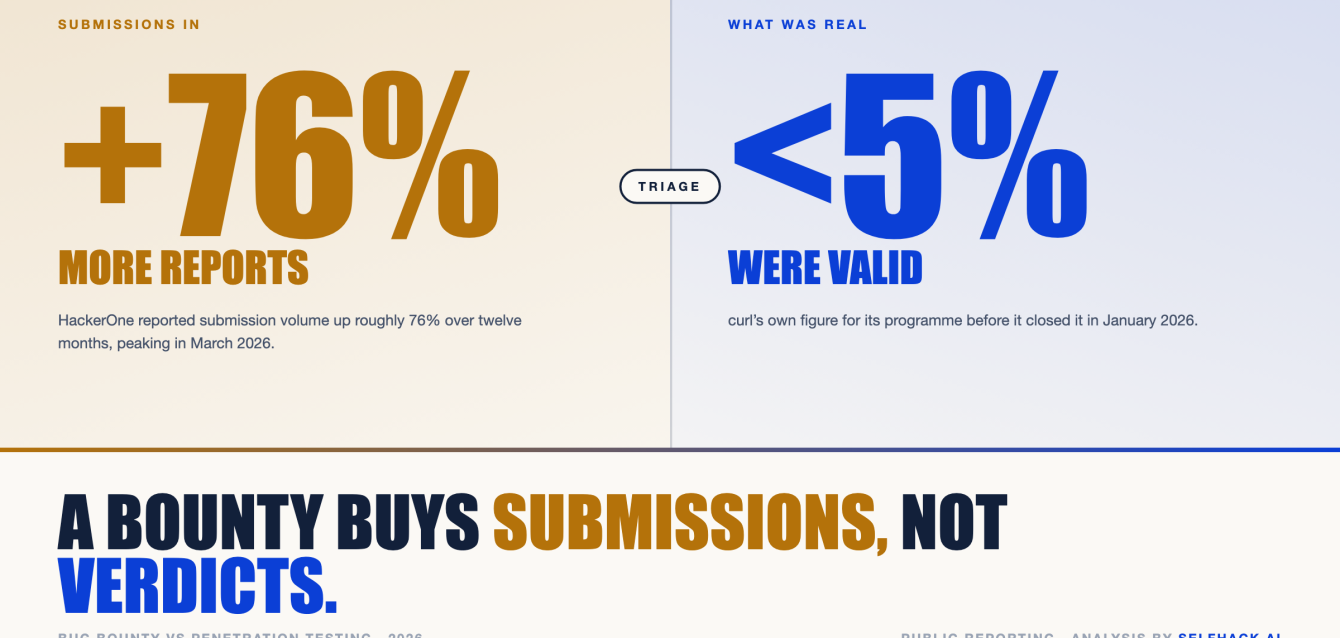
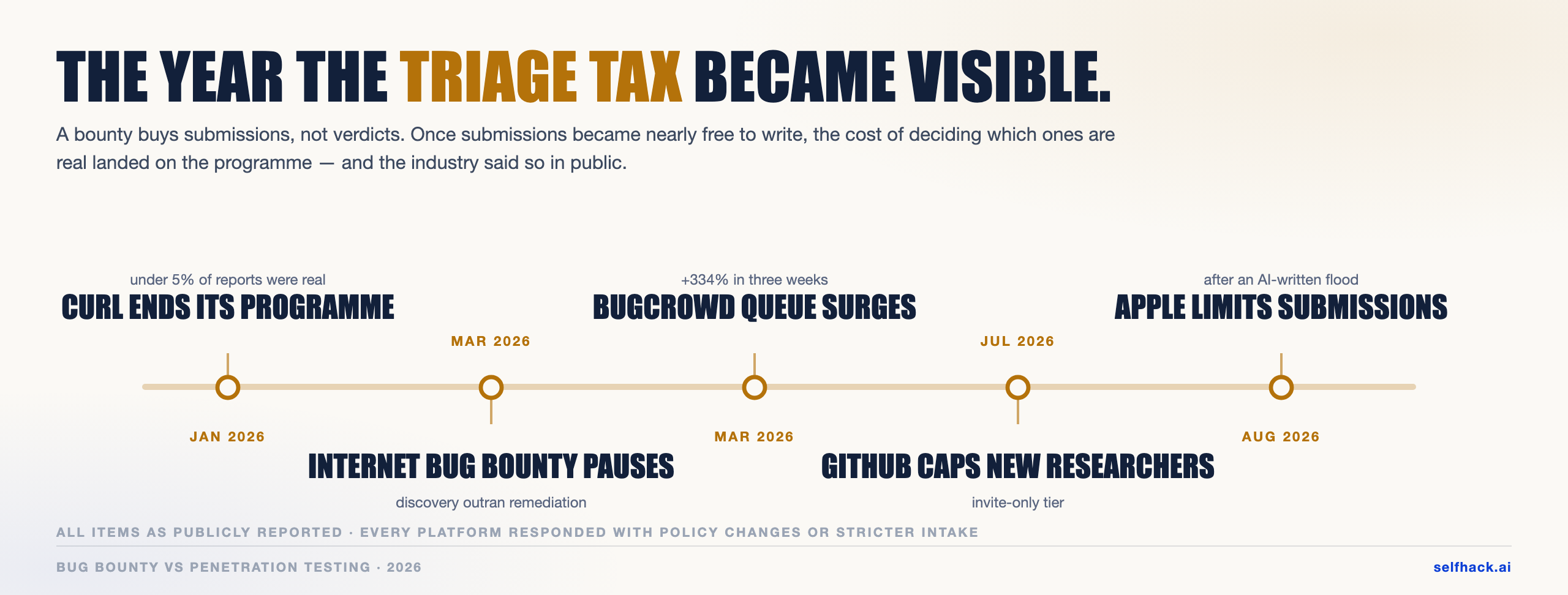
The public record from 2026 is specific. The curl project ended its bug bounty programme in January after its maintainers reported that fewer than 5% of submissions identified a real vulnerability, with twenty reports arriving in the first twenty-one days of 2026 and none of them valid; Daniel Stenberg described the experience as “death by a thousand slops”. In March, the Internet Bug Bounty — the open-source funding programme run on HackerOne, not HackerOne itself — paused new submissions effective 27 March, citing a worsening imbalance between the rate of discovery and open-source maintainers’ capacity to remediate. Node.js subsequently paused its own programme, citing the loss of that funding. HackerOne reported submission volume up roughly 76% over twelve months, peaking in March 2026. Bugcrowd published policy changes aimed squarely at “AI slop” submissions, after describing a triage queue that grew by more than 334% in a three-week stretch. In July, GitHub restructured around an invite-only tier and a four-submission cap for new researchers. In August, Apple limited submissions after a similar flood.
That is a lot of movement in eight months. It reframed bug bounty vs penetration testing for a lot of buyers.
Read that list carefully, because the honest reading is not “bug bounty is dead”. It is the opposite: the platforms and programmes spotted the failure mode early and acted in public, which is more than most of the security industry manages. Bugcrowd wrote about it on its own blog. That is a sector correcting itself, not collapsing.
But the correction reveals the structural property that matters for the bug bounty vs penetration testing decision: a bounty programme buys submissions, not verdicts. When submissions were expensive to produce, that distinction was affordable. Once they became nearly free to produce, it stopped being.
The triage tax: what you are really buying
Every bug bounty programme has a hidden line item nobody puts in the business case. Call it the triage tax.
Nobody puts it in the bug bounty vs penetration testing spreadsheet either.
It is the salaried hours your security engineers spend reading submissions, reproducing claims, arguing severity, closing duplicates and explaining to a researcher why their finding is not a finding. For a busy public programme, this is not a rounding error; it is a permanent job. And it is paid in your scarcest resource — the attention of the people who could otherwise be fixing things.
The 2026 wave simply made the tax visible by multiplying the denominator. If a programme’s valid-report rate falls, the bounty spend can stay flat while the triage cost doubles. curl’s maintainers hit the extreme version: a valid-report rate under 5% means more than nineteen out of twenty reports consumed time and produced nothing. Most commercial programmes are nowhere near that bad, and platforms are actively filtering harder now. But the direction of travel is the point.
Volume went up. Validity did not follow.
Here is what makes this structural rather than temporary. The crowd is incentivised to submit; you are the one who pays to find out whether each submission is real. That asymmetry is inherent to the model. It can be managed — vetted researcher pools, managed triage, submission caps, reputation gates, and every platform is now doing some of this — but it cannot be designed out, because the thing you are buying is a claim that someone else made.
An agentic pentest inverts that asymmetry, and that is the single most important difference in the whole bug bounty vs penetration testing comparison. A finding arrives already proven, because the same system that found it also exploited it and recorded the path. There is no claim to adjudicate. There is a demonstration to read.
Coverage is incentive-shaped, not systematic
The second structural difference has nothing to do with AI, and it was true long before 2026.
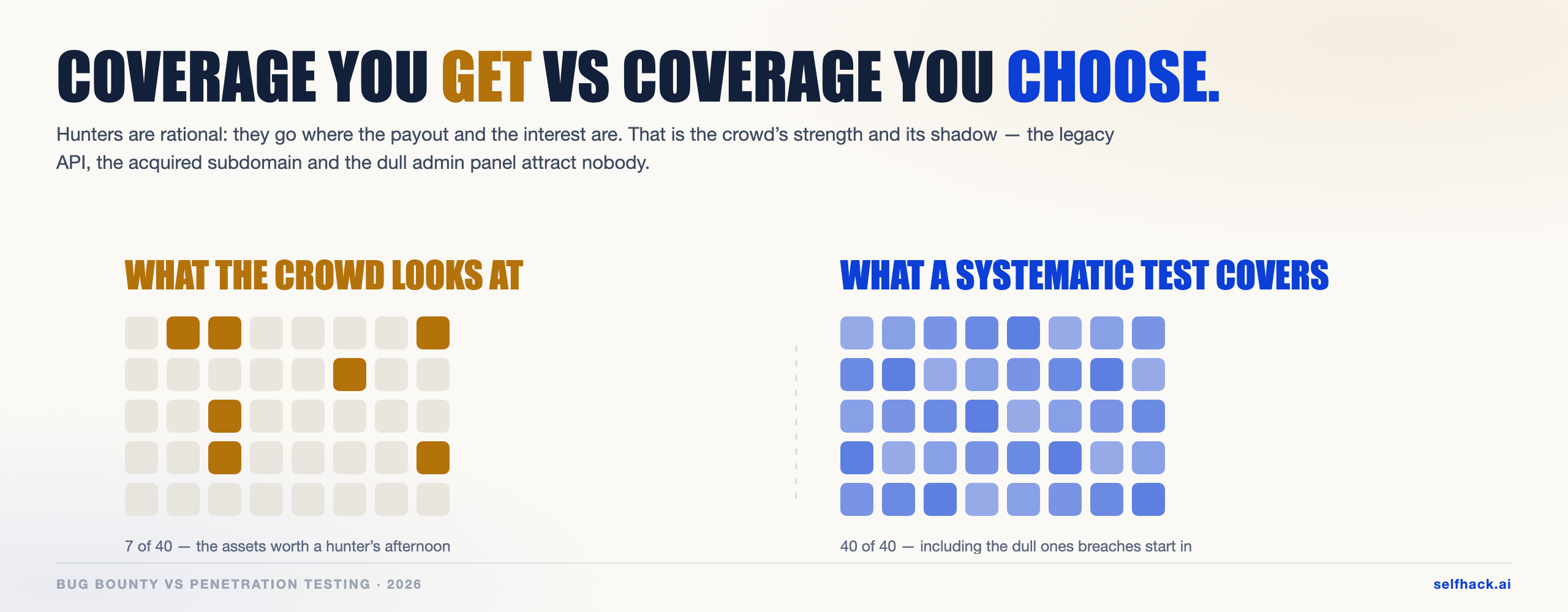
In a bounty programme, you do not choose what gets tested. You post a scope and a reward table, and the crowd allocates its own attention. Hunters are rational: they go where the bounties are highest, where the surface is interesting, and where their particular skill pays. That is a feature — it is why the model surfaces creative findings — but it has a predictable shadow.
This is the quiet half of bug bounty vs penetration testing, and it predates every AI headline.
The shadow is everything boring. The internal admin panel with a dull name. The legacy API that still serves a handful of enterprise customers. The subdomain from an acquisition that nobody has looked at in two years. None of these attract a hunter’s afternoon, because none of them look like a place a big payout lives. They are, of course, exactly where breaches start, which is the whole argument behind our work on external pentest coverage.
Ask any organisation running a mature programme which of its assets got hunter attention last quarter and you will get an honest shrug, because the answer is unknowable. In the bug bounty vs penetration testing trade-off, that unknowability is the price of the crowd’s creativity. A systematic test has the inverse property: less surprise, complete coverage of what you pointed it at.
Coverage is the axis where bug bounty vs penetration testing diverges most sharply.
Neither property is better in the abstract. But only one of them answers “is my forgotten acquisition subdomain exploitable”, and that is a question most CISOs would like answered before someone else answers it for them.
A bounty is not a coverage report
The third difference is the one that ends the discussion for regulated organisations, and it gets surprisingly little airtime.
A bug bounty programme produces a stream of individual findings over time. What it does not produce is a statement of what was tested, by what methodology, over what period, with what result — which is precisely the artefact an auditor, a customer security questionnaire, or a framework like PCI DSS expects. You cannot hand an assessor a bounty dashboard and call it evidence of testing, because it describes what people happened to look at, not what you set out to verify.
Evidence is where bug bounty vs penetration testing stops being a matter of taste.
This is not a criticism of the model; bounties were never designed to be audit evidence. It is simply a scope boundary that a lot of buyers discover late, usually the week an enterprise customer asks for a pentest report. We wrote the whole compliance penetration testing hub around this gap, because it recurs across SOC 2, ISO 27001, HIPAA and DORA in slightly different dialects.
So if your reason for testing includes “we need to show someone”, the bug bounty vs penetration testing question answers itself for that particular need. You need a defined scope, a methodology, findings with severity, remediation and a retest. A bounty gives you none of those as a package, however good the individual findings are.
Where agentic pentest is structurally different
An agentic pentest — an autonomous system that does reconnaissance, forms hypotheses, exploits, chains and reports — is not “a bounty with robots”. It differs on all three axes above, by construction.
Three differences, and none of them is about who is cleverer.
Validation is built in. The system that reports a finding is the system that exploited it. You receive a demonstrated path, not a claim to triage. That removes the triage tax rather than managing it, which is the difference between treating a symptom and removing its cause.
Coverage is chosen, not bid for. You define scope and everything inside it gets tested — the flagship product and the dull admin panel, on the same pass. Nothing is skipped for being unglamorous, because nothing is deciding where to spend its afternoon.
The output is a record. What was tested, when, what was found, how severe it proved, what was fixed, whether the fix held. That is the artefact the audit wanted, produced as a by-product of testing rather than as a separate exercise.
None of that makes the crowd worse. It makes bug bounty vs penetration testing a choice of shape.
There is a fourth difference that only shows up once you have lived with both: cadence. A bounty is always on but unevenly attentive; an annual pentest is intensely attentive but almost never on. Continuous agentic testing is the only one of the three that is both, which is the thread running through our analysis of autonomous cyber attacks — attackers now operate continuously, so a testing model that is attentive twice a year is structurally behind.
Being honest about what agentic testing does not do
An argument that only lists your own advantages is marketing, so here is the other side, plainly.
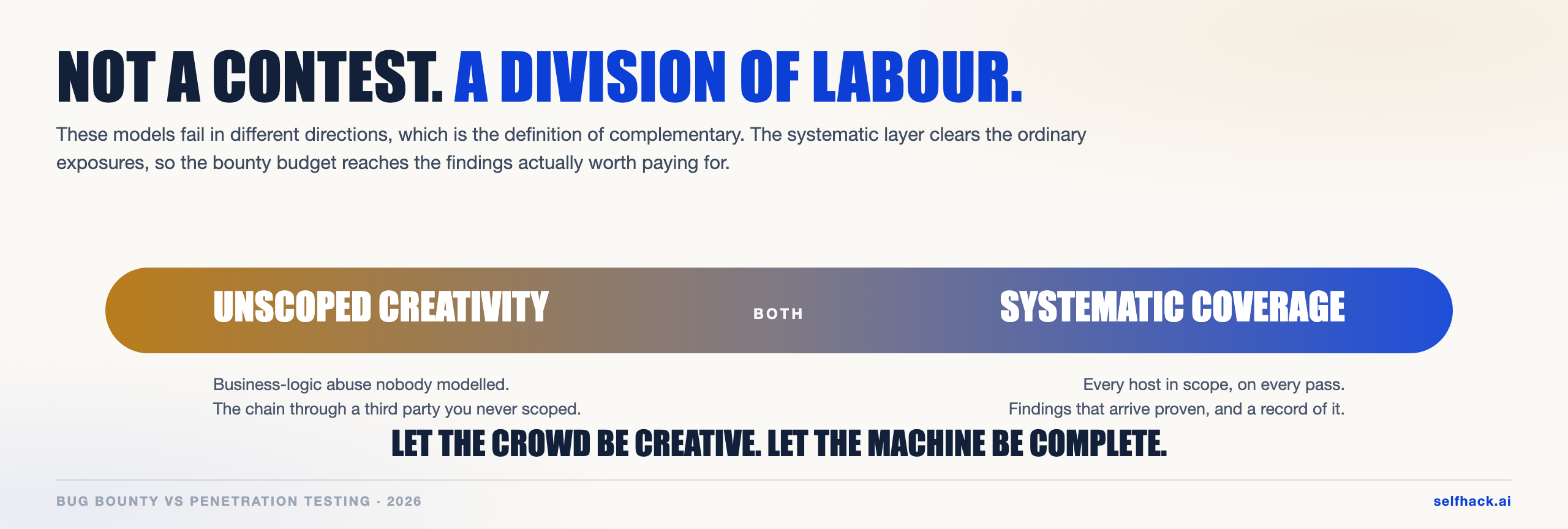
Agentic testing does not replicate crowd creativity. A thousand independent minds with different incentives will occasionally do something genuinely unexpected — a bizarre business-logic abuse, a chain through a third-party integration nobody modelled — and no autonomous system today reliably reproduces that long tail. If your product is mature and widely used, the crowd will find things we would not think to look for. That is a real advantage and it is worth paying for.
That limit is real, and it belongs in any honest bug bounty vs penetration testing assessment.
Agentic testing also does not eliminate human judgement. Someone still has to decide what “critical” means for your business, whether a proven finding matters given your compensating controls, and what to fix first. A demonstrated exploit removes the argument about whether something is real; it does not remove the decision about whether it is important.
And no autonomous system is infallible. It tests what you scope, during the time it runs, with the techniques it has. Something introduced after a run, or outside the boundary you drew, is not covered. This is why we argue for continuous rather than periodic testing, and why we say plainly in our manual pentest analysis that the right answer is usually a combination rather than a replacement.
The truth is, the bug bounty vs penetration testing framing sets up a fight that does not need to happen. These models fail in different directions, which is the standard definition of complementary.
Where each one actually fits
Strip away the positioning and there is a reasonably clean decision rule.
Here is the short version of bug bounty vs penetration testing, as a decision rule.
Run a bug bounty when you have a mature, widely used, public-facing product; you have the engineering capacity to absorb triage; and you want the creative long tail that only a crowd produces. Use a vetted or managed tier if submission quality is a concern — every major platform now offers one, and in 2026 that is no longer an optional upgrade.
Run an agentic pentest when you need to know that your whole scope was actually tested; when you want findings that arrive proven rather than claimed; when you need evidence for an auditor or a customer; or when you ship fast enough that the gap between annual tests is where your real risk lives.
Run a human engagement when you need deep, creative, context-heavy work on a specific target — a new architecture, a novel protocol, a threat model that needs a person to reason about it.
Read as a portfolio, bug bounty vs penetration testing stops being adversarial.
Most organisations that have thought about it properly end up with the systematic base always running, the human engagement periodically, and the bounty on top for the long tail. In that arrangement the bug bounty vs penetration testing question dissolves, because each part is doing the job it is actually good at.
How SelfHack AI runs the systematic half
SelfHack AI is an autonomous penetration testing platform. Our claim is narrow and, we hope, checkable: we do the systematic, validated, evidenced half of that arrangement well, and we do not pretend to be the crowd.
We are one half of a bug bounty vs penetration testing portfolio, not a replacement for it.
Concretely, that means continuous reconnaissance across everything you expose, so the dull subdomain gets the same pass as the flagship app. Exploit-validated findings, so what reaches your engineers is a demonstrated path rather than a submission to adjudicate. Attack-chain analysis, because the interesting question is rarely one vulnerability and usually what three of them do together. And a standing record of scope, findings, fixes and retests, which is the thing an auditor or an enterprise customer actually asks for.
If you already run a bounty, none of this competes with it. It reduces what reaches it: the systematic layer catches the ordinary exposures first, so the crowd’s attention — and your bounty budget — goes to the creative findings that are genuinely worth paying for. That is a better use of both.
We put our positioning against the rest of the field in our AI pentest tools overview, written with the same rule as this page: credit what competitors do well, and be specific about where we differ. If you want to talk about the systematic half, talk to us.
FAQ
Is a bug bounty cheaper than penetration testing?
On the invoice, often yes, because you pay per valid finding. The comparison changes once you include the triage tax — the salaried hours spent validating submissions, including the invalid ones. In the bug bounty vs penetration testing cost question, the honest metric is total cost per validated finding, and that number moved against bounties in 2026 as submission volumes rose.
Did bug bounty platforms stop working in 2026?
No, and it is worth being precise. The Internet Bug Bounty — an open-source funding programme run on HackerOne — paused new submissions in March 2026; HackerOne itself continued operating. Individual programmes such as curl closed, and GitHub and Apple tightened intake. Platforms responded with anti-slop policies and stricter gating. That is a model under pressure and adapting, not a model that failed.
Can a bug bounty satisfy SOC 2 or PCI DSS?
Generally no, on its own. Frameworks expect a defined scope, a methodology, findings with severity, remediation and a retest — presented as a coherent report. A bounty produces individual findings over time, not that package. Most organisations use a pentest for the evidence and a bounty for continuous crowd attention alongside it.
Do AI agents submitting to bounty platforms change the picture?
They are part of what caused the 2026 volume surge, and platforms are adapting intake rules accordingly. The important distinction is not human versus machine but validated versus unvalidated: an autonomous system reporting into your own scope, with the exploit demonstrated, is a very different artefact from an unvalidated submission arriving from outside. Automated hunting bots increase submission volume; agentic testing increases validated coverage.
Should we replace our bug bounty with agentic testing?
Usually not. Replace the part that was never a good fit — using a bounty as your systematic coverage or as audit evidence — and keep the bounty for the creative long tail it genuinely delivers. In practice the bug bounty vs penetration testing decision is a portfolio question, not an either-or.
The verdict
The bug bounty vs penetration testing argument has been miscast for a decade as a contest about who finds more bugs. It is not. It is about who validates, who chooses coverage, and who can prove what happened.
Bug bounty vs penetration testing is a division of labour question.
2026 did not break the crowd model. It exposed the one thing the crowd was never designed to do: tell you, reliably and cheaply, which claims are real. Platforms are fixing what they can fix, and they deserve credit for naming the problem in public rather than quietly absorbing it.
What is left is a straightforward division of labour. Let the crowd do what only a crowd can do. Let a systematic, exploit-validated, continuously running test do the part that needs to be complete rather than creative. Then the question stops being which model wins and becomes which half each one is covering.
Cover both halves and the bug bounty vs penetration testing debate stops mattering.
If the systematic half is the one you are missing, talk to us.
Sources & methodology: 2026 developments are summarised from public reporting and the platforms’ own statements, including Bugcrowd’s policy changes on AI-slop submissions and reporting on the Internet Bug Bounty pause, the curl programme closure, and the GitHub and Apple intake changes. Platform scale figures (researcher counts, payout totals) are as publicly reported and may have moved since. Testing methodology references the OWASP Web Security Testing Guide and NIST SP 800-115. SelfHack AI has no affiliation with any platform named here and was not involved in any of the events described. Only test systems you own or are authorised to test.