

ISO 27001 Penetration Testing: Which Clauses It Supports and How to Run It for the Audit
- ISO 27001 does not command a penetration test in a single line, but ISO 27001 penetration testing supports several parts of it: the risk assessment and treatment process, and the Annex A controls on technical vulnerabilities and security testing in development.
- An ISO auditor cares about the loop as much as the test: risk identified, treated, tested, reviewed. A finding with no remediation trail is an incomplete deliverable.
- Certification runs on a three-year cycle with annual surveillance audits, which makes ISO 27001 penetration testing a recurring commitment, not a one-off before certification.
- The annual model leaves most of the cycle unexamined. Continuous testing keeps the risk picture and the evidence current. That is what SelfHack AI is built to do.
General guidance, not certification advice. The authoritative source is ISO/IEC 27001:2022 and your certification body. Only test systems you own or are authorised to test.
What ISO 27001 penetration testing is
ISO 27001 is the international standard for an information security management system, and it is the one auditors treat as a living system rather than a checklist.
ISO 27001 penetration testing is the testing you run to support certification against ISO/IEC 27001:2022. If you sell internationally, or to enterprises that expect a recognised global standard rather than a regional one, this is often the certificate they ask for. Like SOC 2 and HIPAA, the standard does not contain a single line that says “you must run a penetration test”. Unlike them, it is explicitly built around a management system, which changes how testing fits.
Here is the key difference. ISO 27001 is not a list of controls you either have or lack. It is a system for identifying risks, deciding how to treat them, implementing controls, and continually checking that the whole thing works. ISO 27001 penetration testing earns its place inside that system, feeding the risk process with real findings and demonstrating that technical controls do what the paperwork claims.
So the goal is not to prove a test is mandatory in isolation. It is to show how ISO 27001 penetration testing supports the specific parts of the standard an auditor will examine, and how to run it so it produces evidence the auditor accepts.
The clauses and controls a test supports
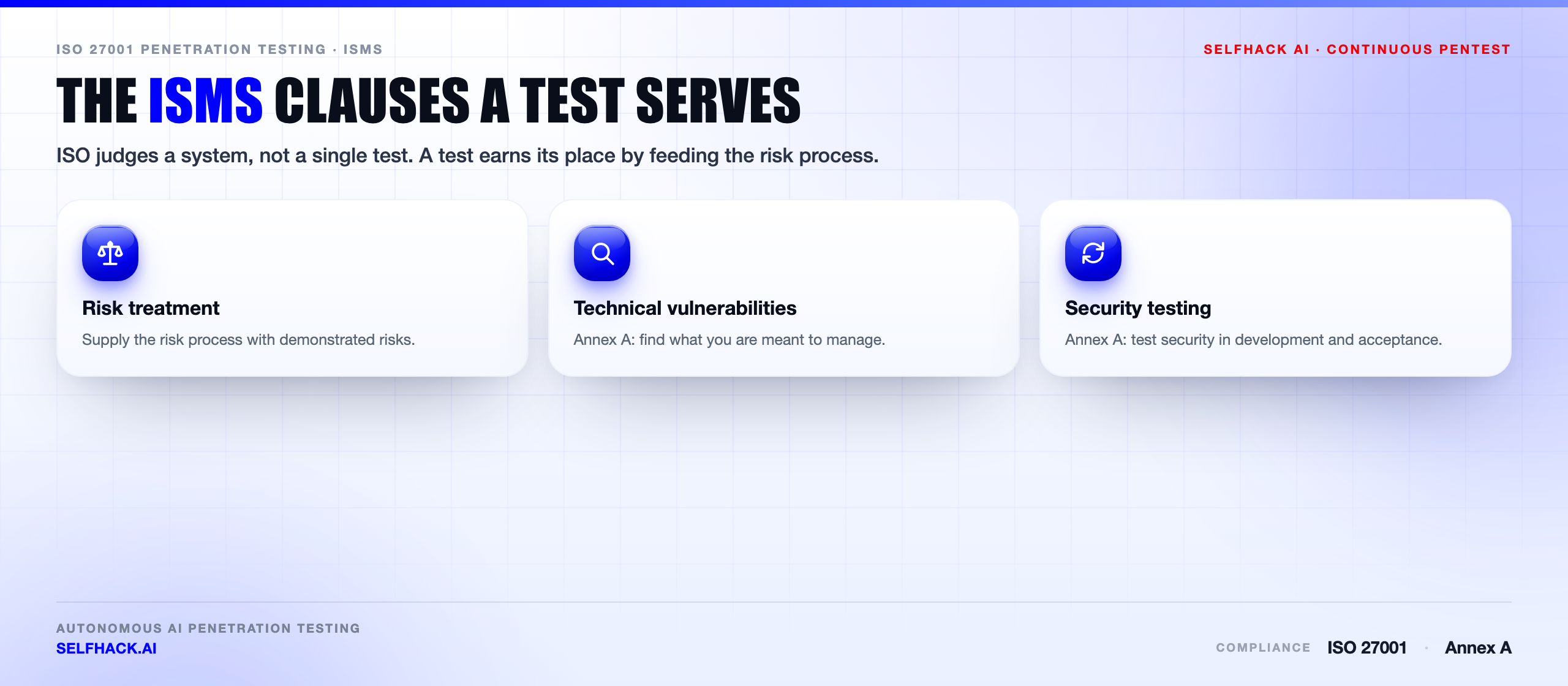
To defend ISO 27001 penetration testing to an auditor, you point at the parts of the standard it serves. Several are relevant.
In the main clauses, the risk assessment and risk treatment process expects you to identify and evaluate information security risks and decide how to handle them. A test supplies that process with demonstrated risks rather than assumed ones. The performance evaluation clauses expect you to monitor and review whether your controls are effective, and a test is direct evidence of that review for technical controls.
In Annex A, the 2022 version includes controls on the management of technical vulnerabilities and on security testing during development and acceptance. ISO 27001 penetration testing is a natural way to evidence both: it is how you find the technical vulnerabilities you are supposed to manage, and how you test security before and after release. An auditor who sees a test tied to these controls has little left to question about whether they operate.
None of these clauses print the word “pentest”. All of them are easier to satisfy convincingly with one. That is the pattern across every framework, and ISO is no exception.
Why the ISMS framing changes everything
The thing that makes ISO 27001 penetration testing different from a PCI test is the word “system” in information security management system.
PCI checks controls. ISO checks whether you run a functioning process for managing security over time. That means an auditor is less interested in a single heroic test and more interested in whether testing is part of how you operate: whether findings flow into your risk register, whether treatment decisions get made and recorded, whether you re-check that treatments worked, and whether management reviews the whole loop.
This is good news and bad news. The bad news is that a one-off test, disconnected from your management system, impresses an ISO auditor less than you would hope. The good news is that ISO 27001 penetration testing done properly — feeding a live risk process — is exactly what the standard wants, and it is also just good security. The framework and the practice point the same way.
It also means cadence and integration matter more than raw test depth. A brilliant annual test that never touches your risk register is weaker evidence, in ISO terms, than a steady stream of testing that visibly drives treatment decisions.
How testing feeds risk assessment and treatment
The risk process is the beating heart of ISO 27001, and ISO 27001 penetration testing is one of the best inputs it can have.
A risk assessment built on workshops and assumptions tends to be neat and wrong. People rate risks by how worried they feel, not by what an attacker can actually do. A test corrects that. When a finding proves that a particular weakness leads to a real compromise, the risk it represents stops being a guess and becomes a documented fact with a demonstrated impact.
Treatment is the decision about what to do with each risk: fix it, mitigate it, accept it, or transfer it. ISO 27001 penetration testing sharpens those decisions by showing the true severity. A risk that looked minor on the register but turns out to chain into full data access gets re-prioritised. A risk that looked severe but proves unreachable can be accepted with confidence. The test turns the treatment plan from opinion into evidence.
Then the loop closes: after treatment, you retest to confirm the risk is actually reduced, and you feed that result back into the register. An auditor following your ISMS wants to see exactly this trail, and ISO 27001 penetration testing is what produces it.
The Statement of Applicability and your scope
ISO scope runs through two documents: the ISMS scope itself and the Statement of Applicability, and both shape ISO 27001 penetration testing.
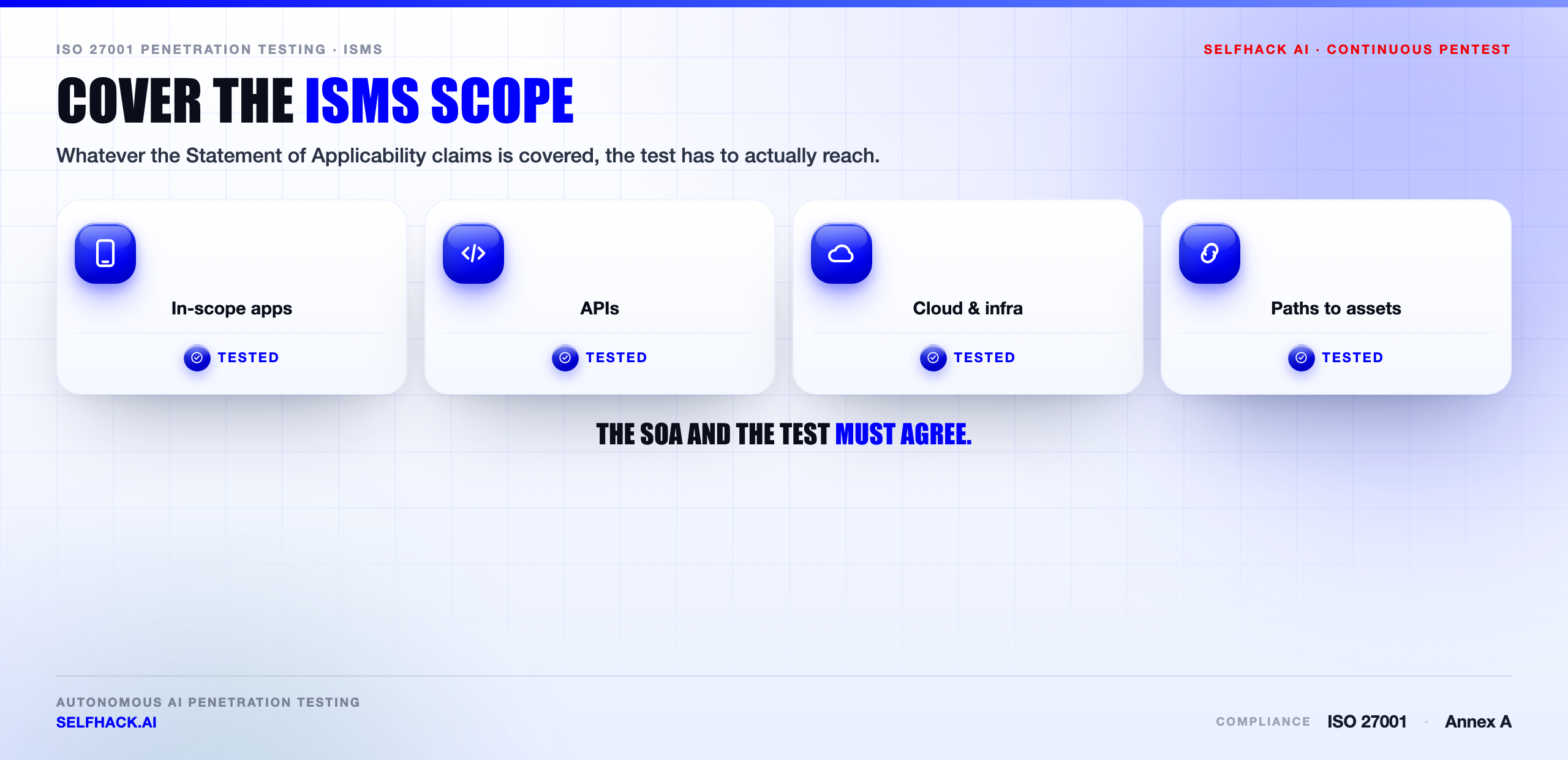
The ISMS scope defines which parts of your organisation the management system covers. The Statement of Applicability, or SoA, records which Annex A controls apply and why. Together they tell you what your ISO 27001 penetration testing has to reach: the systems inside the ISMS scope, and specifically the ones the applicable technical controls depend on.
The trap is a scope drawn narrow for the certificate but wide in reality. If your SoA claims the technical vulnerability and secure-development controls apply, your testing has to actually exercise the systems those controls protect — not a convenient subset. An auditor cross-references the SoA against your evidence, and a test that skips systems the SoA covers is a visible gap.
Before you finalise scope, enumerate what you genuinely run. Our free security checks guide helps you find the systems — forgotten subdomains, exposed interfaces — that an honest ISMS scope and a defensible ISO 27001 penetration testing plan both have to account for.
What an ISO 27001 penetration test should cover
A good ISO 27001 penetration testing engagement covers the systems inside your ISMS scope the way an attacker would approach them, not the way an org chart lists them.
That means the external-facing applications and infrastructure, the APIs behind them, the authentication and authorisation logic, the cloud configuration, and the internal paths an attacker would use to move toward your most sensitive information assets. If the SoA says a control applies to a system, that system should be reachable by the test.
As with every framework, the value is in following the chain to the asset. ISO 27001 penetration testing that proves “this weakness leads to this information asset” produces exactly the risk-with-impact the risk process needs. A generic vulnerability list, disconnected from impact, gives the risk register far less to work with and gives the auditor far less to trust.
What the auditor actually wants to see
An ISO auditor reads for the system, not the heroics. ISO 27001 penetration testing evidence has to show more than a good test.
They want to see the test connected to your risk process: findings that appear in the risk register, treatment decisions recorded against them, and retests confirming the treatments worked. They want to see a defined methodology, so the test was systematic. They want to see that testing recurs and that management reviews the results. In short, they want proof that ISO 27001 penetration testing is part of how you operate, not a document you produced once to wave at the certificate.
This is why a disconnected annual report underperforms in an ISO audit even when the test itself was excellent. The finding is only half the evidence. The trail from finding to treatment to retest to review is the other half, and it is the half the ISMS is built around.
Common findings in an ISO 27001 penetration test
The weaknesses ISO 27001 penetration testing surfaces are rarely surprising. They are the ordinary ones, found in the systems the SoA said were covered.
Broken authorisation is the usual headline. The login works. The per-object permission does not. One account reaches another’s data.
Over-privileged access comes next. A service account with far more reach than its job needs. A cloud role that unlocks more than one system. A key that travels too far.
Then the forgotten surface. An old subdomain still serving code. An admin panel reachable from the internet. A secret left in a public build.
None of these are exotic. All of them fail an ISO audit when they sit inside the ISMS scope, because they show the technical controls the SoA claims are not actually working. ISO 27001 penetration testing that reaches the whole scope finds them. A narrow test never does.
What ISO 27001 penetration testing will not do
Being honest about the limits keeps the rest credible.
A test does not certify you. Certification comes from an accredited body assessing your whole ISMS. ISO 27001 penetration testing is one input to that, not the verdict.
A test does not maintain the management system either. The ISMS is policies, risk process, reviews and controls. Testing evidences part of it. It does not run it for you.
And a test fixes nothing by existing. The finding is a diagnosis. The treatment is the cure. The retest is the proof. An auditor reads for that loop, and ISO 27001 penetration testing that stops at a findings list leaves the most important part unwritten.
None of this argues against testing. It argues for placing it correctly: the technical evidence inside a broader system, most useful when it runs continuously and feeds a risk register that stays honest.
The certification cycle and cadence
ISO 27001 certification is not a one-time event. It runs on a three-year cycle: an initial certification audit, then surveillance audits in the intervening years, then recertification. That structure alone makes ISO 27001 penetration testing a recurring commitment.
The standard does not set a fixed testing frequency — it ties it to your risk process and change rate. Annual is the common baseline, aligned with the surveillance audits. But the same logic as every other framework applies: if you ship regularly, a once-a-year test describes a system that changed many times since, and the risk register it feeds slowly drifts out of date between audits.
The pragmatic reading: at least annual to align with surveillance, testing after significant change, and continuous testing underneath so the risk register reflects reality rather than last year’s snapshot. An ISMS is supposed to be alive; ISO 27001 penetration testing that runs once a year keeps it only intermittently awake.
The evidence gap the annual model leaves
Picture the ISO 27001 penetration testing timeline most certified organisations run. Test before the audit. Update the risk register. Pass. Then a year of change before the next test.
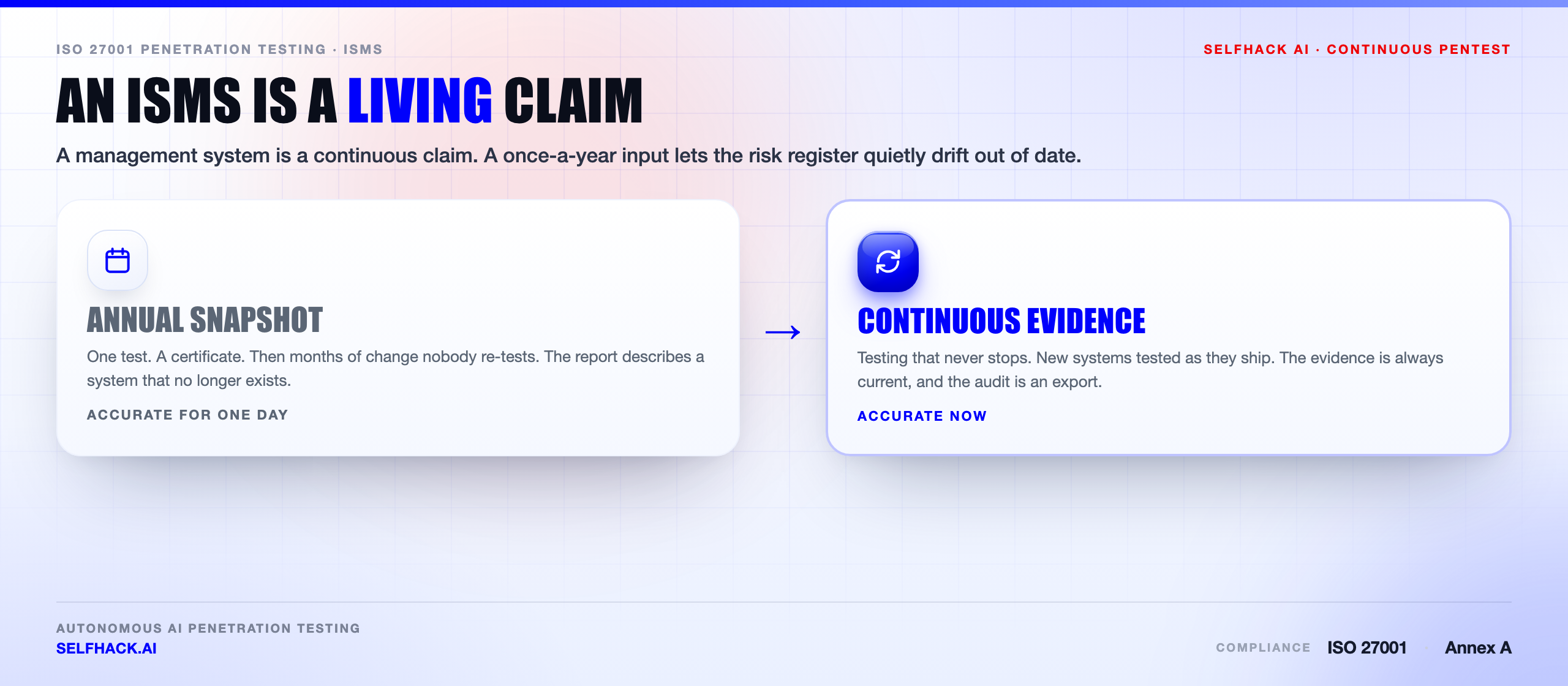
During that year the ISMS is meant to stay current, but the technical evidence underneath it ages. New systems enter scope untested. Treatments applied months ago are never re-verified. The risk register, which the standard wants to be accurate, quietly describes a system that has moved on. At the next surveillance audit, the gap between the register and reality is exactly what a sharp auditor probes.
The truth is, this is a cadence problem, not a test-quality problem. The annual test may have been thorough. But an ISMS is a continuous claim, and continuous claims need continuous evidence. You cannot keep a management system genuinely current with a once-a-year input.
How SelfHack AI keeps the ISMS evidence live
SelfHack AI is an autonomous penetration testing platform, and for ISO 27001 penetration testing it feeds the one thing the standard cares about most: a risk process that stays current.
Because it tests continuously, findings flow into your risk picture as they arise rather than once a year. A new system entering ISMS scope gets tested when it appears. A treatment applied last month can be re-verified automatically rather than waiting for the next annual engagement. The “monitor and review the effectiveness of controls” expectation stops being a periodic scramble and becomes a live property of the system.
It also produces the trail an ISO auditor follows: what was tested, what was found, how severe it actually proved, and whether the fix held — as standing evidence rather than a stale document. When the surveillance auditor asks how your ISMS keeps its technical risk assessment accurate between audits, ISO 27001 penetration testing that runs continuously is a far stronger answer than a report from last spring.
This does not replace your certification body or a skilled human engagement — keep those for judgement and depth. It replaces the gap between annual tests, which is where an ISMS quietly drifts out of date. See how the platform compares in our AI pentest tools overview, and how ISO fits with the other frameworks in the compliance penetration testing hub.
Related compliance testing
ISO 27001 rarely arrives alone, and the same testing capability serves the frameworks that tend to accompany it.
Certifying to ISO once and reusing the testing for the rest is the efficient path. US customers often ask for a SOC 2 report alongside ISO, so SOC 2 penetration testing covers overlapping ground. If you take card payments, PCI DSS penetration testing applies to that flow. If you handle health data, HIPAA penetration testing applies. One testing programme can feed several audits, because underneath they ask the same question.
FAQ
Does ISO 27001 require penetration testing?
Not in a single explicit line. But ISO 27001 penetration testing supports the risk assessment and treatment process and the Annex A controls on technical vulnerabilities and security testing, and auditors routinely expect it as evidence those controls operate. In practice, certification without any technical testing is difficult to defend. Confirm specifics with your certification body.
How often should we run ISO 27001 penetration testing?
The standard ties frequency to your risk and change rate rather than fixing a number. Annual, aligned with surveillance audits, is the common baseline, with testing after significant change. Because an ISMS is meant to stay current, continuous testing is increasingly the answer for organisations that ship or change regularly.
Does the test need to be done by an external party?
ISO 27001 does not strictly mandate an external tester, but independence strengthens the evidence and many organisations use one. What the auditor examines is a defined methodology, real findings connected to the risk process, and a treatment-and-retest trail — produced by something credible, whether external, internal, or a platform.
How does penetration testing relate to the internal ISMS audit?
They are different. The internal audit checks whether your management system conforms to the standard and your own policies. ISO 27001 penetration testing checks whether your technical controls actually resist attack. The pentest feeds the risk process that the internal audit then reviews; they are complementary, not substitutes.
Can one test cover ISO 27001 and SOC 2 together?
Often yes. Both want evidence that you find, evaluate, treat and re-verify security weaknesses. A test scoped to cover both can supply evidence to each, with the report and framing adapted per audience. The testing is shared; only the presentation differs. See the compliance hub for the overlaps.
The verdict
ISO 27001 penetration testing is not a box to tick before the certificate. It is an input to a living management system, and the auditor judges it by how well it feeds that system, not by how impressive a single test looks.
The mistake is running one disconnected annual test and hoping the ISMS looks alive at the next surveillance audit. A management system is a continuous claim, and continuous claims need continuous evidence. Testing that keeps your risk register genuinely current is what an ISMS was always supposed to have.
If you would rather keep your ISMS evidence live than defend a drifting risk register once a year, talk to us.
Sources & methodology: testing methodology references the OWASP Web Security Testing Guide and NIST SP 800-115. Clause and control references are summarised from ISO/IEC 27001:2022 and its Annex A; the authoritative source is the current standard text and your certification body. General guidance, not certification advice. Only test systems you own or are authorised to test.