
HIPAA Penetration Testing: How to Satisfy the Security Rule When It Never Says “Pentest”
- HIPAA never uses the words “penetration test”. It requires a risk analysis and a periodic technical evaluation of the safeguards protecting electronic protected health information — and HIPAA penetration testing is how mature organisations satisfy both.
- Because the rule is intent-based rather than prescriptive, scope is yours to justify. That freedom is a trap: too narrow and it is worthless, too vague and it fails scrutiny.
- You cannot honestly claim to have evaluated technical safeguards against attack without, at some point, attacking them. That is the whole argument for HIPAA penetration testing.
- The annual model leaves the rest of the year unevaluated in a sector attackers target relentlessly. Continuous testing keeps the evaluation current. That is what SelfHack AI is built to do.
General guidance, not legal or compliance advice. The authoritative source is the HIPAA Security Rule (45 CFR Part 164) and your compliance counsel. Only test systems you own or are authorised to test.
What HIPAA penetration testing actually is
HIPAA is where the wording gets slippery, and where a lot of healthcare vendors quietly get caught out.
HIPAA penetration testing is the testing you run to satisfy the HIPAA Security Rule, the part of the regulation that governs how electronic protected health information — ePHI — must be protected. If you are a covered entity or a business associate handling health data in the United States, the Security Rule applies to you. And unlike PCI DSS, it never once says “penetration test”.
That silence is the problem. Because the rule does not name the test, some organisations conclude HIPAA penetration testing is not required and skip it. Then a breach happens, the Office for Civil Rights investigates, and the question becomes: how exactly did you evaluate whether your safeguards actually worked? “We wrote a policy” is not a satisfying answer to that question. “We tested them, here is what we found and fixed” is.
So HIPAA penetration testing is not required by name. It is required by consequence. The rule demands that you analyse risk and evaluate safeguards, and testing is how a serious organisation does both in a way that survives scrutiny.
Where the Security Rule implies a test
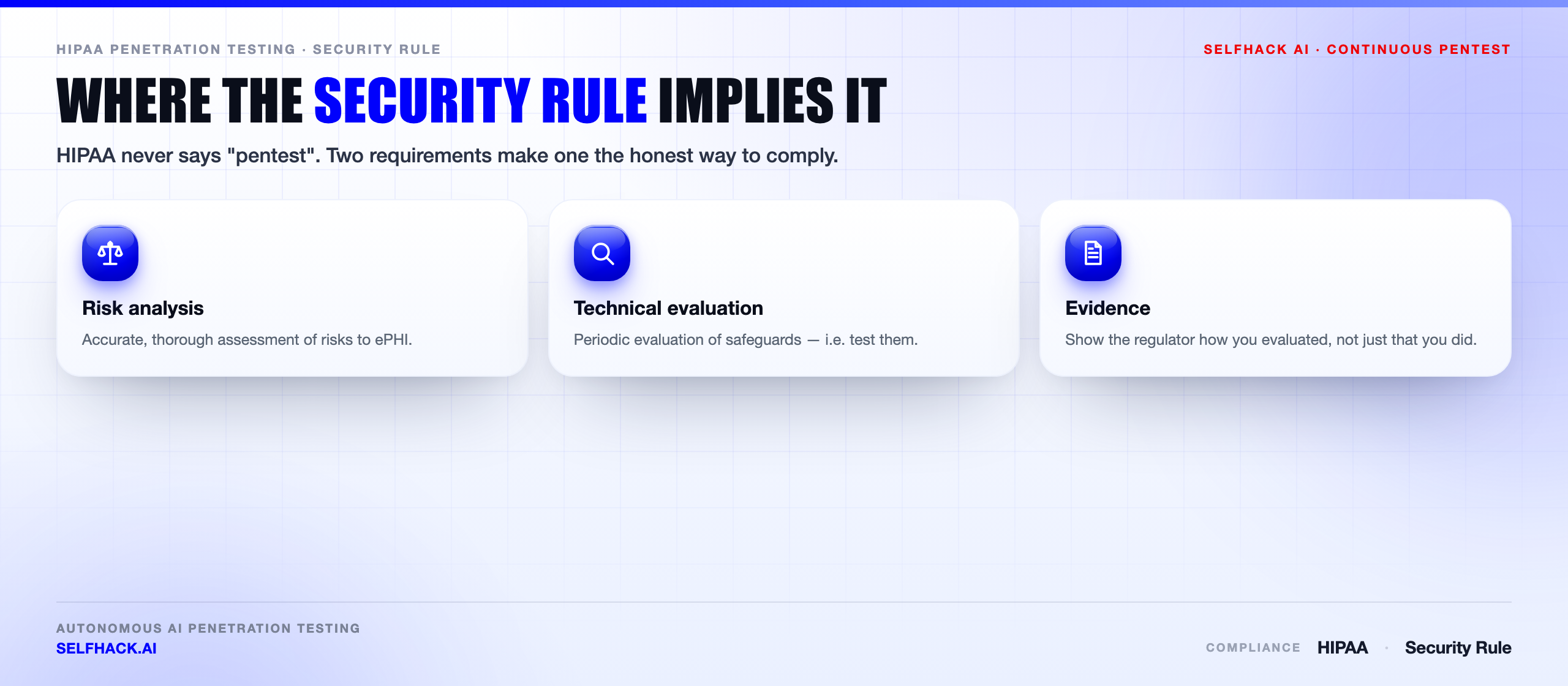
To defend HIPAA penetration testing, you need to point at the parts of the rule it satisfies. There are two that matter.
The first is the risk analysis requirement. The Security Rule requires you to conduct an accurate and thorough assessment of the potential risks and vulnerabilities to the confidentiality, integrity and availability of ePHI. A risk analysis built only on questionnaires and assumptions is neither accurate nor thorough. HIPAA penetration testing feeds it with real, demonstrated vulnerabilities rather than theoretical ones.
The second is the evaluation requirement. The rule requires periodic technical and non-technical evaluation of how well your security measures meet the rule. “Technical evaluation” is about as close as a regulation gets to saying “test it” without printing the word. You cannot technically evaluate whether a safeguard resists attack without attempting the attack, and that attempt is HIPAA penetration testing.
Neither clause says “pentest”. Both are far easier to satisfy convincingly when you have one. That gap between what the rule says and what it clearly intends is the whole subject of this page.
Risk analysis vs evaluation, and where testing fits both
These two requirements get muddled constantly, and the difference matters for how you position HIPAA penetration testing.
The risk analysis is the map. It identifies where ePHI lives, what could go wrong, and how likely and how damaging each risk is. It is meant to be thorough and ongoing, not a one-time document filed and forgotten. A test contributes to the risk analysis by replacing guesses with facts: instead of “this system might be vulnerable to injection”, you have “this system is vulnerable to injection, here is the proof, here is the impact on ePHI”.
The evaluation is the check. It asks whether the safeguards you put in place because of the risk analysis are actually working. This is where HIPAA penetration testing sits most naturally — it is a direct, evidence-producing evaluation of technical safeguards under real attack conditions, rather than a paper review of whether a control exists.
Run together, they form a loop: analyse risk, apply safeguards, test whether the safeguards hold, feed the results back into the risk analysis. HIPAA penetration testing is the step in that loop that keeps the other steps honest, because it is the only one that involves an adversary actually trying.
Why “addressable” does not mean “optional”
HIPAA splits its implementation specifications into “required” and “addressable”, and the word addressable causes more compliance failures than almost anything else in the rule.
Addressable does not mean optional. It means you must assess whether the specification is reasonable and appropriate for your environment, implement it if it is, and if it is not, document why and put an equivalent alternative in place. Choosing to do nothing, without that reasoning and alternative, is not compliance — it is a finding waiting to be discovered.
This matters for HIPAA penetration testing because the honest way to know whether a safeguard is reasonable and effective is to test it. A team that treats addressable specifications as “skip if inconvenient” tends to have exactly the gaps a test exposes. Testing turns the addressable-versus-required debate from a paperwork exercise into an evidence-based decision about what actually protects ePHI.
Scoping HIPAA penetration testing around ePHI
Because HIPAA is intent-based, scope is yours to define — and that freedom is where HIPAA penetration testing most often goes wrong.
Start from the data. Map every place ePHI is created, received, maintained or transmitted: the patient portal, the clinical application, the databases, the backups, the integrations with labs or payers, the messaging systems, the cloud storage. That map is your scope. Anything that touches ePHI, or can reach something that does, belongs in it.
The trap is scoping to the budget instead of the data. A test that covers only the flagship application, while the real ePHI flows through an old integration nobody wanted to include, produces a clean report and a false sense of safety. When the breach lands in the excluded integration, the narrow scope becomes evidence of what you chose not to examine.
Before you commit to a boundary, enumerate what you actually run. Our free security checks guide helps you find the forgotten systems — the old subdomain, the exposed interface — that a defensible HIPAA penetration testing scope has to account for.
What a HIPAA penetration test should cover
A useful HIPAA penetration testing engagement mirrors how a real attacker would go after health data, not how an auditor’s checklist reads.
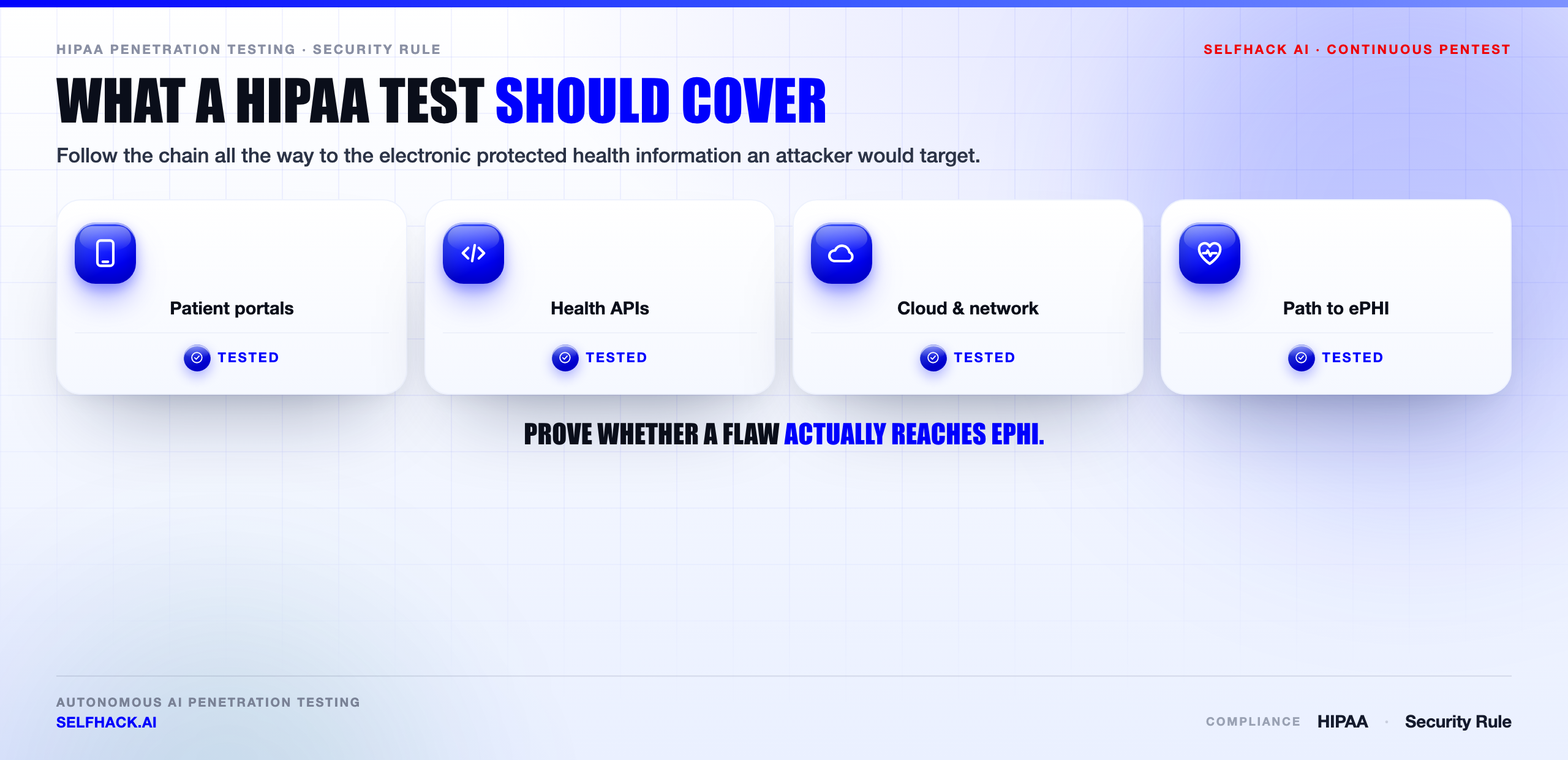
It covers the web applications and patient portals where ePHI is accessed, including their authentication and, critically, their authorisation — whether one patient or one clinic can reach another’s records. It covers the APIs behind those applications, because health systems are increasingly API-driven and cross-account access flaws are common. It covers the cloud and network infrastructure, and the internal paths an attacker would use to move from a foothold toward the databases where ePHI actually sits.
Importantly, it follows the chain to the data. The point of HIPAA penetration testing is not to list vulnerabilities in the abstract; it is to demonstrate whether a given weakness actually exposes ePHI. A finding that proves “this flaw leads to protected health records” carries the weight in a risk analysis that a generic vulnerability listing never will.
Common findings in healthcare environments
Healthcare has its own recurring weaknesses, and HIPAA penetration testing surfaces the same ones again and again.
Broken authorisation between patients or between clinics is the headline. A portal that authenticates users correctly but checks per-record permissions poorly lets one account read another’s health records — a direct confidentiality breach of ePHI. Interoperability makes this worse: the more systems exchange health data through APIs, the more places a cross-account flaw can hide.
Then the familiar set, amplified by the sector’s constraints. Legacy systems that cannot be patched because they run critical clinical functions. Medical devices and integrations with weak or default credentials. Over-privileged service accounts bridging clinical and administrative networks. Data left unencrypted where the rule expects protection. HIPAA penetration testing that reaches beyond the flagship app finds these; a narrow test never sees them, because they live in the parts of the estate nobody wanted in scope.
The business-associate problem most vendors miss
If you build software for healthcare, this section is the one that catches people, so read it twice.
A business associate — any vendor that handles ePHI on behalf of a covered entity — carries its own obligations under the Security Rule. You do not inherit your customer’s compliance, and you cannot point at their controls to cover your gaps. Your systems, your safeguards, your evaluation. HIPAA penetration testing of your own environment is how you demonstrate that the data your customers trusted you with is actually protected on your side of the line.
This matters commercially, not just legally. Health systems increasingly send security questionnaires before they sign, and “when did you last test, and how often” is a standard question. A vendor who can answer “continuously” moves through procurement faster than one who answers “last year, once”. HIPAA penetration testing has quietly become a sales asset, not just a compliance cost, for anyone selling into healthcare.
The trap is assuming that because your customer is the covered entity, the testing burden is theirs. It is not. If you touch ePHI, you own the evaluation of your own safeguards, and a breach on your side is your finding to explain.
What HIPAA penetration testing will not do
Being honest about the limits keeps the rest credible.
A test does not make you HIPAA compliant on its own. The Security Rule is broad — administrative, physical and technical safeguards, policies, training, business-associate agreements. HIPAA penetration testing evidences the technical evaluation piece powerfully, but it is one part of a larger programme. A perfect test alongside untrained staff and missing agreements still leaves you exposed.
It also does not certify you as breach-proof. A test describes a defined scope during a defined effort. New systems, new integrations and newly disclosed vulnerabilities fall outside any single test the moment they appear. This is exactly why cadence matters more than the depth of any one engagement, and why continuous testing has become the sensible default in a sector under constant attack.
And it does not fix anything by existing. The finding is a diagnosis, the remediation is the cure, and the retest is the proof. HIPAA penetration testing that stops at a list of problems, with no loop to close them, documents your weaknesses without reducing them — which is the worst of both worlds if that document is ever discovered.
How often to test, and the sector reality
HIPAA does not set a fixed cadence. It says periodic, and ties evaluation frequency to changes in your environment and the threat picture. So the honest question is not “what does the rule demand” but “what does the threat demand”.
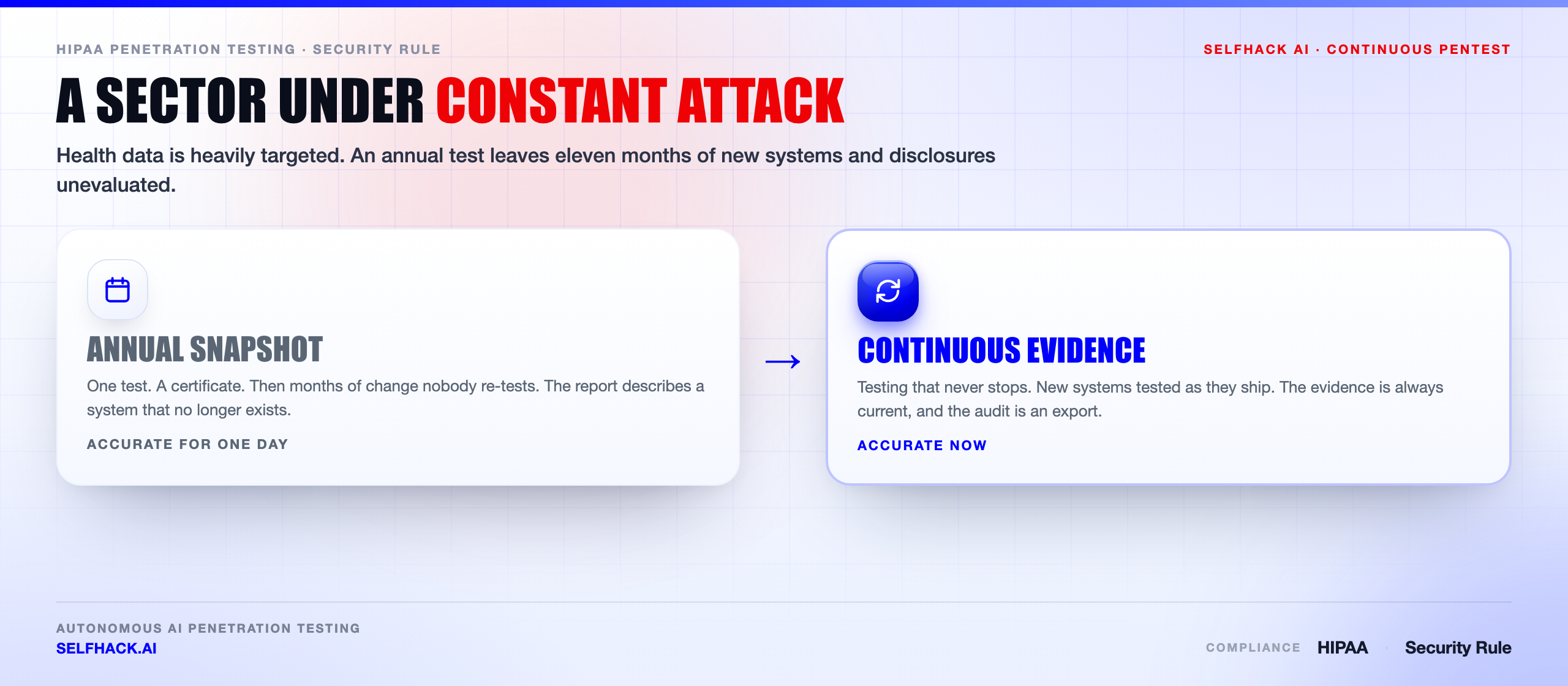
And the threat in healthcare is relentless. Health data is among the most valuable to attackers and the sector is targeted constantly, precisely because so much of it runs on systems that are hard to patch and hard to replace. An annual HIPAA penetration testing exercise in that environment leaves eleven months during which new systems, new integrations and newly disclosed vulnerabilities go unevaluated.
The pragmatic reading: annual as an absolute floor, testing after any significant change to systems handling ePHI, and continuous testing underneath for any organisation that ships or integrates regularly. In a sector this heavily targeted, the gap between tests is not a paperwork detail. It is the window attackers actually use.
The evidence gap the annual model leaves
Consider the HIPAA penetration testing timeline most healthcare organisations run. Test once. Remediate. File the results with the risk analysis. Then a year of change with no further evaluation.
During that year, a new telehealth feature ships, a new lab integration goes live, a vendor updates a system, a fresh vulnerability is disclosed in a library you depend on. None of it is evaluated until the next annual test. The risk analysis the rule wants to be “accurate and thorough” is quietly describing a system that no longer exists.
The truth is, this is not a failure of the test. The annual engagement may have been excellent. It is a failure of cadence, and in a sector attacked as heavily as healthcare, cadence is the whole game. You do not fix a cadence problem by testing harder once a year. You fix it by testing continuously.
How SelfHack AI keeps the evaluation current
SelfHack AI is an autonomous penetration testing platform, and for HIPAA penetration testing it addresses the exact weakness of the annual model: it keeps the technical evaluation current instead of frozen on the test date.
Because it tests continuously, the evaluation of your safeguards describes now, not last year. A new integration handling ePHI gets tested as it ships. A newly disclosed vulnerability in a dependency gets caught when it appears, not at the next annual review. The “periodic technical evaluation” the Security Rule asks for becomes genuinely ongoing rather than an annual snapshot.
It also produces the evidence a risk analysis needs, as a standing record: what was tested, what was found, what reached ePHI, what was fixed, and when. If the Office for Civil Rights ever asks how you evaluated your technical safeguards, the answer is a live history rather than a stale document. And it follows the chain to the data, so the risk analysis reflects real exposure of ePHI rather than a list of abstract weaknesses.
This does not replace your compliance counsel or a skilled human engagement — keep those for judgement and depth. It replaces the eleven-month gap the annual model leaves in a sector that cannot afford it. See how the platform compares in our AI pentest tools overview, and how HIPAA fits alongside the other frameworks in the compliance penetration testing hub.
Related compliance testing
Healthcare organisations rarely face HIPAA alone. The same testing capability serves the frameworks that tend to arrive with it.
If you sell software to health systems, they will likely ask for a SOC 2 report, so SOC 2 penetration testing applies. If you take payments for care, PCI DSS penetration testing applies to that flow. If you operate internationally, ISO 27001 penetration testing covers similar ground for a global audience. One programme, several obligations.
FAQ
Does HIPAA require penetration testing?
Not by name. The HIPAA Security Rule requires a risk analysis and a periodic technical evaluation of safeguards for ePHI, and HIPAA penetration testing is the standard, defensible way to satisfy both. Regulators and investigators increasingly expect testing as evidence that technical safeguards were genuinely evaluated, not merely documented. Confirm your specifics with compliance counsel.
How often should we run HIPAA penetration testing?
HIPAA says “periodic” rather than setting a number, tying frequency to changes and risk. Annual is the common floor, with testing after significant changes to systems handling ePHI. Given how heavily healthcare is targeted, continuous testing is increasingly the sensible answer for any organisation that ships or integrates regularly.
Who needs HIPAA penetration testing — covered entities, business associates, or both?
Both. The Security Rule applies to covered entities and to business associates that create, receive, maintain or transmit ePHI on their behalf. If you are a vendor handling health data for a provider or payer, the obligation to evaluate your safeguards — and the practical need for HIPAA penetration testing — applies to you too.
What is the difference between a HIPAA risk assessment and a penetration test?
A risk assessment is the broad analysis of where ePHI is at risk and how much. HIPAA penetration testing is a focused, hands-on evaluation that proves which technical weaknesses are actually exploitable and whether they reach ePHI. The test does not replace the risk assessment; it feeds it with evidence, turning assumptions into demonstrated facts.
Will a vulnerability scan satisfy HIPAA?
A scan helps but rarely suffices on its own. It lists potential weaknesses without proving impact on ePHI, and the Security Rule’s evaluation intent is about whether safeguards actually resist attack. HIPAA penetration testing demonstrates real exploitability and reaches conclusions a scan cannot, which is why mature programmes use both.
The verdict
HIPAA penetration testing is required by consequence, not by name. The Security Rule demands that you analyse risk and evaluate whether your safeguards actually protect ePHI, and there is no honest way to do the second without testing.
The mistake is treating the test as an annual box to tick in a sector where the threat never pauses. A once-a-year evaluation describes a system that changed the week after. Continuous testing keeps the evaluation — and the risk analysis it feeds — genuinely current, which is what “accurate and thorough” was always meant to mean.
If you would rather evaluate your safeguards continuously than defend a stale annual snapshot to a regulator, talk to us.
Sources & methodology: testing methodology references the OWASP Web Security Testing Guide and NIST SP 800-66 (HIPAA Security Rule guidance). Requirements are summarised from the HIPAA Security Rule (45 CFR Part 164); the authoritative source is the current regulation and your compliance counsel. General guidance, not legal advice. Only test systems you own or are authorised to test.