Pentera Alternative: When Exposure Validation Isn’t the Whole Pentest
- Pentera is a strong, mature platform. By its own description it is an “Exposure Validation Platform” trusted by more than 1,000 organisations, with deep strength in internal networks, Active Directory, privilege escalation, lateral movement and ransomware emulation.
- Most teams searching for a Pentera alternative are not unhappy with what it does. They are looking for coverage of what it is not centred on: application logic, multi-user API authorisation, and the AI layer that now sits inside most products.
- Our view, stated plainly: for most modern product teams, SelfHack AI is the stronger Pentera alternative. It is built where today’s risk actually lives — web, API and AI-layer testing — with exploit-validated findings, running continuously, across a scope that runs from web and cloud to IoT, OT, drones and satellites — in 16+ languages.
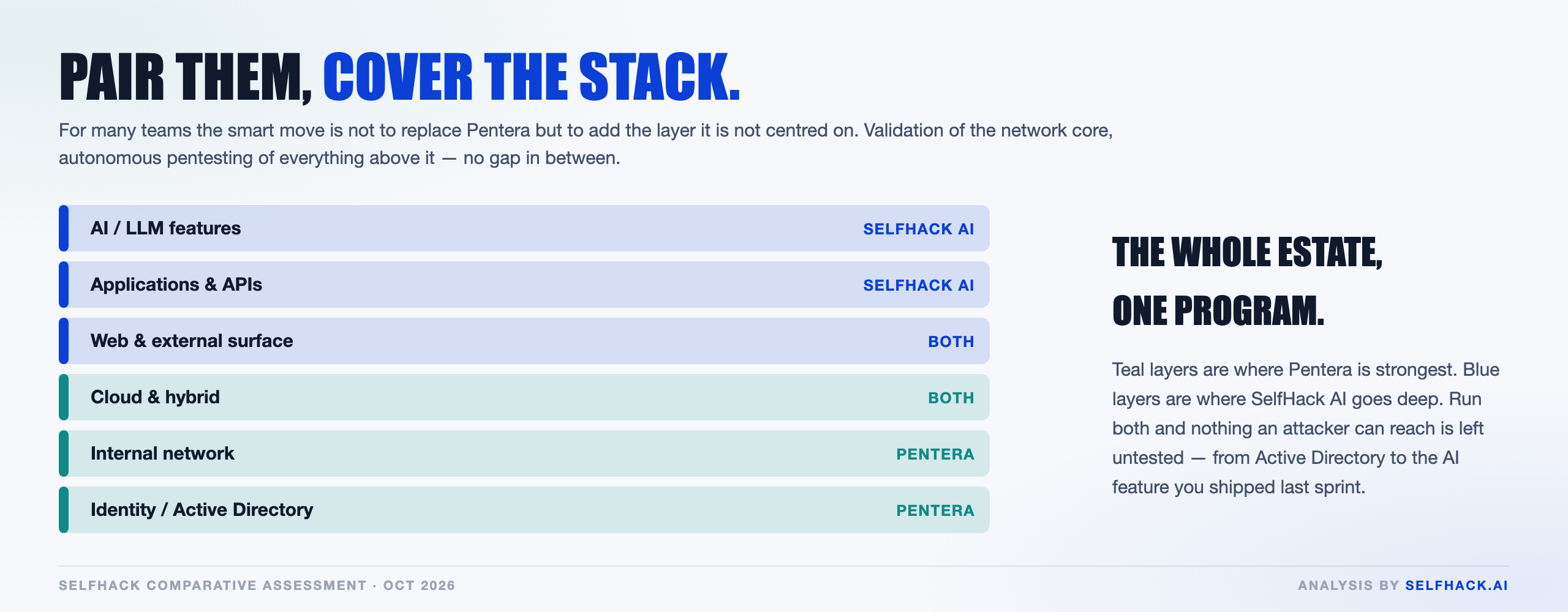
- For many organisations the honest answer is not “replace Pentera” but “pair it”: validation of the network core, autonomous testing of everything your users and attackers actually touch.
SelfHack comparative assessment, October 2026. Pentera’s capabilities are summarised from its own public website; products change, so verify current features with the vendor. Only test systems you own or are authorised to test.
Why people search for a Pentera alternative
Let us start with an observation that shapes everything else on this page: very few people searching for a Pentera alternative think Pentera is bad.
Pentera is one of the most established names in automated security testing. It has a large customer base, strong peer reviews, and a clear product. When a security team starts looking for a Pentera alternative, it is usually because of fit rather than failure — something in their environment, their roadmap or their budget no longer lines up with what the platform is built around.
In our conversations, the reasons cluster into a handful of patterns. The team’s risk has moved from the internal network to the application layer. Their product now ships APIs faster than anyone can scope a test. They have deployed AI features and agents that nobody has tested. Or they want testing that behaves like a pentest of what customers touch, rather than validation of controls inside the perimeter.
Here’s the thing: every one of those reasons is about where testing happens, not how well. That distinction is the whole point of a fair Pentera alternative comparison, and it is why this page spends as much time on what Pentera does well as on where SelfHack AI differs.
What Pentera is genuinely great at
Credit first, because the platform earned it.
Pentera describes itself as an “Exposure Validation Platform”, built around what it calls “real adversarial emulation, safe-by-design”. Its modules map neatly onto the classic enterprise estate: Pentera Core for internal network security validation, Pentera Surface for external network validation, Pentera Cloud for cloud identity and hybrid environments, and Pentera Resolve for remediation orchestration.
Its depth is clearest inside the network. By its own account it tests privilege escalation and lateral movement, includes password-cracking and Active Directory assessment, and offers ransomware emulation — the kind of testing that answers “if an attacker lands on one workstation, how far do they get?” It runs in live production environments and re-validates fixes. Pentera states it is trusted by more than 1,000 organisations and cites over 400 reviews across G2 and Gartner.
That is a serious capability set. For an organisation whose biggest fear is an attacker moving through Active Directory to domain admin, Pentera is a natural choice, and nothing on this page argues otherwise. Any honest Pentera alternative has to start by acknowledging that the network core is home ground for them.
Validation and penetration testing are different jobs
The single most useful idea when choosing a Pentera alternative is to separate two jobs that often get blurred together.
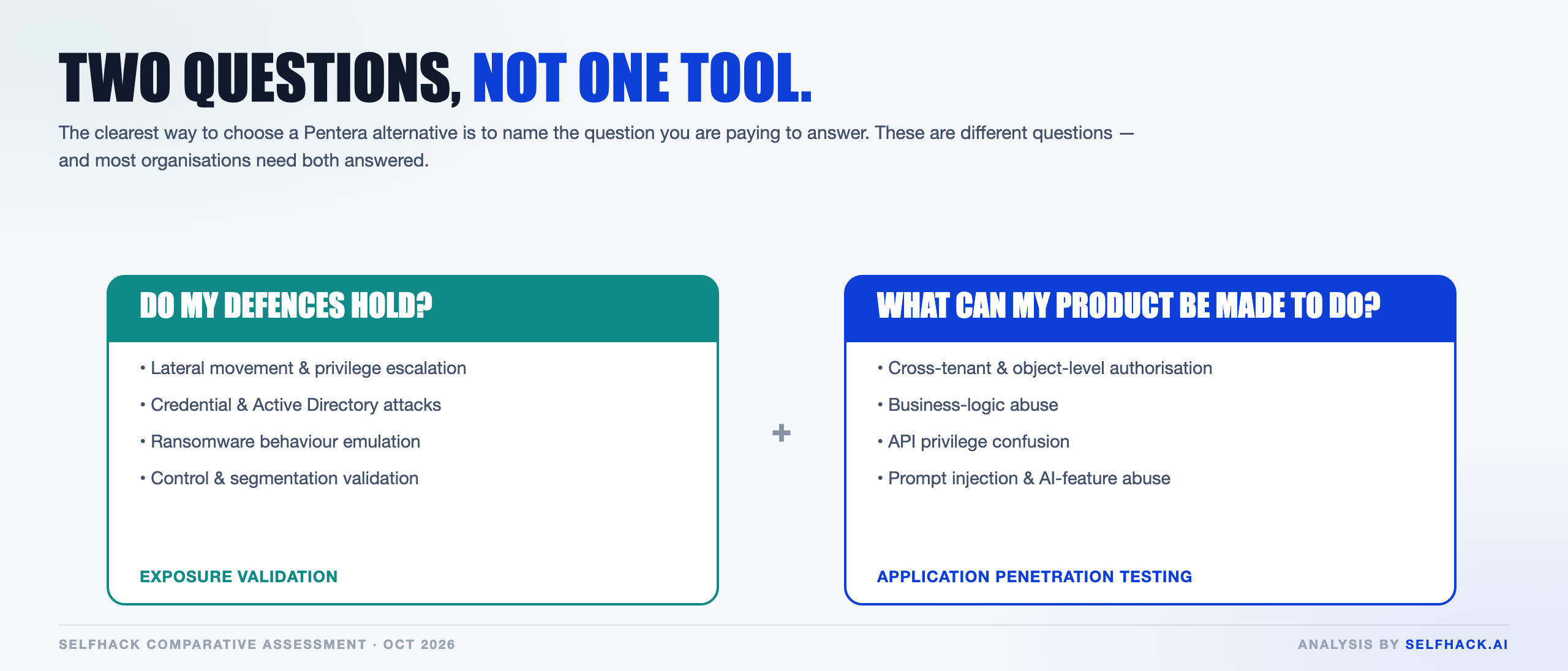
Exposure validation asks: do my defences work against known attacker techniques? Can an emulated adversary escalate privileges, move laterally, crack credentials, encrypt files? It is fundamentally a test of your controls — segmentation, identity hygiene, endpoint detection — against a library of realistic techniques.
Penetration testing of an application asks a different question: what can someone do to this product that its designers did not intend? Can one tenant read another tenant’s data? Can a low-privilege user trigger an admin action through an API nobody documented? Can a prompt make an AI feature leak what it should not? The answers live in business logic, not in the network.
Both jobs matter. They are not substitutes. A network can be impeccably segmented while the application on top of it hands every customer’s records to anyone who changes an ID in a URL. Conversely, a flawless application can sit on a flat network where one phished laptop reaches everything.
The truth is, most organisations need both answers. The reason teams start looking for a Pentera alternative is usually that they have the first answer and are missing the second.
Where the centres of gravity differ
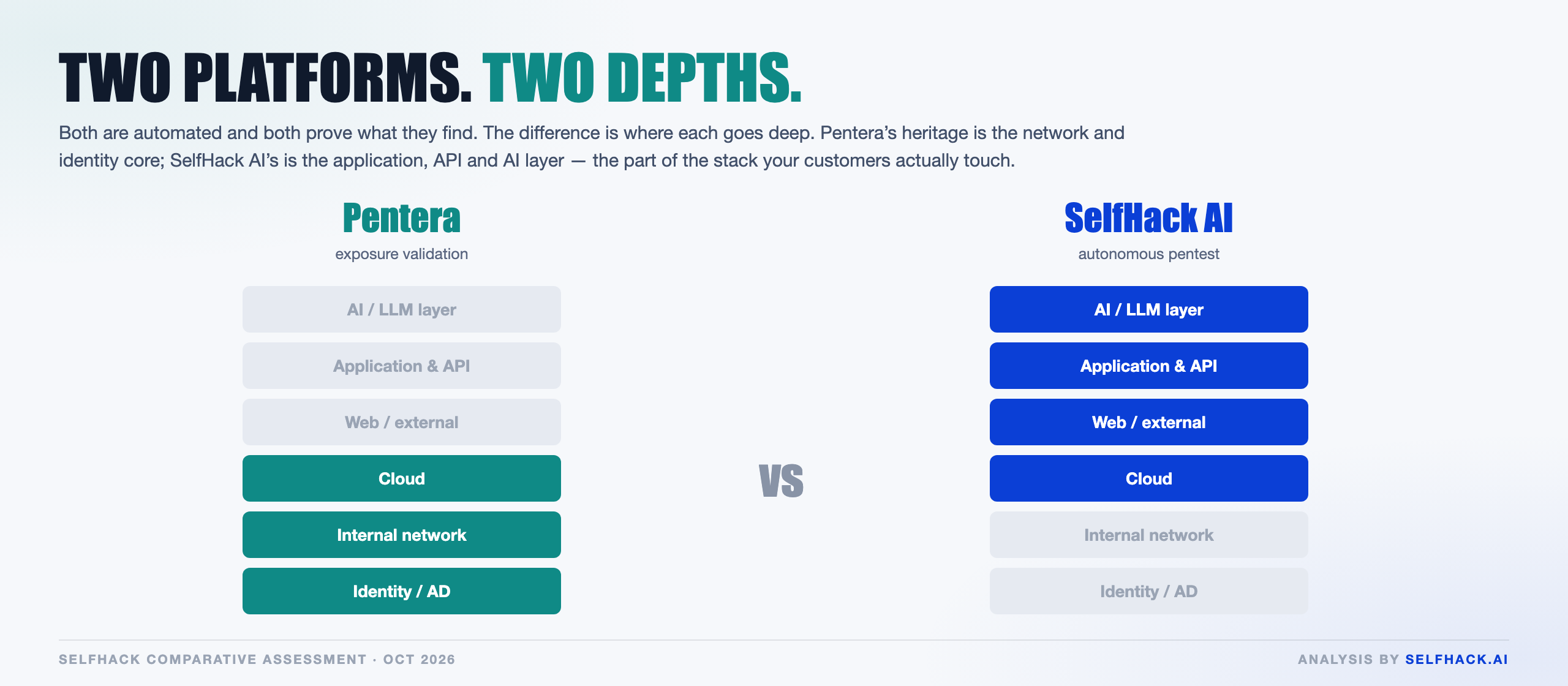
It would be inaccurate to say Pentera does not touch external assets or cloud — it has modules for both. The more precise framing is centre of gravity: where each platform’s depth and heritage sit.
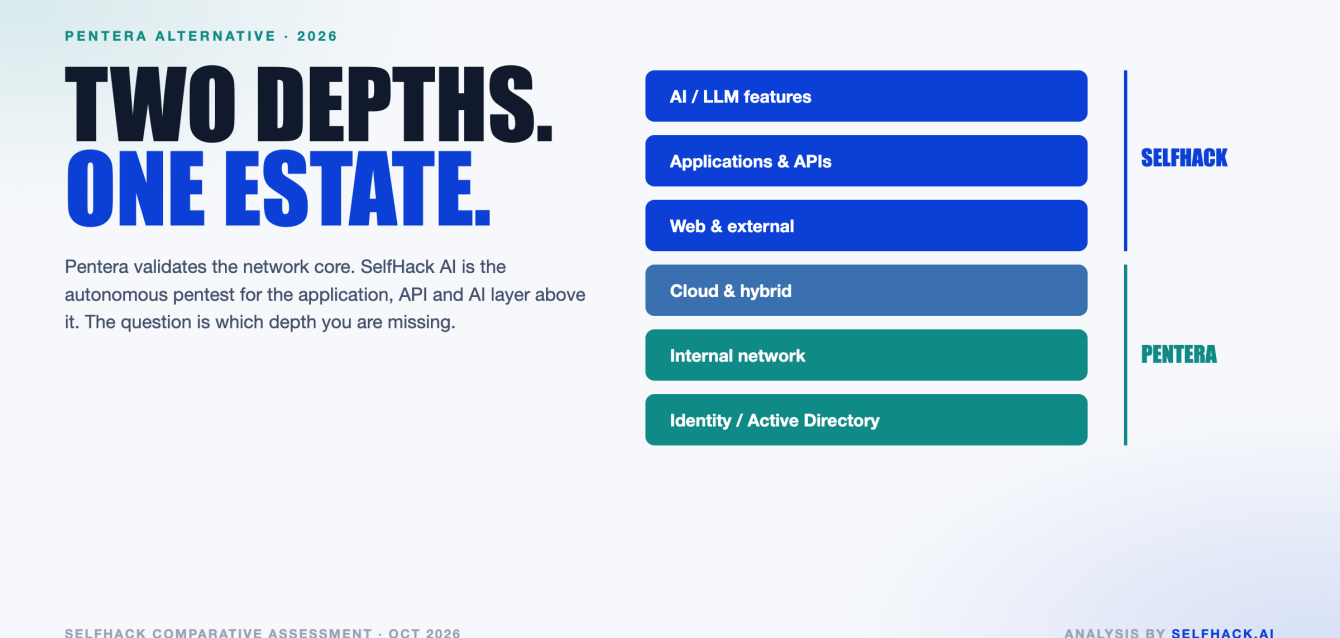
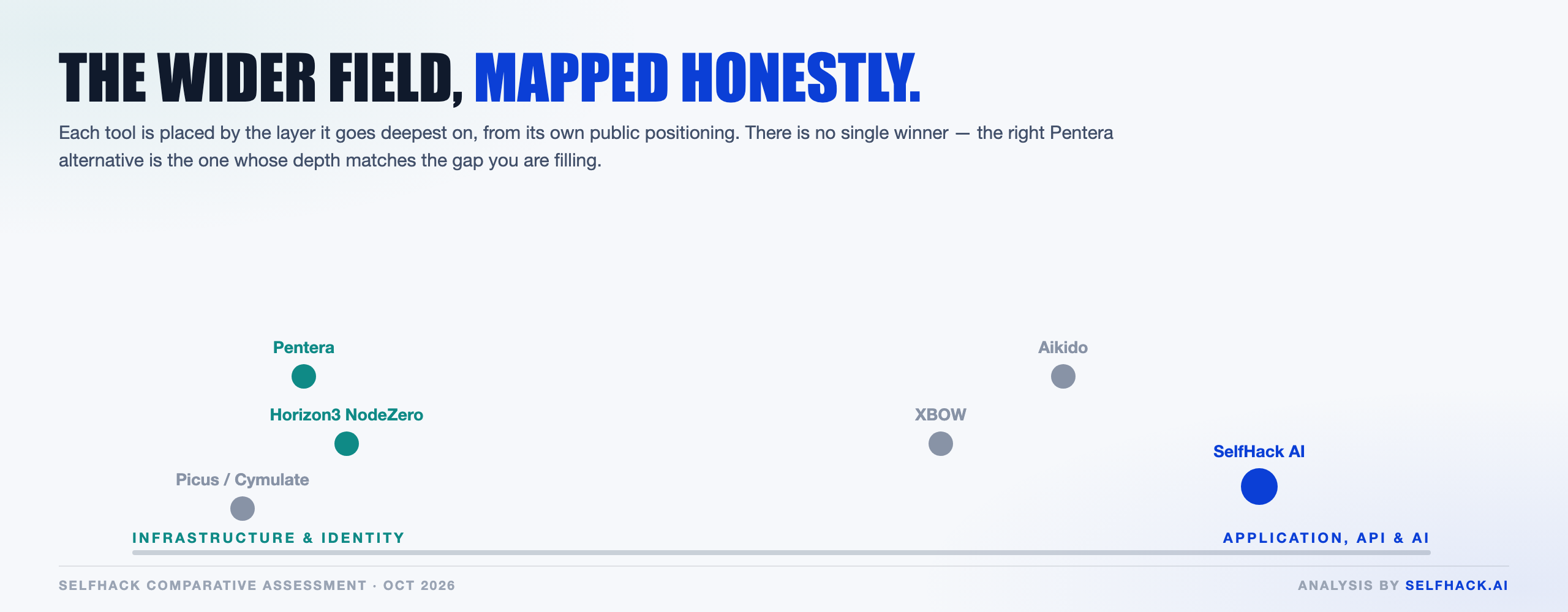
Pentera’s centre of gravity is the infrastructure and identity layer. Its flagship module is internal network validation, and its signature tests — lateral movement, credential attacks, ransomware emulation — are about what happens once an attacker is inside.
SelfHack AI’s centre of gravity is the layer above that: web applications, APIs, authentication and authorisation logic, and the AI features embedded in modern products. Our autonomous agents reason about how a specific application works, attempt to break its logic, chain findings together, and only report what they have actually exploited.
So a Pentera alternative evaluation should start with “which layer is my biggest unanswered risk”. If it is the network core, Pentera’s strengths line up. But for most organisations shipping software in 2026, the honest answer is the application, API and AI layer — and that is where we believe SelfHack AI is simply the better tool. That is not a hedge. It is the layer we built the platform to win.
The application and API layer
This is the first concrete reason teams evaluate a Pentera alternative, and it is getting more urgent every quarter.
Modern products are API-first. A single SaaS platform might expose hundreds of endpoints, each with its own authorisation rules, many written by different teams under deadline. The vulnerabilities that matter most here — broken object-level authorisation, cross-tenant data access, privilege confusion between roles — are not visible from the network. They only appear when something logs in as two different users and compares what each can see.
That multi-user, authenticated testing is a core part of how SelfHack AI works. Our agents can register accounts, obtain tokens for different roles, and systematically test whether user A can act on user B’s resources. We described this pattern in detail in our analysis of what manual pentests miss, because single-session testing — human or automated — routinely misses it.
If your incident history or your threat model is dominated by application-layer issues rather than network compromise, that is a strong signal that the right Pentera alternative for you is one whose depth sits where your risk sits.
The AI layer nobody scoped for
The second reason is newer, and it is the one most security programmes have not caught up with yet.
Products now ship AI features: assistants, copilots, agents with tool access, retrieval systems reading internal documents. Each introduces a class of vulnerability that neither network validation nor traditional application testing was designed to find — prompt injection, system-prompt extraction, insecure output handling, and agents that can be talked into using their tools against their own users.
This is home ground for an AI-native pentest platform. We cover the methodology in our LLM pentest guide, mapped to the OWASP Top 10 for LLM applications. If your roadmap includes AI features — and in 2026 almost every roadmap does — the AI layer belongs in scope, and it is a reasonable thing to weigh when choosing a Pentera alternative.
We are not claiming other vendors ignore this; the market is moving quickly and capabilities change. The point is to ask every vendor directly how they test AI features, and to ask for a demonstrated finding rather than a slide.
Scope: everything an attacker can reach
The biggest practical difference in this Pentera alternative comparison is breadth of scope.
Pentera’s published modules cover internal networks (Core), external networks (Surface), cloud identity and hybrid environments (Cloud), and remediation orchestration (Resolve). That is a coherent, well-defined estate, centred on enterprise infrastructure.
SelfHack AI’s scope is deliberately wider, because attackers do not stop at the edge of a product category. One platform covers web applications and APIs, internal and external networks, cloud environments including Google Cloud, AI and LLM features, IoT devices, operational technology, drones and satellite systems.
That breadth matters most for organisations whose estate does not look like a classic office network — manufacturers with OT, logistics firms with connected fleets, aerospace and defence suppliers, telecoms, and anyone shipping AI. For them, a Pentera alternative that stops at the network and the cloud leaves the most interesting parts of the estate untested.
It is worth separating two things here. Pentera and Horizon3.ai describe themselves as automated and autonomous, and that description is fair. But a large share of the wider market — traditional pentest consultancies and many PTaaS models — still runs with a human driving each engagement. SelfHack AI is autonomous end to end, across the whole scope above, which is the combination we believe sets it apart.
Other Pentera alternatives worth evaluating
A page that only recommends itself is not a guide, so here is the wider field, described from each vendor’s public positioning.
Horizon3.ai (NodeZero) is the closest like-for-like option for internal, external and cloud autonomous pentesting, and the one most often compared directly with Pentera. If you like Pentera’s network focus but want an autonomous-pentest framing, evaluate it. We wrote a separate Horizon3 alternative comparison.
Picus Security and Cymulate are breach-and-attack simulation and exposure management platforms, strong if your priority is continuously validating security controls and detection rules.
XBOW focuses on autonomous web exploitation — see our XBOW alternative page. Aikido Security is a developer-facing scanning suite, covered in our Aikido alternative comparison.
The full ranked picture, written to the same rule of crediting what competitors do well, is in our AI pentest tools overview. The right Pentera alternative depends on which gap you are filling, and different gaps point to different tools.
When you should stay with Pentera
An honest comparison has to say when the answer is “don’t switch”.
Stay with Pentera if your dominant risk is internal compromise: a large Active Directory estate, flat or complex internal networks, a history of credential-based incidents, or a board-level concern about ransomware propagation. That is exactly what the platform is centred on, and switching away from it to chase application coverage would trade one gap for another.
Stay if your team has built processes around its validation reports and remediation workflow. Operational fit has real value, and a tool your team uses well beats a theoretically better one it does not.
And stay if what you actually need is control validation rather than application testing. If the question you are paying to answer is “do our defences hold?”, a Pentera alternative focused on application logic is answering a different question.
In many of these cases the better move is additive: keep Pentera for the network core and add application, API and AI-layer testing alongside it. That is a perfectly sensible outcome of a Pentera alternative evaluation.
How to choose: a decision rule
Strip away the marketing on every side, including ours, and the decision gets simpler.
If your biggest unanswered question is “how far does an attacker get once inside?” — network, identity, lateral movement — Pentera or Horizon3 are built for that.
If it is “what can someone make our product do?” — tenant isolation, API authorisation, business logic, AI features — you want a platform whose depth is in the application layer.
If it is both, and for most mid-size and larger organisations it is, run both, scoped so they do not overlap. The cost of two complementary tools is usually lower than the cost of the gap one of them leaves.
Whichever way you lean, run a proof of concept on your own environment. Ask each vendor for a finding with the full exploit chain demonstrated, and judge on what they find in your estate rather than in their demo. A Pentera alternative that cannot show you a real, reproduced finding in a pilot is not one worth switching to.
What a fair Pentera alternative pilot looks like
Most evaluations go wrong in the pilot, not in the decision. Here is a structure that gives you a real answer in two to three weeks.
Pick one scope and give it to every vendor. Choose a real application with real authentication — ideally one with multiple user roles and an API behind it. If each vendor tests something different, you are comparing demos, not tools.
Seed nothing. Do not plant known vulnerabilities for the vendor to find. You learn far more from what each platform discovers on its own in an environment it has never seen.
Score on proof, not volume. Count findings that arrive with a reproduced exploit chain. Ignore counts of “possible” issues; volume without proof is the triage tax that made teams leave scanners in the first place.
Measure time-to-first-real-finding. How long from kickoff to the first finding your engineers agree is real? That single number tells you more about operational fit than any feature matrix.
Check the evidence. Ask your auditor or compliance lead to read the output. If it would not survive their review, it does not count, however impressive the dashboard.
One more practical point: involve the engineers who will fix things. Their judgement on whether a finding is real, reproducible and worth a sprint is the most honest signal you will get from any pilot.
Run the same pilot with Pentera if you are an existing customer. A Pentera alternative only earns the switch if it finds things in your estate that matter and that your current tooling did not.
How SelfHack AI works as a Pentera alternative
SelfHack AI is an autonomous penetration testing platform. Here is what that means in practice, and why some teams choose it as a Pentera alternative or alongside it.
Autonomous reasoning about your application. Our agents map the application, form hypotheses about where its logic can break, and test them — rather than replaying a fixed library of techniques.
Exploit-validated findings. Nothing reaches your team as a “possible” issue. Every finding arrives with the path demonstrated, so engineers spend their time fixing rather than proving.
Attack-chain analysis. Real breaches are chains. We follow a low-severity foothold to see whether it reaches something that matters, and report the chain rather than the fragments.
Full-stack scope, including the AI layer. Web, API, authentication, cloud-exposed services and AI features, tested continuously rather than once a year — which matters because, as we showed in our analysis of enterprise penetration testing, attackers now break out in minutes.
Evidence you can hand an auditor. Scope, findings, remediation and retest, documented continuously. And as a European company, SelfHack AI is a natural fit for teams working under EU frameworks.
16+ languages, across everything. SelfHack AI supports more than sixteen languages across the platform, its reports and its testing — so regional teams act on findings in their own language, and applications built for non-English markets are tested in the language their users actually use. Among the platforms compared on this page, SelfHack AI is the only one to offer this: neither Pentera nor Horizon3.ai lists multi-language support on its public website (checked October 2026).
If the gap your Pentera alternative search is really about is the application and AI layer, talk to us and run a pilot against your own estate.
FAQ
Is SelfHack AI a direct replacement for Pentera?
For some teams, yes; for many, it is a complement. Pentera’s centre of gravity is internal network and identity validation, while SelfHack AI’s is application, API and AI-layer penetration testing. If your main risk is in the application layer, SelfHack AI can be your primary Pentera alternative. If you need both, running them together usually beats choosing one.
What is the difference between exposure validation and penetration testing?
Exposure validation tests whether your defences hold against known attacker techniques — lateral movement, credential attacks, ransomware behaviour. Penetration testing of an application tests what someone can make a specific product do that its designers did not intend. Both are valuable, and they answer different questions.
Does a Pentera alternative need to run in production?
Testing production is how you learn what is actually exploitable, and both Pentera and SelfHack AI are designed for it. Safe production testing depends on agreed rules of engagement — scope, rate limits, excluded actions — and on authorisation from the asset owner.
Which Pentera alternative is best for internal networks?
If internal network and Active Directory testing is your priority, Horizon3.ai’s NodeZero is the most direct like-for-like alternative, and breach-and-attack simulation platforms such as Picus and Cymulate are worth evaluating for control validation. SelfHack AI’s strength is the application, API and AI layer.
How should I evaluate a Pentera alternative fairly?
Run a proof of concept on your own environment, with the same scope for each vendor. Ask for findings with the full exploit chain demonstrated, compare what each finds rather than what each claims, and check whether the output works as audit evidence.
The verdict
Pentera is a strong platform with a clear centre of gravity: validating that your defences hold inside the network. Most people searching for a Pentera alternative are not trying to escape that — they are trying to cover what sits outside it.
If your unanswered risk is the application your customers use, the APIs behind it, and the AI features you shipped this year, the right Pentera alternative is a platform built to test that layer autonomously and prove what it finds. We built SelfHack AI to be that platform, and for that layer we think it is the best choice available.
Keep the tool that answers your network question well. Add the one that answers your application question. And if you want to see what that second answer looks like on your own estate, talk to us.
Sources & methodology: Pentera’s product descriptions, module names and scale claims are quoted or summarised from pentera.io; Horizon3.ai’s from horizon3.ai, both as of October 2026. AI-layer testing references the OWASP Top 10 for LLM Applications; testing methodology references NIST SP 800-115. This is a SelfHack comparative assessment: competitor descriptions reflect their public positioning, products change, and you should verify current capabilities with each vendor. SelfHack AI makes no claim about any vendor beyond what it states publicly. Only test systems you own or are authorised to test.