
Aikido Alternative in 2026: The Autonomous Pentest Scanning Can’t Replace
- Most people searching for an Aikido alternative are really asking one of two questions: “is there a better scanner?” or “I don’t just want flags — I want something that proves what’s exploitable.” This page is about the second one.
- Aikido Security is an excellent AppSec and cloud scanning platform. But scanning finds; it does not exploit and prove. If you want that proof, the Aikido alternative you need is an autonomous pentest, not another scanner.
- SelfHack AI is that pentest — autonomous, exploit-validated, full-stack, with published research. It answers a different question than Aikido, and the two often work best together.
- We build SelfHack AI, so we’ll be precise: this is not “Aikido is bad.” It’s “scanning and pentesting are different jobs, and confusing them is the costly mistake.”
Comparisons reflect SelfHack’s own assessment (Q2 2026); Aikido is described from its public positioning as an AppSec/scanning platform. We credit what it does well.
Why teams look for an Aikido alternative
There are two very different people typing “Aikido alternative” into a search bar, and they want opposite things. One wants a cheaper or broader scanner — a different tool in the same category. The other has a scanner already, is drowning in flagged findings nobody has time to verify, and wants something that will actually prove which of those findings an attacker could exploit. This page is for the second person.
That frustration is common, and it isn’t Aikido’s fault. It is the nature of scanning. A scanner’s job is to look across your code and cloud and surface everything that might be a problem. It does that at scale and at speed. But the output is a list of possibilities, and possibilities pile up faster than any team can triage them. At some point “we have 400 medium findings” stops being security and starts being noise.
So the search for an Aikido alternative is often really a search for a different kind of answer. Not “what might be wrong” but “what is actually exploitable, proven, right now.” That is not a scanner question. It is a pentest question, and it needs a pentest tool.
We build SelfHack AI as exactly that tool, so we’ll be upfront about the framing: if you want another scanner, this may not be the Aikido alternative you’re looking for. If you want proof instead of flags, read on — and we’ll be fair to Aikido on the way, because it’s genuinely good at the job it’s built for.
Scanning vs pentesting: the distinction that decides it
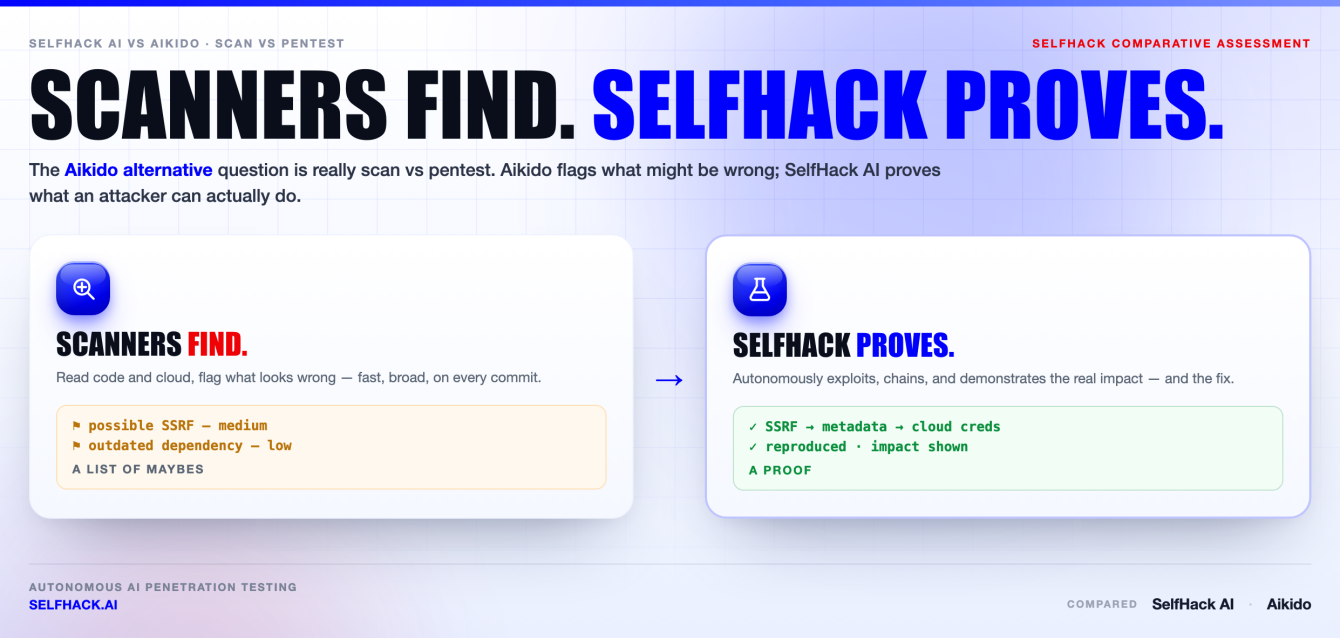
This one distinction settles most of the confusion in this market, so it’s worth stating plainly. A scanner finds and flags. A pentest exploits and proves. They are complementary jobs, not competing ones, and the right Aikido alternative depends entirely on which job you actually need done.
- A scanner reads code, dependencies, cloud config and secrets, and flags what looks wrong. Fast. Broad. Runs on every commit.
- A pentest takes a real target, exploits a weakness, chains it, and proves the impact. Deep. Reasoned. Ends in a demonstrated attack.
- The output differs. A scanner hands you a list of maybes. A pentest hands you a proof.
- The urgency differs. A flag says “investigate.” A proven chain says “fix this now — here is what happens if you don’t.”
- The right Aikido alternative depends on which of those you actually need.
A scanner like Aikido reads your code, your dependencies, your cloud configuration, and your secrets, and it tells you where something looks wrong. That is enormously useful for coverage and hygiene. It runs on every commit. It catches the obvious mistakes early. It gives developers a fast feedback loop. What it does not do — because it is not designed to — is chain those findings into a working attack and show you the actual impact.
A pentest does the opposite. It doesn’t try to list everything that might be wrong; it tries to break in. It takes a real target, reasons about how the pieces connect, exploits a weakness, chains it with others, and hands you a demonstrated path from outside to impact. The output isn’t a list of maybes. It’s a proof.
Here is why the difference matters for money and risk. A flag tells you to investigate. A proof tells you to fix, and tells you what happens if you don’t. Teams ignore scanners not because scanners are bad, but because an unverified flag has no urgency attached. A proven exploit chain has all the urgency in the world. That is the value an autonomous pentest — the right Aikido alternative for this need — brings that no scanner can.
Scanner or pentest? Three questions settle it
You don’t need a spreadsheet. Three questions tell you which Aikido alternative you actually need.
Too many findings, or too little proof? Too many findings means you have a scanner and need triage. Too little proof means you need a pentest.
Does your board want coverage, or evidence? Coverage is a scanner story. Evidence — a demonstrated exploit — is a pentest story.
Where does your risk live? If it’s mostly code and cloud config, a scanner reaches it. If it runs deeper — firmware, confidential compute, cross-layer seams — only a pentest does.
Answer those and the choice is usually obvious. Most mature teams end up wanting both.
What Aikido genuinely does well
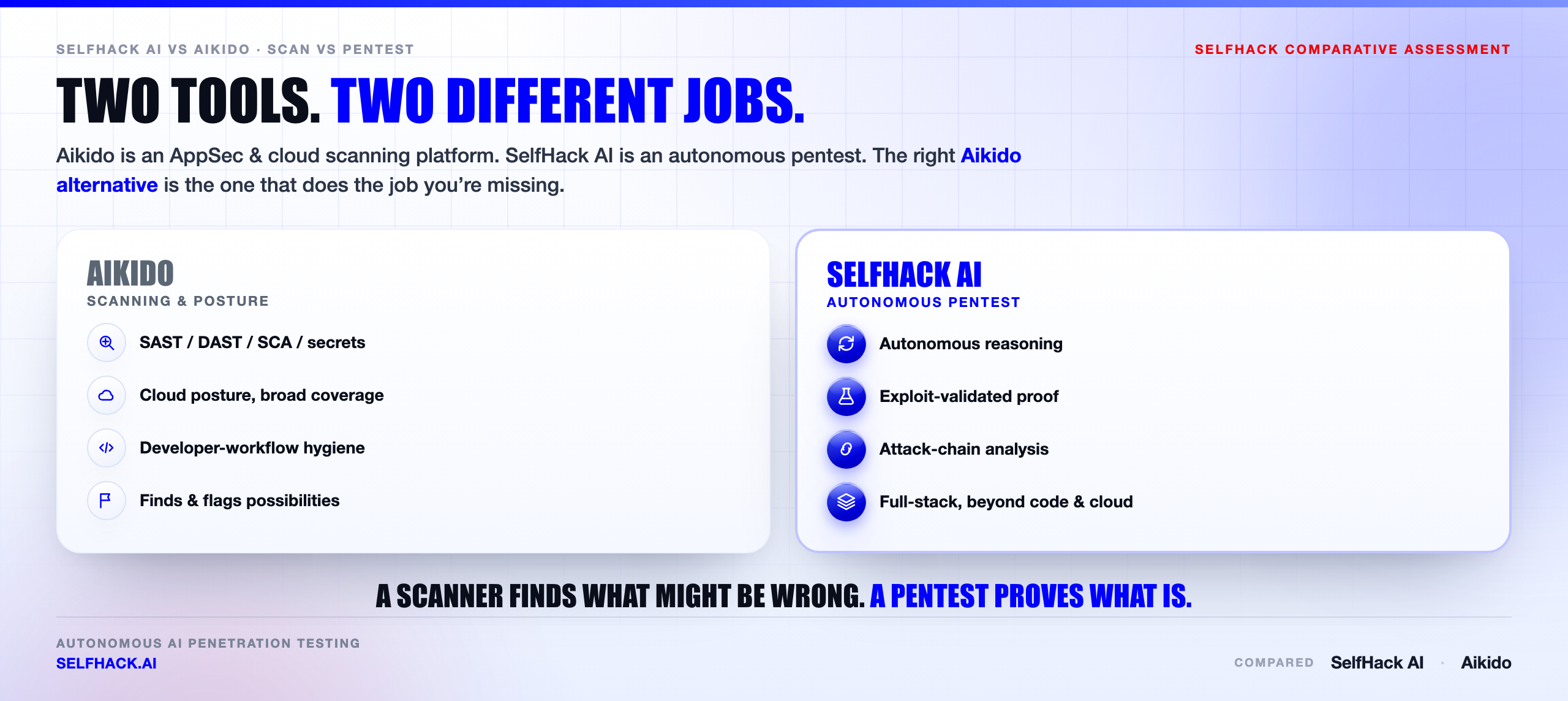
A fair Aikido alternative page has to start by being honest about what Aikido is good at, because it is genuinely good at it. Aikido Security consolidates a pile of AppSec tools — static analysis, dependency scanning, secrets detection, dynamic scanning, cloud posture — into one developer-friendly product. That consolidation is real value.
Before tools like Aikido, teams stitched together half a dozen separate scanners. Each had its own dashboard. Its own false positives. Its own noise.
Aikido’s pitch is that you get one place, one workflow, and sensible prioritization across all of it. For a development team that wants AppSec hygiene baked into the pipeline without becoming a full-time job, that is a strong offering.
It is also fast and low-friction, which matters more than security people sometimes admit. A scanner that developers actually run beats a perfect one they ignore. Aikido leans into developer experience, and that is a legitimate reason teams choose it and stay.
None of that is in question here. The point of looking for an Aikido alternative is not that Aikido scans badly. It is that scanning, however well done, answers a different question than the one a pentest answers — and some teams need both answers.
The 400-findings problem
Every team that has run a scanner for a year knows this feeling. The dashboard fills up. The numbers climb. And nobody has time to check them all.
It is not a failure of the scanner. It is what scanning produces: possibilities, at scale.
But a possibility isn’t a decision. “Possible SSRF, medium” doesn’t tell you whether an attacker can actually reach it. So the list grows, and the important finding hides in the noise with 399 others.
A pentest cuts through that. It doesn’t add to the list. It proves which items on it are real.
That is the shift teams are buying when they look for this kind of Aikido alternative. Not more findings. A verdict on the ones they already have.
Fewer numbers. More certainty. That trade is the whole point.
The Aikido alternative that proves, not just flags
If the job you need done is proof, SelfHack AI is the Aikido alternative built for it. It is not a scanner with a bigger badge. It is an autonomous penetration testing system that treats a target the way an attacker does.
SelfHack AI maps a real attack surface, generates its own hypotheses about how trust could break, tests them in isolation, corrects itself when the evidence disagrees, and chains what it confirms into a demonstrated impact. Where a scanner outputs “possible misconfiguration,” SelfHack AI shows you the misconfiguration being exploited, the chain it enables, and the fix that closes it.
And it does this across far more than application code. SelfHack AI has published autonomous research on the confidential-computing trust boundary between AMD and NVIDIA chips, on avionics firmware and buses, on the off-chain-to-on-chain seam in blockchain platforms, and on connected-vehicle backends. That is the kind of reasoning a scanner cannot do, and it is the proof that this Aikido alternative genuinely pentests rather than pattern-matches.
The published research is the tell. Anyone can claim their tool “tests.” Very few can point to reproducible, technical results at layers a scanner never touches. That evidence is what turns “autonomous pentest” from a slogan into something you can verify before you buy.
And the breadth compounds the value. A scanner is bounded by what it knows to look for; an autonomous pentest reasons about what it finds. So when your estate grows past code and cloud — into devices, firmware, or a chain — the pentest follows the risk instead of stopping at the edge of a ruleset. That is coverage a scanner architecture can’t reach, and it is a core reason teams add this kind of Aikido alternative rather than another scanner.
SelfHack AI vs Aikido at a glance
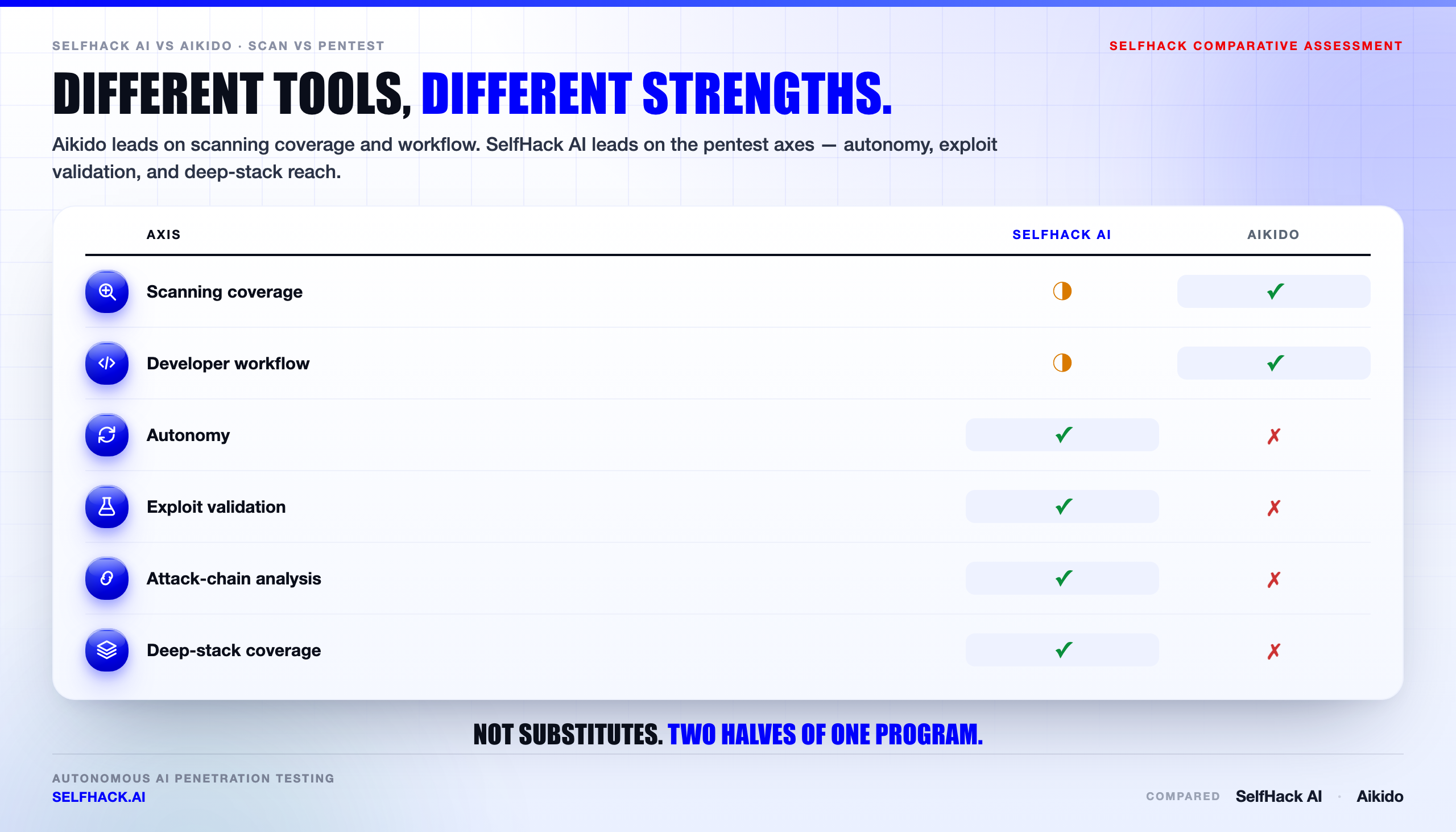
Line them up on what each is actually for, and the comparison stops being a contest and becomes a clarification. Aikido is a scanning and posture platform; SelfHack AI is an autonomous pentest. On coverage of potential issues across code and cloud, Aikido is strong. On proving exploitability with reproducible chains, SelfHack AI is built for exactly that and Aikido is not designed to.
On the axes buyers weigh, the split is clean. For breadth of scanning and developer-workflow hygiene, Aikido leads. For autonomy, exploit validation, attack-chain analysis, and coverage of the deep stack below the application layer, SelfHack AI leads — because those are pentest capabilities, and it is the pentest. The honest read is that they are not really substitutes; they are two halves of a mature program, and the right Aikido alternative for the “proof” half is an autonomous pentest.
For the scored, dimension-by-dimension view across the whole category, see our AI pentest benchmark and the wider best AI pentest tools guide.
What changes when a finding is proven
A proof does something a flag never can. It ends the argument.
Engineers stop debating whether a finding is real. They watch it happen, then fix it.
Leadership stops asking “is this a big deal.” They see the exploit and the impact.
Auditors stop asking for assurances. They get a demonstrated result and a closed gap.
And your team gets its time back. Instead of triaging a wall of maybes, they fix a short list of proven exploits. That is not a small operational win. It is the difference between a security program that drowns in its own tooling and one that ships fixes that matter.
That is the quiet power of the right Aikido alternative. Not more findings. Fewer arguments.
Replace Aikido, or pair it? An honest answer
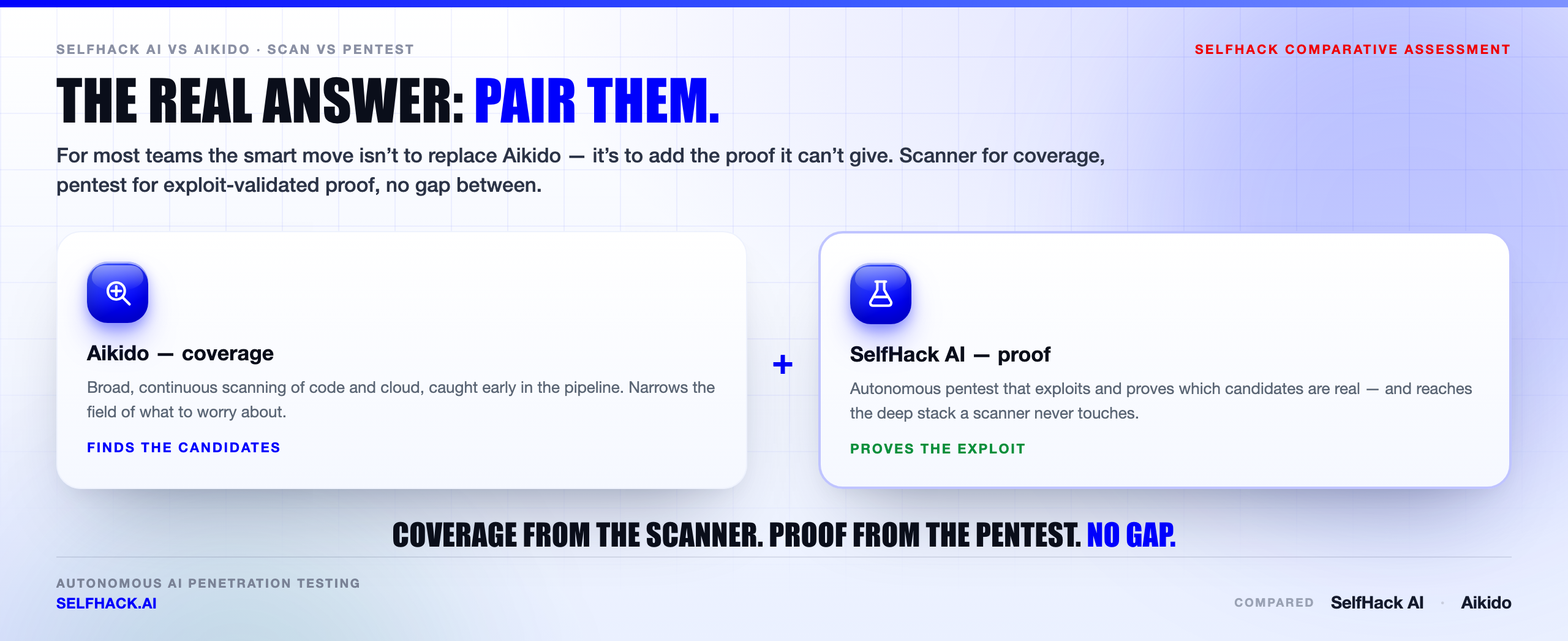
Here is the recommendation most Aikido alternative pages won’t give you, because it isn’t maximally self-serving: for most teams, the right move is not to replace Aikido at all. It’s to pair it.
Run a scanner like Aikido for what scanning is good at — broad, continuous coverage of code and cloud, caught early in the pipeline, with a clean developer workflow. Run an autonomous pentest like SelfHack AI for what pentesting is good at — proving which of those exposures is actually exploitable, chaining them into real impact, and covering the layers a scanner never reaches. The scanner narrows the field; the pentest proves the exploit.
Think of it as two lenses on the same estate. The scanner’s lens is wide and shallow — it sees everything, lightly. The pentest’s lens is narrow and deep — it sees a few things, completely, and proves them. You want both lenses, because a gap in either is a place a real attacker gets to work uninterrupted. Pairing them is how you close that gap for good, and it is why the smartest Aikido alternative decision is usually additive, not a swap.
The only time “replace” is the right frame is when a team bought a scanner believing it was a pentest, and now needs the pentest it thought it had. In that case the Aikido alternative isn’t a swap of like for like — it’s adding the capability that was missing. Either way, the goal is the same: coverage from the scanner, proof from the pentest, and no gap between them where a real exploit hides.
How to evaluate an Aikido alternative
Whatever you’re considering, evaluate an Aikido alternative against the job you actually need done, not the label on the box. A few questions cut straight to it.
Ask whether it flags or proves. If the demo shows you a list of findings with severities, that’s a scanner — useful, but not a pentest. If it shows you an exploit chain executed end to end, that’s a pentest. Ask how much of the stack it reaches beyond application code and cloud config. Ask whether it can reproduce a critical finding on demand. And ask to see published, technical evidence of its reasoning, not just a feature grid.
Ground the whole evaluation in public methodology: the OWASP Web Security Testing Guide, NIST SP 800-115 for testing structure, and the MITRE ATT&CK framework for mapping coverage. A scanner and a pentest will map to those very differently — and that difference is exactly the one you’re trying to see.
FAQ
Is SelfHack AI an Aikido alternative?
It depends on what you need. If you want another AppSec scanner, SelfHack AI is not that — it’s a pentest. If you want an Aikido alternative that proves exploitability instead of flagging possibilities, then yes, SelfHack AI is built for exactly that: autonomous, exploit-validated testing across the full stack. Many teams run both, using the scanner for coverage and the pentest for proof.
What’s the difference between Aikido and SelfHack AI?
Aikido is an AppSec and cloud scanning platform: it finds and prioritizes potential issues across code and cloud, fast and at scale. SelfHack AI is an autonomous penetration testing system: it exploits weaknesses, chains them into real impact, and proves what an attacker could actually do — across web, cloud, firmware, confidential computing, and more. Scanning finds; pentesting proves.
Should I replace Aikido with SelfHack AI?
Usually not — you should pair them. Scanning and pentesting are complementary jobs. Keep the scanner for broad, continuous coverage and developer workflow, and add an autonomous pentest for exploit-validated proof and deep-stack coverage. The exception is when a team bought a scanner expecting a pentest, in which case the Aikido alternative fills a capability that was genuinely missing.
Can a scanner replace a pentest?
No, and vice versa. A scanner surfaces possibilities across a wide surface; a pentest proves which possibilities are exploitable and what they lead to. Treating one as the other is the most common and most expensive mistake in this market. The strongest programs run both and mind the gap between them.
Does SelfHack AI cover cloud like Aikido does?
It tests cloud, but differently. Aikido scans cloud posture and configuration broadly for potential issues. SelfHack AI pentests the cloud — it tries to exploit the exposures and prove impact, and it extends past cloud into firmware, confidential computing, and other layers. For posture breadth, the scanner; for proof of exploitability, the pentest. In practice, the scanner tells you a bucket is misconfigured; the pentest shows you the data that misconfiguration actually exposes, and the chain that reaches it. Both facts are useful. Only one of them ends the debate about whether it matters.
The verdict
If you’re evaluating an Aikido alternative, get precise about the job first. For AppSec scanning and posture with a clean developer workflow, Aikido is genuinely strong and you probably shouldn’t replace it. For proof — exploit-validated, autonomous, full-stack testing that shows what an attacker can actually do — you need a pentest, and our assessment is that SelfHack AI is the strongest option for that job in 2026.
The honest bottom line is one most vendors won’t say: scanning and pentesting are complementary, and the best programs run both. Aikido for coverage, SelfHack AI for proof, no gap between. If you want to see what an autonomous pentest surfaces that your scanner can’t, talk to our team and give it something real to prove.
If you take one thing from this page, take the distinction. Scanning finds. Pentesting proves. A scanner will never hand you a demonstrated exploit chain, and a pentest will never replace the broad, continuous coverage a scanner gives you. The mistake is expecting either to be the other. Get that right and the Aikido alternative question answers itself: keep the scanner, add the proof, and stop paying for a gap between them that an attacker would be glad to use.
Coverage without proof is a guess. Proof without coverage is a blind spot. You want neither.
So run the scanner. Add the pentest. Mind the gap. That is the whole playbook, and it is the one most teams arrive at once they stop confusing the two.
Methodology & sources: comparison reflects SelfHack’s internal assessment (Q2 2026); Aikido described from its public positioning as an AppSec/cloud scanning platform. Frameworks: OWASP WSTG, NIST SP 800-115, MITRE ATT&CK. See the AI pentest benchmark 2026 for scored detail.