XBOW Alternative: Why Security Teams Choose SelfHack AI in 2026
- If you are shopping for an XBOW alternative, the real question isn’t “who else does autonomous hacking” — it’s “who does it across my whole stack, not just web apps.”
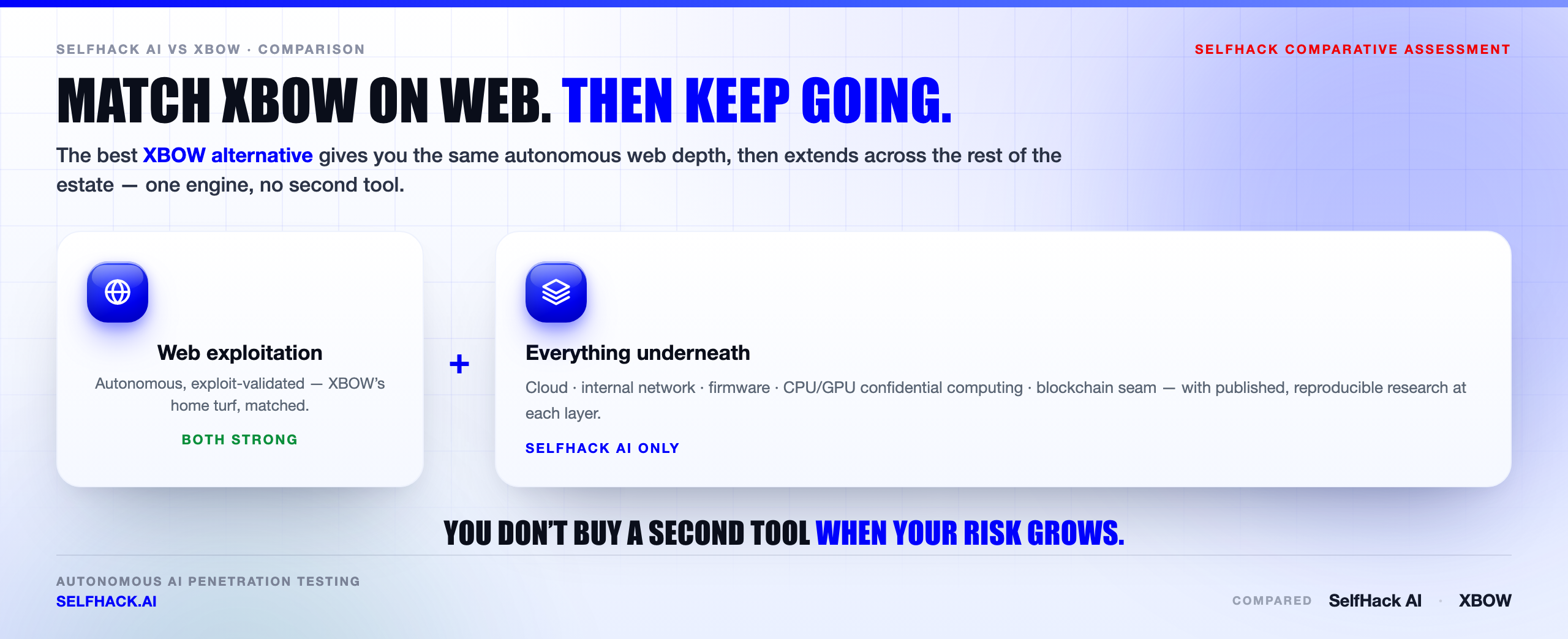
- XBOW is a genuinely strong autonomous web-exploitation engine. SelfHack AI is the XBOW alternative for teams whose risk runs deeper: firmware, cloud, confidential computing, blockchain, and the seams between them.
- Both are autonomous. The difference is breadth and evidence — SelfHack AI publishes exploit-validated research well beyond the web layer, so you can judge the reasoning, not just the pitch.
- We build SelfHack AI, so we say this plainly and back it with public research. Below: an honest, side-by-side look.
Comparisons reflect SelfHack’s own assessment (Q2 2026); XBOW is described from its public positioning. We name it fairly and credit where it’s strong.
Why teams look for an XBOW alternative
People searching for an XBOW alternative almost never want “the same thing, cheaper.” They want one of three things: broader coverage than web, published proof that the autonomy is real, or a system they can grow into as their attack surface expands past applications. XBOW earned attention for autonomous offensive security, and that attention is deserved — but it also set the expectation that autonomous testing should reach everywhere an attacker does.
That is the gap most teams are actually trying to close. Your risk isn’t only in a web form. It is in the cloud account nobody audits, the firmware in a device you bought, the trust boundary between your CPU and your GPU, the seam where an off-chain API meets an on-chain contract. An autonomous web hacker is powerful. An autonomous tester that reaches all of that is a different category. That category is what a serious XBOW alternative has to deliver.
There is also a maturity reason teams start the search. A tool that only tests web ties you to a single-layer view of risk, and single-layer views are exactly how breaches slip through. The moment a security program grows up — adds cloud, buys connected hardware, ships an AI feature, touches a chain — the web-only tool becomes a partial answer. Looking for an XBOW alternative early, before that gap bites, is the mark of a team thinking ahead rather than reacting.
So the honest framing for this page: this is not “XBOW is bad.” It is “if you need more than autonomous web exploitation, here is what more looks like.” We build SelfHack AI, and we think it is the strongest XBOW alternative for exactly that reason — but we will show you where XBOW is strong first, because a comparison that only flatters itself isn’t worth reading.
SelfHack AI vs XBOW at a glance
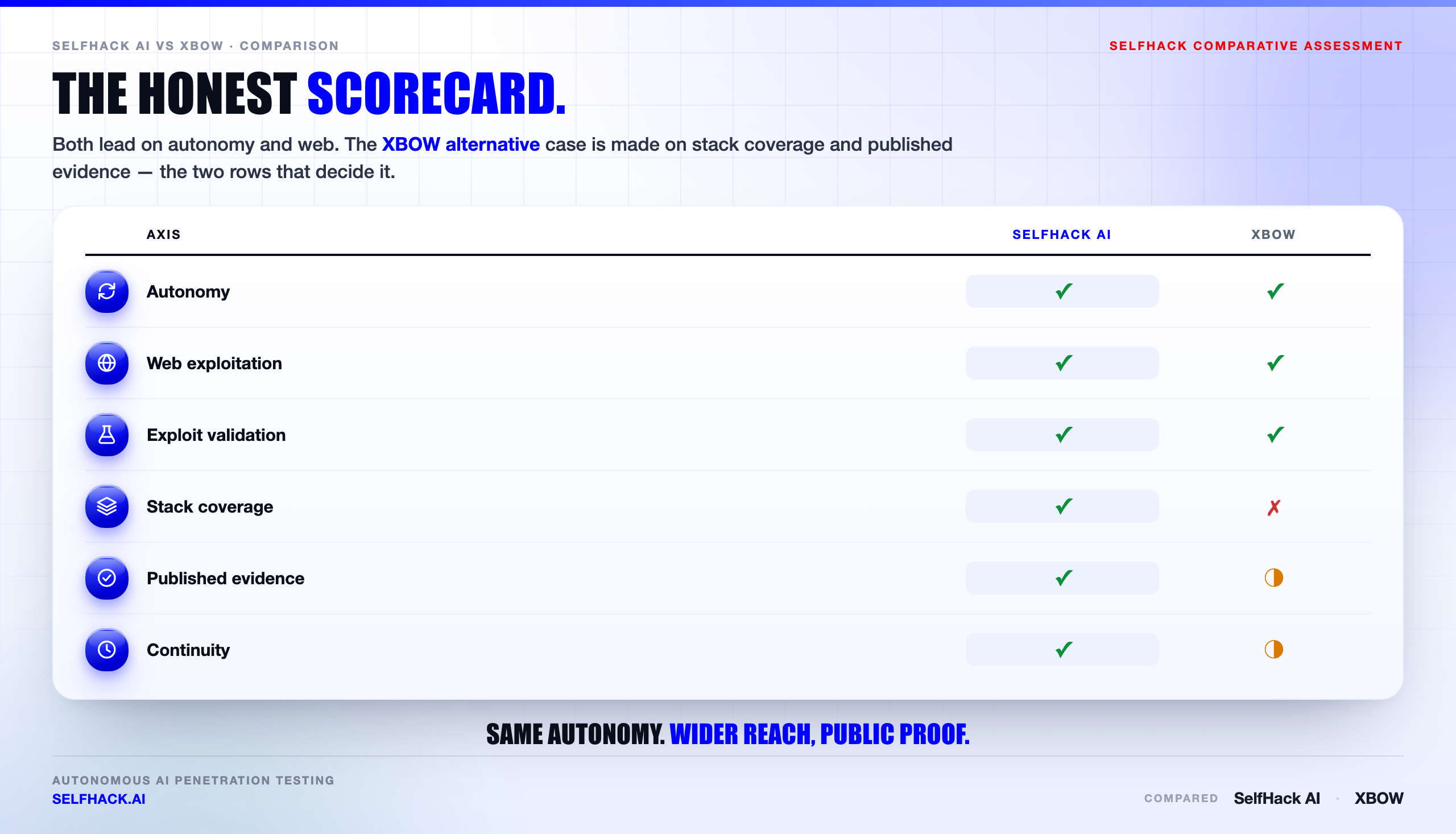
Both SelfHack AI and XBOW are autonomous. Both reason about targets instead of running a fixed script. On web exploitation specifically, both are strong. The separation shows up on two axes that matter to buyers: how much of the stack the system covers, and how much public, reproducible evidence backs the autonomy claim.
- Autonomy — both reason about targets and self-correct; neither runs a fixed human script.
- Web exploitation — both are strong. This is XBOW’s home turf, and a serious XBOW alternative has to match it. SelfHack AI does.
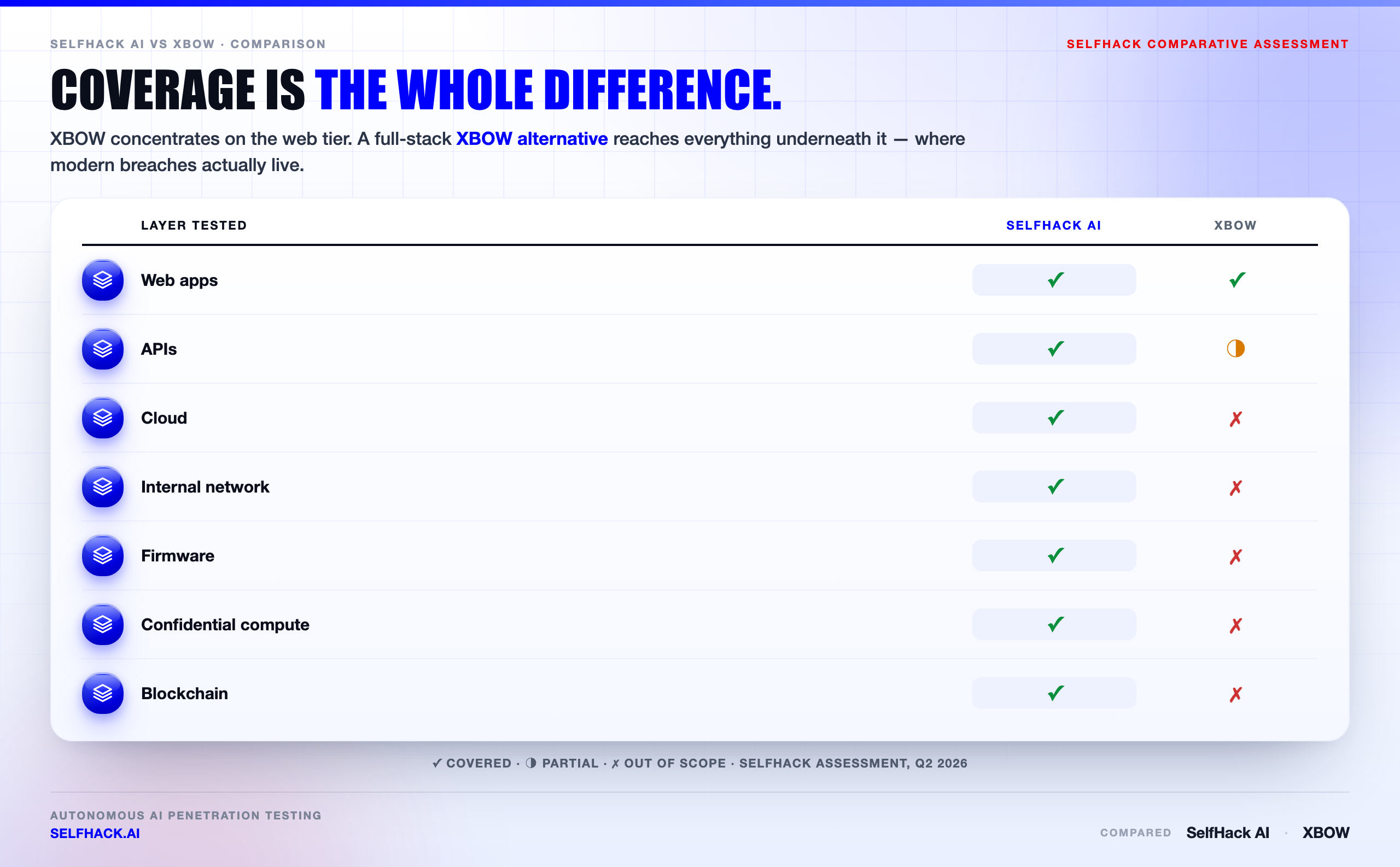
- Stack coverage — XBOW centers on web; SelfHack AI adds cloud, internal networks, firmware, confidential computing and blockchain.
- Published evidence — SelfHack AI documents reproducible research at each layer; that is how you verify the autonomy is real.
- Continuity — both can run continuously; the buyer’s question is what actually triggers a re-test.
On coverage, XBOW’s public footprint centers on web and offensive web exploitation. SelfHack AI is deliberately wider — web and API, yes, but also cloud, internal networks, firmware, confidential computing, and blockchain. On evidence, SelfHack AI publishes technical research with reproducible detail; that is the part that turns “trust us, it’s autonomous” into “here is the reasoning, judge it yourself.”
For the buyer weighing an XBOW alternative, those two axes are usually the whole decision.
The one-line difference between SelfHack AI and XBOW
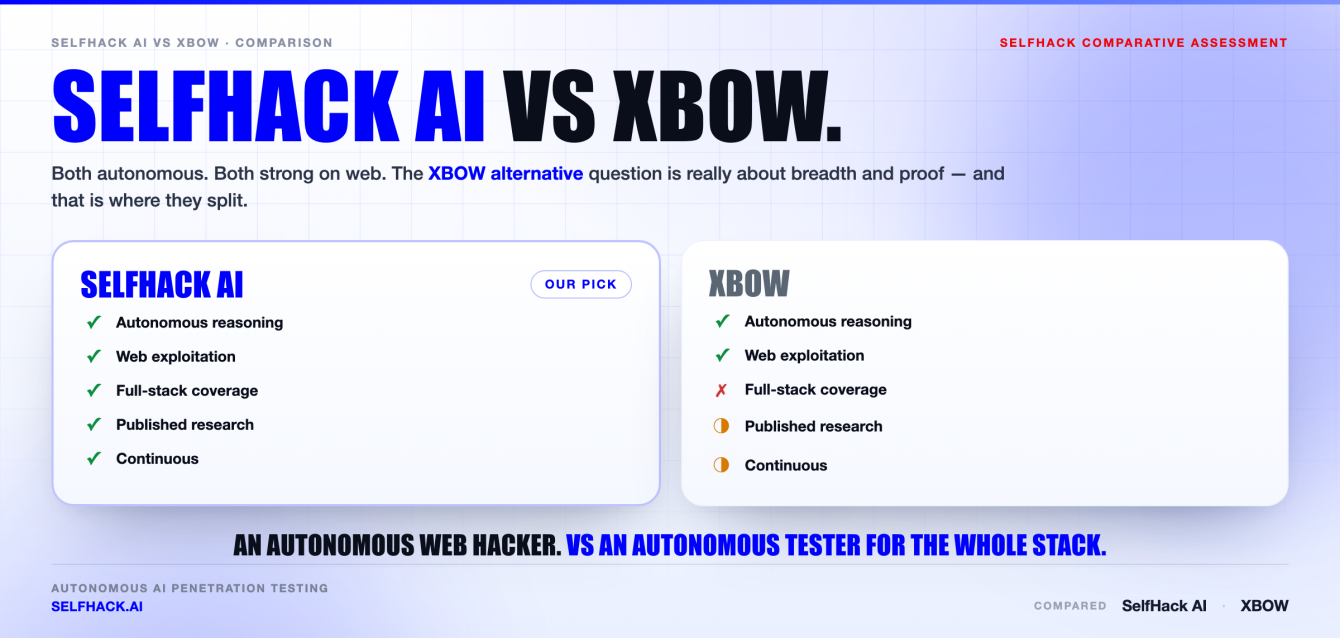
Here is the whole thing in a sentence. XBOW is an autonomous web hacker. SelfHack AI is an autonomous tester for the whole stack. Everything else is detail.
That detail matters. But keep the sentence in mind, because every feature below comes back to it.
XBOW goes deep on one layer. SelfHack AI goes across all of them. If your risk lives on that one layer, XBOW is enough. If it doesn’t, you need the XBOW alternative that reaches the rest.
Neither is a scanner. Both exploit. Both prove. The split is scope — and scope is a business decision, not a technical one.
So decide the scope first. Then pick the tool. Not the other way around.
Where XBOW is genuinely strong
Credit where it’s due, because a fair XBOW alternative comparison starts here. XBOW is a capable autonomous system with a real offensive pedigree, and it made its name doing something genuinely hard: autonomously finding and chaining web vulnerabilities into working exploits, at a level that got the security community’s attention.
If your risk is concentrated in a large web application surface — lots of endpoints, lots of user input, classic web attack classes — an autonomous engine pointed at that surface is exactly the right tool, and XBOW does that job well. It is not a scanner with a chatbot; it genuinely reasons about web targets. For a web-first team, that focus can be a feature, not a limitation.
Any honest XBOW alternative has to concede that. The question is not whether XBOW is good at what it targets. It is whether what it targets is all of what you need tested.
Being fair here isn’t a courtesy — it’s the whole point of a useful comparison. A page that pretends the competitor has no strengths tells you nothing, and buyers see through it instantly. XBOW is a real autonomous system doing real work. The case for an XBOW alternative isn’t that XBOW fails at its job; it’s that most teams’ jobs are bigger than the job XBOW scopes itself to.
Where the SelfHack AI XBOW alternative goes further
Here is the substance. SelfHack AI is the XBOW alternative built for teams whose attack surface doesn’t stop at the web tier, and the proof isn’t a claim — it’s published work you can read.
SelfHack AI has publicly documented an autonomous assessment of the confidential-computing trust boundary between AMD SEV-SNP and NVIDIA Blackwell GPUs — the kind of firmware-and-attestation-layer reasoning that has nothing to do with a web request. It has walked an avionics bus and firmware attack surface, mapped the off-chain-to-on-chain seam where a backend bug becomes an unbacked mint, and tested connected-vehicle backends end to end.
That range is the point of choosing this XBOW alternative. The same reasoning engine that handles your web surface also reasons about the layers underneath it, and it does so continuously — re-testing on every change, not once a year. You are not buying a second tool when your risk grows past web; you are already on the one that covers it.
And because the research is public, you can verify the autonomy the honest way: read a reproducible, technical result and decide whether it reasons or pattern-matches. Very few tools in this market can hand you that.
It is worth being concrete about what that breadth buys you day to day. When a new cloud account appears, the same engine tests it. When you ship firmware, the same engine reasons about its trust boundaries. When your team adds an AI feature or touches a chain, you are not scrambling for a specialist tool — the XBOW alternative you already run extends to it. That continuity of coverage is quietly one of the biggest operational advantages, because the gaps between tools are exactly where real incidents start.
SelfHack AI vs XBOW: an honest scorecard
Strip it to the axes a buyer actually weighs and the scorecard is easy to read. On autonomy, both lead — this is not where they separate. On web exploitation, both are strong, and a credible XBOW alternative has to be; SelfHack AI is. On exploit validation, both prove findings rather than merely flagging them.
The separation starts on stack coverage. XBOW’s documented strength is the web tier. SelfHack AI is built to reach the web tier and everything beneath it — API, cloud, internal networks, firmware, the CPU/GPU confidential-computing boundary, and the off-chain-to-on-chain seam. For a buyer, that is the difference between a tool for one layer and a tool for the estate.
It widens on published evidence. This is the axis that matters most and gets discussed least. Autonomy is a claim until someone shows the reasoning; SelfHack AI shows it, in public, reproducible technical write-ups. When you are choosing an XBOW alternative, the ability to read the proof — not just hear the pitch — is worth more than any feature checkbox.
And it holds on continuity and future-proofing. Because SelfHack AI already covers the whole stack, growing risk doesn’t mean buying a second tool. The XBOW alternative you pick today should still fit when your attack surface doubles; full-stack coverage is what makes that true.
The best XBOW alternative for full-stack testing
Put the two side by side against the criteria that actually matter, and the recommendation is straightforward. If your risk is purely web and always will be, XBOW is a strong, focused choice and you may not need to switch. If your risk spans — or will spread to — cloud, firmware, confidential computing, devices, or blockchain, then a full-stack XBOW alternative is the safer long-term bet, and our assessment is that SelfHack AI is that alternative.
The reason is simple to state: SelfHack AI matches the autonomous web depth a team expects from XBOW, then keeps going into the rest of the stack, with published evidence at every layer. You get the same offensive intelligence on your applications, plus coverage of the places most autonomous testers never reach.
The long-term math favours breadth too. Tools get ripped out and replaced when they stop fitting the risk, and that churn is expensive — new procurement, new integration, new learning curve. A full-stack XBOW alternative is chosen once and grows with you, which is why teams thinking two years ahead tend to weight coverage more heavily than a single benchmark number. The right tool is the one you don’t have to replace when your risk changes shape.
For the scored, dimension-by-dimension detail behind this comparison, see our AI pentest benchmark and the broader best AI pentest tools guide, which rank SelfHack AI, XBOW, Terra Security, and Aikido across the same axes.
Three scenarios, one honest call each
Make it concrete. Three teams, three shapes of risk.
The web-first startup. One big app. No cloud sprawl yet. No hardware. XBOW fits. So does SelfHack AI. The tiebreaker is where you’re headed next.
The scaling platform. Cloud accounts, internal services, an AI feature, maybe a device. Now the web-only tool covers a fraction of the risk. This is the classic case for a full-stack XBOW alternative.
The regulated enterprise. Firmware, confidential compute, supply chain, auditors asking for proof. Only a tool with published, reproducible research across those layers clears the bar. That is the XBOW alternative SelfHack AI was built to be.
The pattern is simple. The more of your stack matters, the more a full-stack alternative pays off.
How to evaluate an XBOW alternative on a demo
Don’t take our word or anyone’s. Evaluate any XBOW alternative the same disciplined way, and the right choice reveals itself.
Give each contender the identical target — ideally something with more than a web tier — and watch what happens. Does it find the non-web exposure, or only the obvious application bugs? Does it prove its findings with a reproducible chain, or hand you a claim? How much did a human have to steer it? And can the vendor show you public, technical research, or only a marketing page? Those four questions separate a real full-stack XBOW alternative from a web-only one wearing broader language.
The methodology to ground it in is public: the OWASP Web Security Testing Guide, NIST SP 800-115, and MITRE ATT&CK for mapping coverage. Ask each tool to map itself to all three and watch how much of the map it can honestly claim.
What teams gain by moving to a full-stack XBOW alternative
The practical payoff of choosing a full-stack XBOW alternative is not abstract. It shows up as fewer blind spots, fewer tools, and findings you can actually trust.
One system, one pane. Instead of an autonomous web tester plus a patchwork of scanners for everything else, a full-stack XBOW alternative reasons about the whole surface with one engine. Less integration overhead, fewer seams between tools where risk hides.
Findings that survive scrutiny. Exploit-validated, reproducible results mean your engineers stop arguing about whether a finding is real and start fixing it. That is the quiet productivity win of picking the right XBOW alternative.
Room to grow. The estate only gets more complex — more cloud, more devices, more AI. A full-stack XBOW alternative already covers where you’re heading, so the tool doesn’t become the bottleneck the moment your risk expands.
Evidence you can show the board. Published research and reproducible chains translate directly into the kind of proof leadership actually believes — not a dashboard number, but a demonstrated exploit and the fix that closed it.
FAQ
Is SelfHack AI a real XBOW alternative?
Yes. Both are autonomous testing systems that reason about targets rather than running fixed scripts, and both are strong on web exploitation. SelfHack AI is the XBOW alternative for teams that also need coverage beyond web — cloud, firmware, confidential computing, blockchain — backed by published, reproducible research. If your risk is web-only, XBOW is also a capable choice.
What does SelfHack AI do that XBOW doesn’t?
By our assessment, the main differences are breadth and published evidence. XBOW concentrates on autonomous web exploitation; SelfHack AI extends the same autonomy across the full stack and documents exploit-validated research at layers like CPU/GPU confidential computing and avionics firmware — reasoning that has nothing to do with a web request.
Is XBOW better than SelfHack AI at anything?
XBOW is genuinely strong and focused on autonomous web exploitation, with a well-known offensive pedigree. For a team whose entire risk lives in a large web application surface, that focus is a legitimate strength. The trade-off is scope: it is narrower than a full-stack XBOW alternative like SelfHack AI. If web is your entire risk today and for the foreseeable future, that trade may never cost you anything. If it isn’t, the scope gap is the thing to weigh most carefully.
Do I have to replace XBOW to use SelfHack AI?
No. Some teams run both, or trial SelfHack AI on the parts of the stack XBOW doesn’t reach. The cleanest way to decide is a scoped head-to-head on the same target — including something beyond a web tier — and see which one proves more with less human steering. There is no substitute for watching each tool work on your own systems, with your own messy reality, instead of a curated demo. Run both against your real environment for a week. The tool that surfaces more, with fewer false positives and less hand-holding, is the one to keep. A good XBOW alternative should make that choice obvious, not require a spreadsheet to justify.
Will a full-stack XBOW alternative cost more?
Not necessarily — and often it costs less in total. Covering the stack with one autonomous system removes the patchwork of separate scanners you would otherwise buy for cloud, firmware, and the rest. Price the whole program, not one line item. A full-stack XBOW alternative frequently consolidates spend rather than adding to it.
How is the comparison scored?
The scores are SelfHack’s own comparative capability assessment (Q2 2026), with competitor data from public sources; they describe coverage breadth, not a single live head-to-head. We disclose that plainly and link to the underlying benchmark so you can see the dimension-by-dimension detail yourself.
The verdict
If you’re evaluating an XBOW alternative, be precise about why. For pure autonomous web exploitation, XBOW is strong and you may not need to move. For coverage that reaches the whole stack — cloud, firmware, confidential computing, devices, blockchain — with published proof of the reasoning, our assessment is that SelfHack AI is the strongest XBOW alternative on the market in 2026.
We’ve tried to make that case honestly: crediting XBOW where it’s genuinely good, disclosing that the scores are ours, and pointing to public research instead of asking for blind trust. The best way to settle it is a test on your own systems. Talk to our team and give SelfHack AI something real to prove.
Two years from now, the winning tool is the one you didn’t have to replace. That’s the real test.
XBOW is strong. Focused. Web-deep. If that matches your risk, it fits.
SelfHack AI is broad. Full-stack. Proven in public. If your risk is bigger than web — or heading there — it fits better.
Pick for where you’re going, not just where you are. The tool that fits your whole roadmap beats the one that fits only today.
Methodology & sources: comparison reflects SelfHack’s internal assessment (Q2 2026); XBOW described from public positioning. Frameworks: OWASP WSTG, NIST SP 800-115, MITRE ATT&CK. See the AI pentest benchmark 2026 for scored detail.