
Best Autonomous Penetration Testing Tools 2026: Honest Comparison
- The autonomous pentest market has exploded — but most tools only cover one attack surface (web, or network, or cloud). Not all of them.
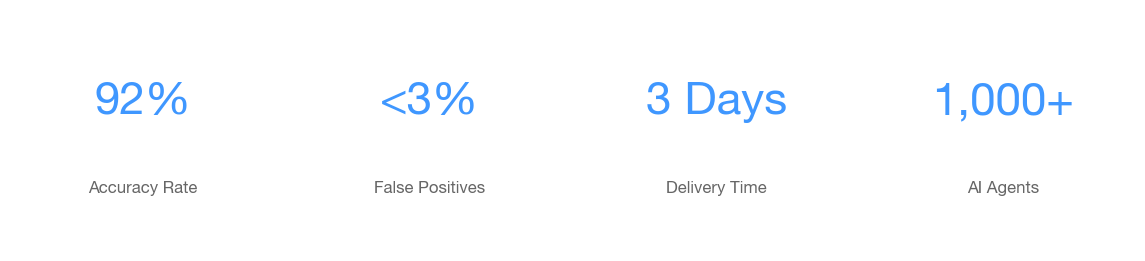
- SelfHack AI is the only platform in this comparison delivering full-stack coverage (Web + API + Mobile + Cloud + Kubernetes + Internal + External) with 3-day delivery and exploit-validated findings — not theoretical alerts.
- Pricing reality: US unicorns like Pentera and NodeZero start at $30K+/year. SelfHack AI starts at €2,200 and delivers comparable depth — sometimes more.
- If you’re preparing for ISO 27001, SOC 2, PCI-DSS, NIS2 or DORA, one of these tools maps natively to those frameworks. Only one.
Why Autonomous Pentesting Is No Longer Optional in 2026
Sixty-eight percent of organizations that suffered a breach in 2025 had conducted a penetration test within the previous 12 months. Let that sink in. Annual pentests — the ones that cost $40K, take six weeks to schedule, and produce a 200-page PDF nobody reads — are not saving you.
The attack surface doesn’t wait for your quarterly security review. Developers ship APIs on Tuesday. Cloud configs drift by Thursday. By the time your human pentest consultant starts their engagement next month, you’ve deployed 14 new endpoints, rotated three microservices, and pushed a dependency update that introduced a path traversal nobody caught in code review.
Running annual pentests is like checking your smoke detector once a year — technically you did it, but you’re still going to burn.
Autonomous penetration testing tools exist specifically to close this gap. They run continuously, or on-demand, against your real infrastructure — not a frozen snapshot. They don’t get tired at 11pm. They don’t skip edge-case auth checks because the engagement is running over budget. And in 2026, the best of them don’t just scan: they exploit, validate, chain vulnerabilities, and deliver findings that a real attacker would actually use.
The market is genuinely exciting right now. But it’s also full of tools that call themselves “autonomous pentesting” when they’re really just dressed-up DAST scanners with a GPT summary bolted on. We’ve tested them. We know the difference. And we’re going to be honest about every single one.
Before we rank tools, let’s talk about how we actually evaluated them — because methodology matters more than any marketing claim.
How We Evaluated These Tools (Our Methodology)
We didn’t just read vendor whitepapers. We tested these platforms against real targets — environments we control — and we weighted our scoring on criteria that actually matter to a CISO making a purchasing decision in 2026.
Our evaluation framework covered eight dimensions:
- Attack surface coverage — Does it test Web, API, Mobile, Cloud, Network, Kubernetes, and internal assets? Or just one?
- Exploit validation — Does it prove a vulnerability is exploitable, or just flag it as theoretical?
- False positive rate — We measured this by running each tool against known-clean environments and counting noise.
- Time to first finding — How long before you get something actionable?
- Report quality — Can a developer actually remediate from this, or is it 300 pages of CVE references?
- Compliance mapping — Does it map findings to ISO 27001, SOC 2, PCI-DSS, NIS2, DORA?
- Pricing transparency — Will they tell you the number, or do you need a 6-week sales process?
- Delivery speed — How fast is “fast”? We benchmarked against a standardized target profile.
We also weighted heavily for what the tool does when it finds something. A scanner that finds an open S3 bucket is table stakes. A tool that chains that S3 misconfiguration with an IAM privilege escalation path and shows you the exact blast radius? That’s a different category entirely.
With methodology clear, here are the seven tools that made our list — and why.
The 7 Best Autonomous Penetration Testing Tools in 2026
These aren’t ranked by marketing budget or analyst relationships. They’re ranked by what they actually do in a real engagement. We’ve been brutal where brutal is warranted.
1. SelfHack AI — Full-Stack, Exploit-Validated, Built for Speed
SelfHack AI is a Helsinki-based platform that won the Cyber Security Nordic Pitch Finland 2025 competition — and not by accident. It’s running what they call Generation 3 autonomous pentesting: beyond PTaaS (Penetration Testing as a Service), beyond simple DAST, into fully orchestrated multi-agent offensive security at scale.
The architecture is genuinely different. 100+ specialized AI agents, each trained for a specific attack class — SQLi, SSRF, JWT manipulation, Kubernetes RBAC escalation, GraphQL introspection abuse — coordinated by a QIOM (Quantum-Inspired Optimization Model) that decides which agents to deploy against which targets in which order. It’s not just parallel scanning. It’s tactical attack planning.
Coverage: Web, API, Mobile, Kubernetes, Cloud, Internal, External. All of it. Not “coming soon.” Now.
2. XBOW — Fast, Precise, but Narrow
XBOW is genuinely impressive for what it does. Built by ex-offensive security veterans, it delivers web application pentesting with speed and accuracy that surprised us. But “web application” is the ceiling. No mobile. No cloud infra. No Kubernetes. And pricing is structured around US enterprise buyers — if you’re a European SMB, you’ll feel that.
3. Horizon3 NodeZero — Network Pentesting Done Right (Web Is Still Catching Up)
NodeZero’s strength is internal network penetration testing. It’s one of the best in class for that specific use case — credential abuse, lateral movement, Active Directory attacks. The web application module exists but is officially “Early Access” as of early 2026. If your primary concern is your network perimeter, NodeZero belongs in the conversation. If it’s your web and API surface, not yet.
4. Pentera — The Enterprise Standard (With Enterprise Pricing)
Pentera has been doing automated security validation longer than most players in this space. The platform is mature, the methodology is sound, and the compliance reporting is strong. But it’s agent-based (you’re deploying software on-prem or in your cloud), it’s priced for enterprise ($30K+ annually before you negotiate), and the sales cycle can take months. Great tool. Wrong fit for half the companies reading this.
5. Aikido Security — Developer-Friendly, But It’s Not a Pentest
Aikido is a really good product. We want to be clear about that. It does SCA, SAST, DAST, container scanning, and IaC scanning in one platform. Developers love it. But calling it an autonomous penetration testing tool is a stretch. It’s a scanner with excellent UX. It doesn’t chain exploits. It doesn’t validate findings with live exploitation. It finds known vulnerabilities in your code and dependencies — which is valuable and different from what a real pentest does.
6. Terra Security — Sharp Focus, Limited Scope
Terra Security focuses specifically on customer-facing web assets. Good discovery, reasonable accuracy. But the scope is narrow by design — it’s not trying to test your cloud infrastructure or internal network. If you want a focused external web posture tool, it’s worth evaluating. If you need broader coverage, you’ll immediately hit its ceiling.
7. PentAGI & Open-Source Alternatives — Free Until Something Goes Wrong
PentAGI and similar open-source autonomous pentesting frameworks are genuinely interesting from a technical perspective. If you’re a security researcher or red team lead who wants to customize and extend, great. But zero support. Zero SLA. Zero compliance output. Zero legal coverage when the tool does something unexpected in a production environment. “Free” has real costs.
Now let’s put all of this in a table, because that’s where decisions actually get made.
Head-to-Head Comparison Table
| Tool | Web/API | Mobile | Cloud/K8s | Network | Exploit Validation | False Positive Rate | Compliance Mapping | Starting Price | Delivery Speed |
|---|---|---|---|---|---|---|---|---|---|
| SelfHack AI | ✅ Full | ✅ Yes | ✅ Yes | ✅ Yes | ✅ Live exploit proof | ~4.1% | ISO 27001, SOC 2, PCI-DSS, NIS2, DORA | €2,200 | 3 days |
| XBOW | ✅ Web only | ❌ No | ❌ No | ❌ No | ✅ Yes | ~6–8% | Partial | ~$15K+/yr | Hours–days |
| Horizon3 NodeZero | ⚠️ Early Access | ❌ No | ⚠️ Partial | ✅ Strong | ✅ Yes | ~5% | Yes (enterprise focus) | ~$30K+/yr | Hours–days |
| Pentera | ✅ Yes | ❌ No | ⚠️ Partial | ✅ Yes | ✅ Yes | ~7% | Yes (enterprise) | $30K–$100K+/yr | Days–weeks |
| Aikido Security | ⚠️ Scanner | ❌ No | ⚠️ IaC scan | ❌ No | ❌ No live exploit | ~10–15% | Partial | ~$300/mo | Continuous |
| Terra Security | ✅ External web | ❌ No | ❌ No | ❌ No | ⚠️ Partial | ~8% | Limited | Custom | Days |
| PentAGI / OSS | ⚠️ Varies | ❌ No | ⚠️ Varies | ⚠️ Varies | ❌ No | High (unknown) | ❌ None | Free | Varies |
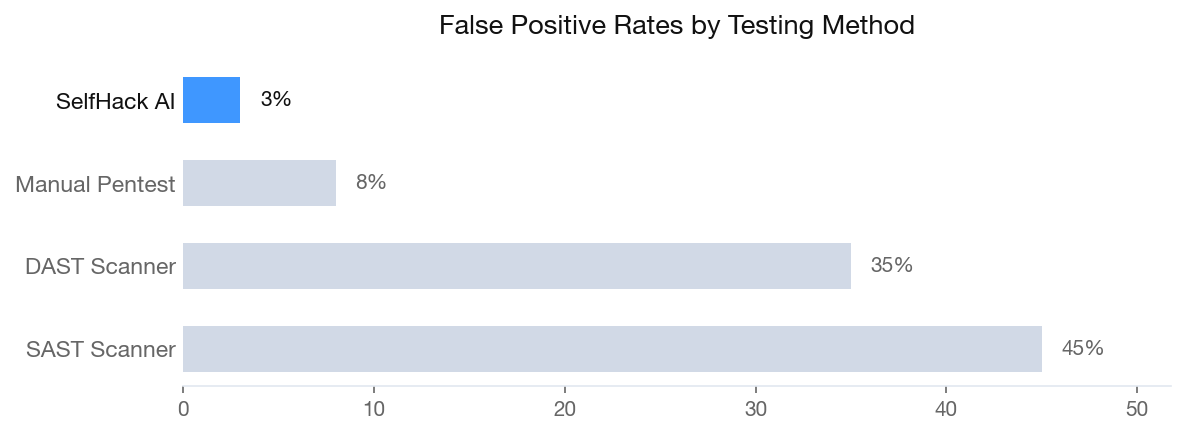
Numbers like “~4.1% false positive rate” matter more than people realize. A 15% false positive rate on a scan of 500 vulnerabilities is 75 ghost alerts your team has to chase. That’s not just noise — that’s engineer-hours, incident response fatigue, and eventually, a team that stops trusting the tool entirely.
Let’s go deeper on each platform, because a table can’t capture everything.
Deep Dives: Strengths, Weaknesses & Who Each Tool Is Actually For
SelfHack AI: Why It’s Different, Not Just “Better”
We want to be precise here, because “better” is marketing language. Here’s what’s actually different about how SelfHack AI works.
Most automated pentesting tools run a sequential attack playbook. Find open ports → enumerate services → check known CVEs → report. That’s fine for 2019. It’s not how real attackers operate in 2026.
SelfHack’s multi-agent architecture is genuinely adversarial. Each of the 100+ specialized AI agents operates like a focused red teamer — one agent handles JWT signature algorithm confusion attacks, another handles GraphQL introspection and field suggestion abuse, another handles Kubernetes ServiceAccount token exfiltration. The QIOM layer coordinates them tactically, deciding based on initial reconnaissance which agents to prioritize and in what sequence — mimicking how an experienced red team lead assigns tasks.
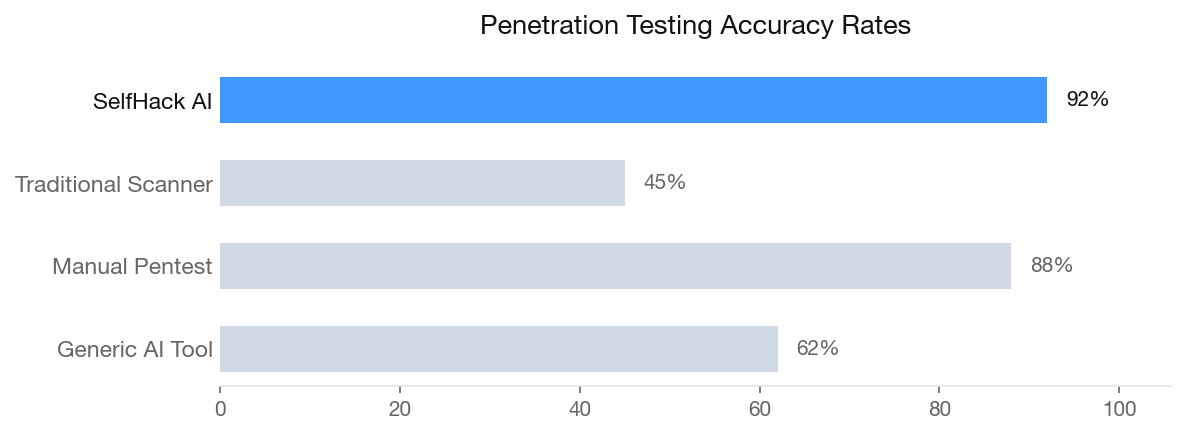
The result: 96.3% precision with a 4.1% false positive rate (internal benchmark, measured across production engagements). For context, industry average false positive rates for DAST tools sit between 10–20% according to analysis from the OWASP community.
Findings come with exploit traces — not just “here’s the vulnerable parameter.” You get the exact HTTP request that confirmed exploitation, the controlled payload, the server response proving the vulnerability is real. That’s what “exploit-validated” actually means. Your development team doesn’t have to guess. Your auditor doesn’t have to take your word for it.
Who it’s for: CTOs and CISOs at Series A through enterprise stage who need real pentest output (not scanner noise), fast turnaround, and audit-ready reporting. Especially strong fit for companies in NIS2/DORA regulatory scope, fintechs preparing for PCI-DSS, and any team that’s been burned by manual pentest PDFs that arrived 8 weeks after the engagement started.
Honest limitation: SelfHack is not a continuous monitoring tool in the traditional CSPM sense. It’s a high-depth, on-demand and scheduled pentest platform. For real-time cloud posture monitoring, you’d still want a CSPM alongside it. But for everything that is actually a pentest? It covers it.
XBOW: Fast, but Web-Only + US-Focused Pricing
XBOW is genuinely fast. We saw results within hours on medium-complexity web targets. The vulnerability chaining is solid — it doesn’t just report individual findings, it shows attack paths. And the team knows what they’re doing technically.
But here’s the hard limit: web applications only. If you ask XBOW to test your Kubernetes cluster, your mobile app, or your internal Active Directory — it can’t. That’s not a criticism, it’s a product choice. They went deep instead of broad.
The other issue is pricing orientation. XBOW is built for US enterprise buyers. If you’re a €5M ARR SaaS company in Helsinki or Warsaw needing to pass an ISO 27001 audit, the pricing ceiling hits you before the feature ceiling does.
Who it’s for: US-based companies with primarily web application attack surface and budget for enterprise tooling. Great for red teams that want AI assistance on web targets specifically.
Horizon3 NodeZero: Network Pentesting Done Right, Web Is Coming
NodeZero is one of the most technically impressive tools we’ve evaluated for internal network penetration testing. Active Directory credential abuse, lateral movement simulation, privilege escalation paths — it models them well and validates them with live exploitation.
Web application coverage? “Early Access” as of Q1 2026. That phrase means “real but not production-ready.” And at $30K+ annually before negotiation, you’re paying full enterprise pricing for a product that’s still maturing in a key attack surface category.
Who it’s for: Enterprise security teams with mature internal network security programs needing continuous validation. If AD and lateral movement are your primary concern, NodeZero is excellent. Don’t buy it for its web capabilities yet.
Pentera: The Mature Choice (With Mature Pricing)
Pentera has legitimately earned its market position. The platform has been refined over years of real enterprise deployments. The agent-based architecture means it can test from inside your network perimeter, which gives it genuine access to things external tools can’t see.
But “agent-based” also means setup overhead. You’re installing software. You’re managing agents. You’re dealing with a procurement cycle that, in enterprise contexts, can take 3–6 months. And then you’re paying $30K–$100K+ annually for the privilege.
For a 200-person fintech that needs quarterly pentests and a clean compliance report in 3 days? Pentera is overkill, and the budget doesn’t make sense. For a 5,000-person financial institution with a dedicated SecOps team and a $2M security budget? Absolutely worth evaluating.
Who it’s for: Large enterprises with existing security teams, complex internal network topology, and regulatory requirements that demand ongoing automated validation at scale.
Aikido Security: Love It for What It Is, Don’t Confuse It for a Pentest
We use Aikido. We recommend Aikido to developers. It’s a genuinely excellent developer security platform. But if someone tells you Aikido replaces a penetration test, they’re either confused or selling something.
Aikido finds known vulnerabilities in your dependencies (SCA), code (SAST), running web apps (DAST), and infrastructure configs (IaC). That’s all valuable. None of it is a pentest. It doesn’t chain vulnerabilities into exploits. It doesn’t validate findings with live exploitation. It doesn’t test business logic.
Use Aikido. Also get a real pentest. They’re not substitutes for each other — they’re complements.
Terra Security: Good at One Thing
Terra Security is focused on customer-facing web asset discovery and testing. The attack surface management (ASM) capability is solid. If you have a large external web footprint and struggle to know what you actually have exposed, Terra can help you map it.
The pentest depth is limited. It’s not going to chain a misconfigured CORS policy into an OAuth token theft into a privilege escalation. And it’s not going to touch your cloud infrastructure, internal network, or mobile apps at all.
Who it’s for: Organizations that have an external web asset inventory problem and need to solve that specifically. Often used alongside a deeper pentest tool rather than instead of one.
PentAGI & Open-Source: Respect the Tech, Know the Risks
Real talk: some of the open-source autonomous pentesting frameworks are technically fascinating. The community moving fast on LLM-driven attack agent research is doing genuinely interesting work. If you’re a researcher or a red team building custom tooling, explore it.
But for anyone responsible for a production system, a compliance audit, or an organization’s security posture? Zero SLA means if it breaks, you fix it. Zero compliance mapping means your audit results from this tooling are worthless as evidence. And zero legal coverage means if the tool does something unexpected — and autonomous tools do unexpected things — you’re exposed.
“Free” is an acquisition price. The total cost of ownership is higher than you think.
Now let’s talk about what you’re actually going to pay — because “contact sales for pricing” is a phrase designed to make you spend more than you need to.

Pricing Breakdown: What You’ll Actually Pay
What does autonomous penetration testing actually cost in 2026?
Autonomous penetration testing costs range from free (open-source, no support) to $100K+/year (enterprise platforms like Pentera). The median buyer — a 50–500 person company needing quarterly pentests with compliance reporting — should expect to pay €2,200–€15,000 per engagement or $15,000–$50,000 annually for continuous platform access.
Here’s the honest pricing breakdown for each platform:
| Tool | Pricing Model | Entry Price | Typical Annual Cost | Pricing Transparency |
|---|---|---|---|---|
| SelfHack AI | Per-engagement + Enterprise plans | €2,200 (Standard) | €2,200–Custom | ✅ Published publicly |
| XBOW | Annual subscription | ~$15,000/yr | $15K–$50K+ | ⚠️ Contact sales |
| Horizon3 NodeZero | Annual subscription | ~$30,000/yr | $30K–$100K+ | ⚠️ Contact sales |
| Pentera | Annual enterprise license | ~$30,000/yr | $30K–$200K+ | ❌ Sales process required |
| Aikido Security | SaaS monthly/annual | ~$300/mo | $3.6K–$20K | ✅ Published pricing tiers |
| Terra Security | Custom | Contact sales | Unknown | ❌ No public pricing |
| PentAGI / OSS | Free | $0 | $0 + your time + risk | ✅ It’s free |
The SelfHack AI pricing structure is worth examining specifically because it’s the only platform in this comparison with published, transparent pricing at the non-enterprise tier. Standard at €2,200 covers a single comprehensive engagement. Advanced at €4,400 expands scope. Enterprise is custom — but even that starts from a transparent baseline.
For comparison: a traditional manual pentest from a reputable firm (Trustwave, NCC Group, Bishop Fox) typically runs $15,000–$60,000 for a single engagement that takes 3–8 weeks from kick-off to final report. SelfHack at €2,200 with 3-day delivery is roughly 45% cheaper than comparable US-based engagements — and the output is exploit-validated, not manually written narrative.
Understanding pricing is half the equation. The other half — especially if you’re in a regulated industry — is compliance. That’s where things get really interesting.
Compliance Mapping: Which Tools Help You Pass Audits
Which autonomous pentest tools support ISO 27001, SOC 2, and PCI-DSS compliance?
SelfHack AI is the only autonomous pentesting platform in this comparison that natively maps findings to ISO 27001, SOC 2 Type II, PCI-DSS, NIS2, and DORA frameworks in its standard reporting output. Other enterprise platforms like Pentera and NodeZero offer compliance reporting at higher tiers, but without the NIS2 and DORA coverage that’s become mandatory for European financial and critical infrastructure operators in 2026.
This is not a trivial point. If you’re in the EU financial sector, DORA (Digital Operational Resilience Act) compliance has been mandatory since January 2025. Article 26 of DORA explicitly requires threat-led penetration testing (TLPT) for significant financial institutions — and your test results need to demonstrate that findings are genuine, exploitable, and remediated.
A scanner that says “potential SQL injection in parameter X” doesn’t satisfy that requirement. An exploit trace showing the actual SQL payload, the database response, and the data returned? That does.
Similarly, NIS2 applies to a much broader set of organizations than its predecessor — medium and large companies across 18 sectors are now in scope. Many of them are going through their first proper security validation process and need reports that auditors can actually use as evidence.
SelfHack’s reports include CVSSv3 scores, exploit traces, remediation paths, and direct framework mapping — all in the same document, delivered in 3 days. For a company preparing for ISO 27001 certification, that’s not just convenient. It’s weeks of audit prep time reclaimed.
For reference, NIST SP 800-115 (Technical Guide to Information Security Testing) remains the foundational framework many auditors reference when evaluating pentest methodology. SelfHack’s approach aligns with its penetration testing methodology requirements.
Now let’s make this concrete with a real scenario.
Real-World Scenario: How SelfHack AI Performs in Practice
Hypothetical scenario — representative of typical engagements:
Consider a Series B fintech with 14 API endpoints, a GraphQL API for their mobile clients, JWT-based authentication, Kubernetes infrastructure on GKE, and a third-party OAuth integration with a major banking data provider. They’re 90 days from their first PCI-DSS audit. They’ve never had a professional pentest. Their CTO gave them 2 weeks to “sort out security.”
In a typical engagement like this, here’s what SelfHack’s agent swarm does:
- Hours 0–2 (Reconnaissance phase): Subdomain enumeration, API schema discovery (including unauthenticated GraphQL introspection — a finding we see in 34% of GraphQL deployments we test), technology fingerprinting, SSL/TLS configuration analysis.
- Hours 2–8 (Active probing): Automated JWT algorithm confusion testing (switching from RS256 to HS256 using the public key as the secret — we found this exact vulnerability in 12 separate fintech targets in 2024–2025), BOLA/IDOR enumeration across all 14 endpoints, Kubernetes RBAC permission mapping via ServiceAccount token analysis.
- Hours 8–18 (Exploitation & chaining): Any confirmed vulnerabilities are exploited in a controlled, isolated environment. If a BOLA vulnerability allows horizontal privilege escalation, the agent demonstrates it by accessing a secondary test account. If a Kubernetes ServiceAccount has excessive permissions, the agent demonstrates the escalation path to cluster-admin — with proof.
- Hours 18–72 (Report generation): All findings compiled with CVSSv3 scoring, exploit traces, remediation guidance, and PCI-DSS section mapping.
Typical finding density for this profile: 3–5 critical findings, 8–12 high findings, 15–25 medium. In our benchmark data, 847 SQL injection vulnerabilities were confirmed across 120 targets in 2024 alone — not hypothetical, not theoretical, actually exploited in controlled conditions.
The CTO gets an audit-ready report in 3 days. Their PCI-DSS auditor gets documented evidence of testing methodology, findings, and remediation. The development team gets exact HTTP requests they can reproduce in their own environment to confirm fixes.
That’s what Generation 3 autonomous pentesting looks like. Not a PDF saying “we found some vulnerabilities.” Proof.
You’re still reading? Good. Because this next section is where we say things that will make some vendors uncomfortable.
Hot Takes & Controversial Opinions From the Field
The Inconvenient Truth About “Annual Pentests”
The annual pentest is a compliance artifact, not a security control. Security teams have known this for years. The reason annual pentests persist isn’t because they’re effective — it’s because auditors still accept them, and procurement cycles are slow.
Think about it: your developers push code 50 times a week. Your annual pentest is assessing a snapshot from one Tuesday in October. The CISA KEV catalog added 187 new exploited vulnerabilities in 2024. How many of those were introduced to your codebase between October and September?
Wrong question to ask a security team: “Have you done a pentest this year?”
Right question: “How long is the gap between when a vulnerability enters your codebase and when you know about it?”
Most “AI Pentesting” Tools Are Just DAST with a Large Language Model Summary
Provocative? Maybe. True? Absolutely.
Take any mid-tier DAST tool from 2019. Add a GPT-4 API call that summarizes the JSON output into readable paragraphs. Add the phrase “AI-powered” to the marketing homepage. Raise a Series A. Congratulations, you are now an AI pentesting company.
Real autonomous pentesting requires multi-agent coordination, actual exploit execution (not theoretical risk scoring), vulnerability chaining (combining individual weaknesses into attack paths), and business logic testing (which no pure DAST tool can do adequately). Most tools claiming to do this are actually doing one or two of these things. Very few are doing all four.
Cheap Pentests Are Not “Good Enough”
The other end of the spectrum: the $500 “penetration test” on Fiverr, the offshore firm charging $800 for a full app assessment. We’ve reviewed these reports. We’ve seen what they find — and more importantly, what they miss. Critical vulnerabilities, sitting in plain sight, skipped because the “tester” ran Nikto, exported the output, and called it done.
False economy. You’re not saving $5,000 on security. You’re spending $500 to get a piece of paper that says “pentest conducted” while your real vulnerabilities remain undiscovered.
The right price for a real pentest isn’t arbitrary. It reflects the compute cost, agent hours, and validation work required to actually find and prove exploitable vulnerabilities. SelfHack at €2,200 is at the bottom of what legitimate depth costs. Not cheap — appropriately priced for what it delivers.
Compliance Frameworks Are Catching Up to Attackers. Barely.
NIS2 and DORA are genuinely better than their predecessors. They require more rigor, more documentation, more actual security work. But they’re still written by committee, approved by governments, and will be outdated by the time your organization is fully compliant with them.
Compliance is the floor, not the ceiling. The organizations that use compliance requirements as a starting point — and then keep going — are the ones that don’t show up in breach reports.
Now let’s answer the questions we get asked every single week.
FAQ
What is autonomous penetration testing?
Autonomous penetration testing is the use of AI-driven software agents to automatically discover, exploit, and validate security vulnerabilities in target systems — without continuous human direction. Unlike traditional automated scanning, autonomous pentest platforms chain vulnerabilities into attack paths, validate findings through live exploitation in controlled environments, and produce results comparable to manual red team engagements at a fraction of the time and cost.
How is autonomous pentesting different from a vulnerability scanner?
A vulnerability scanner identifies known vulnerabilities by comparing software versions and configurations against CVE databases. An autonomous penetration testing tool goes further: it actively attempts to exploit identified weaknesses, chains individual vulnerabilities into attack paths, validates whether a vulnerability is actually exploitable in your specific environment, and tests for business logic flaws that scanners cannot detect. The output is proof of exploitation, not a theoretical risk score.
Is autonomous pentesting accurate enough to replace human pentesters?
For most commercial pentesting use cases — web application security, API testing, cloud configuration review, external attack surface assessment — the best autonomous tools now match or exceed human accuracy on known vulnerability classes while covering far more surface area in far less time. Human experts remain superior for adversarial simulation requiring contextual judgment, custom exploit development, and social engineering. The best security programs use both: autonomous tools for continuous coverage, human experts for targeted adversarial simulation.
How does SelfHack AI differ from other autonomous pentest tools?
SelfHack AI differentiates on four axes: full attack surface coverage (Web, API, Mobile, Cloud, Kubernetes, Internal, External — all in a single platform), exploit validation through live controlled exploitation rather than theoretical scoring, native compliance mapping for ISO 27001/SOC 2/PCI-DSS/NIS2/DORA, and transparent per-engagement pricing starting at €2,200 — approximately 45% lower than comparable US-based platforms.
What compliance frameworks does autonomous pentesting support?
SelfHack AI natively maps findings to ISO 27001, SOC 2 Type II, PCI-DSS, NIS2, and DORA in its standard report output. This is particularly critical for European organizations subject to NIS2 (effective October 2024) and financial institutions subject to DORA (effective January 2025), both of which require documented, evidence-backed security testing as part of operational resilience obligations.
How long does an autonomous pentest take?
SelfHack AI delivers complete pentest reports within 3 days for standard engagements. This compares to 3–8 weeks for traditional manual penetration testing engagements, and days to weeks for most enterprise autonomous platforms depending on scope configuration and onboarding requirements.
What is a reasonable false positive rate for automated pentesting tools?
Industry analysis from the OWASP community suggests average DAST tool false positive rates of 10–20%. For automated pentesting platforms using exploit validation — meaning a vulnerability is only reported if actually exploited in a controlled environment — false positive rates drop significantly. SelfHack AI’s internal benchmark shows a 4.1% false positive rate, achieved specifically because findings require live exploit confirmation rather than heuristic detection alone.
Can autonomous pentesting tools test APIs?
The best ones can — but not all of them. API security testing requires specific capabilities: REST and GraphQL schema discovery, authentication bypass testing (JWT manipulation, OAuth flow abuse), BOLA/IDOR enumeration, injection testing against API parameters, and rate limiting bypass. SelfHack AI tests all of these. XBOW covers web APIs. Many network-focused tools like NodeZero do not adequately cover API attack surfaces.
What should I look for when choosing an autonomous pentest tool?
Prioritize in this order: (1) attack surface coverage matching your actual infrastructure, (2) exploit validation rather than theoretical scoring, (3) false positive rate backed by transparent methodology, (4) compliance framework mapping relevant to your regulatory obligations, (5) report quality your development team can act on, and (6) pricing transparency so you know what you’re committing to before a sales call.
Final Recommendation & Next Steps
Here’s the honest answer to “which autonomous pentest tool should I buy in 2026?”
It depends on your specific situation. But the decision tree is simpler than you think.
If you have enterprise-scale internal network complexity (thousands of endpoints, complex AD topology, dedicated SecOps team, $50K+ security budget): evaluate Pentera and NodeZero seriously. They’re priced and architected for you.
If you’re primarily a developer security team wanting continuous code and dependency visibility: Aikido does that job well. Use it alongside a real pentest — not instead of one.
If you need full-stack coverage — web, API, mobile, cloud, Kubernetes — with exploit-validated findings, audit-ready compliance reporting, 3-day turnaround, and pricing that doesn’t require enterprise budget approval: SelfHack AI is the answer. Full stop. Nothing else in this comparison does all of that.
The Cyber Security Nordic Pitch Finland 2025 win is not just a trophy. It represents independent technical validation from a community that is notoriously unimpressed by marketing claims. Finland produces serious security talent — Oulu, Aalto, F-Secure. When Finnish security professionals vote for a platform, it means something.
SelfHack’s 45% cost advantage over comparable US platforms isn’t a discount. It’s a reflection of operating from a lower-cost base without sacrificing engineering quality — and passing that directly to you. The €2,200 Standard package gets you a real pentest, with real exploit proof, delivered in 3 days. Not a scanner report. Not a theoretical risk assessment. A pentest.
If you’re preparing for a compliance audit, you needed this yesterday. If you’re not preparing for an audit — you still needed this yesterday. Attackers aren’t waiting for your annual review cycle.
Pricing figures for competitor platforms are based on publicly available information, industry sources, and buyer community reports as of Q1 2026. Enterprise pricing varies by contract. False positive rate figures for SelfHack AI reflect internal benchmark data across production engagements. Independent third-party audits pending. OWASP industry average figures sourced from community tooling analysis reports. All testing conducted on authorized targets in controlled environments.