If you are searching for penetration testing as a service, you are already ahead of most organizations. PTaaS replaced the outdated annual pentest model with platform-based, on-demand testing. But here is what most PTaaS providers will not tell you: traditional PTaaS still relies on human pentesters, still takes 2-4 weeks, and still costs EUR 6,500-18,000 per engagement. SelfHack AI represents the next evolution — what comes after PTaaS. Over 1,000 autonomous AI agents, 92+ percent accuracy, 3-day delivery, EUR 2,200. This is not just penetration testing as a service. This is penetration testing reimagined.
The Evolution: Scanners to PTaaS to SelfHack AI
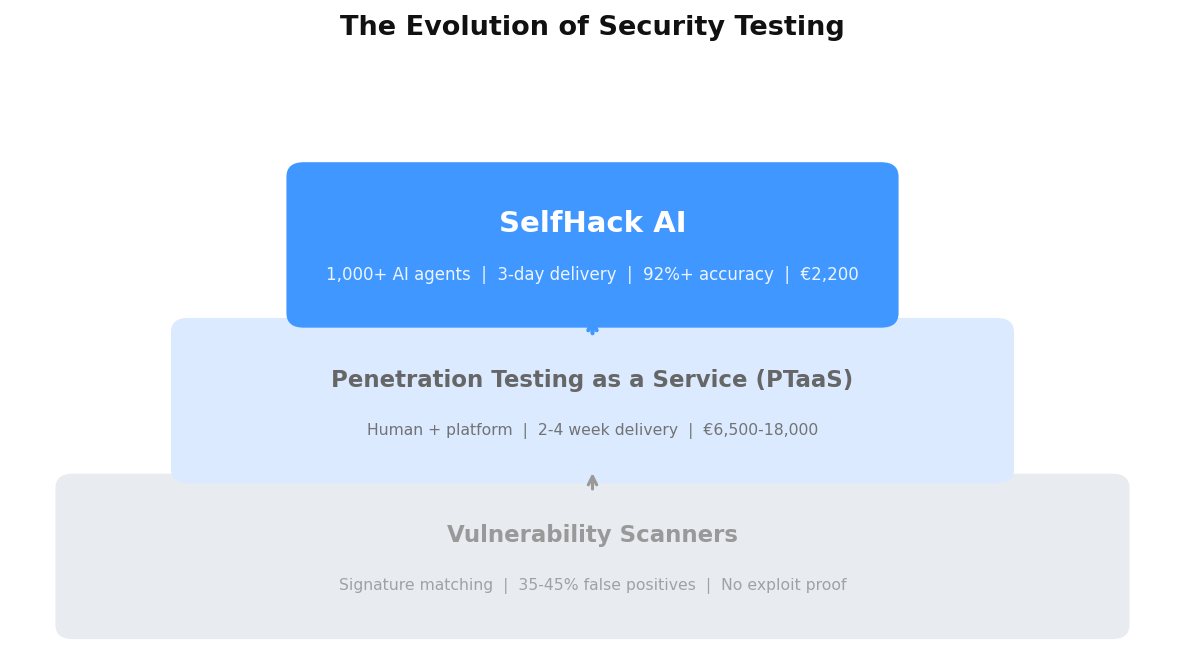
Security testing has evolved through three distinct generations:
Generation 1 — Vulnerability Scanners (Nessus, Qualys, Tenable): Automated signature matching. Fast and cheap, but 35-45 percent false positives, no exploit validation, and zero coverage for business logic or authentication flaws. Scanners find what they already know about — nothing more.
Generation 2 — Penetration Testing as a Service (PTaaS) (Cobalt, Synack, HackerOne): Human pentesters on a platform. Better detection than scanners, audit-ready reports, on-demand scheduling. But delivery still takes 2-4 weeks, costs EUR 6,500-18,000, and quality depends entirely on which pentester you get assigned. Good, but fundamentally limited by human bandwidth.
Generation 3 — Autonomous AI Pentesting (SelfHack AI): Over 1,000 specialized AI agents working in parallel. Each agent is trained for specific vulnerability classes — injection, authentication bypass, business logic, API abuse, cloud misconfiguration, network exploitation. Every finding is exploit-validated. Reports in 3 days. EUR 2,200. This is not incremental improvement over penetration testing as a service — it is a category shift.
SelfHack AI vs Traditional PTaaS: The Numbers
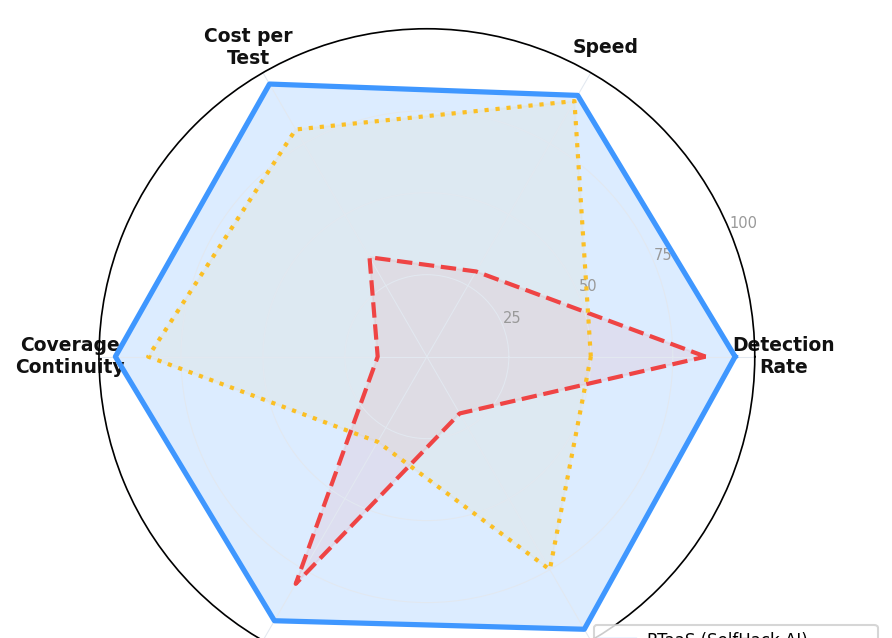
When you compare SelfHack AI against traditional penetration testing as a service providers, the performance gap is clear across every metric:
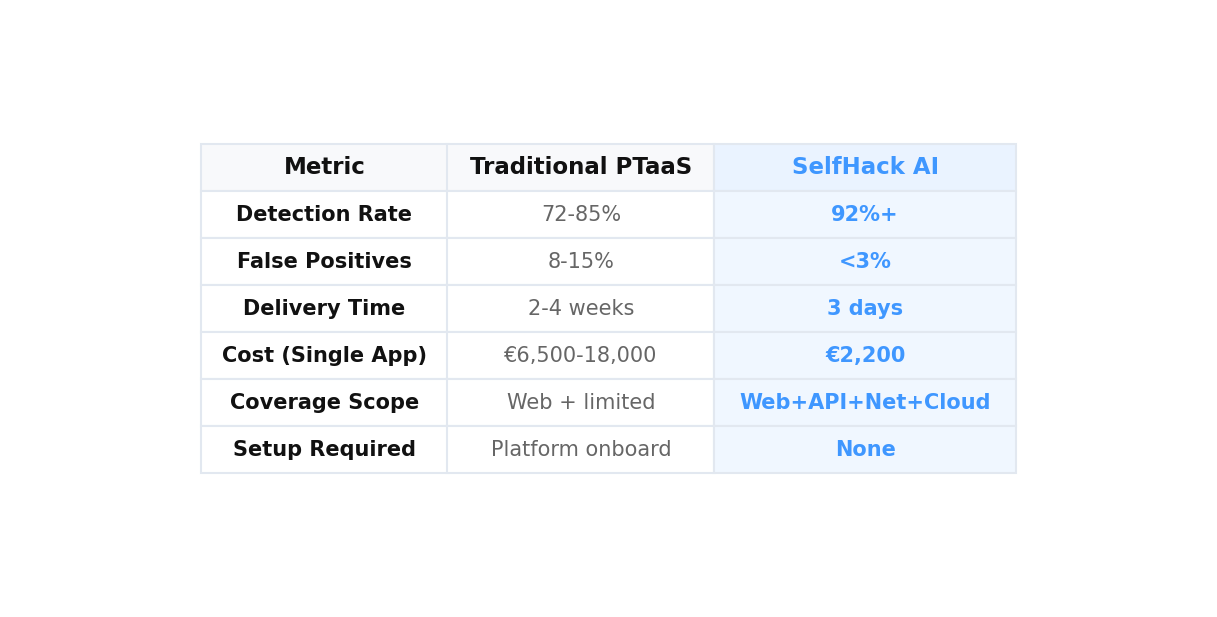
- Detection rate: SelfHack AI achieves 92+ percent vs 72-85 percent for traditional PTaaS. The difference is 1,000+ specialized agents vs a single human pentester working sequentially
- False positives: Under 3 percent vs 8-15 percent. Every SelfHack AI finding comes with exploit proof — no theoretical vulnerabilities, no wasted engineering cycles
- Delivery: 3 days vs 2-4 weeks. SelfHack AI agents work 24/7 in parallel. Human pentesters work business hours sequentially
- Cost: EUR 2,200 vs EUR 6,500-18,000. SelfHack AI costs 66-88 percent less while delivering superior results
- Coverage: Web + API + Network + Cloud in one engagement. Most PTaaS providers charge separately for each scope category
- Setup: Zero. No platform onboarding, no agent installation, no infrastructure changes. Submit your target and go
The True Value: Cost per Validated Finding
The real measure of penetration testing as a service value is not what you pay per engagement — it is what you pay per validated, exploitable finding. This is where SelfHack AI is in a different league:
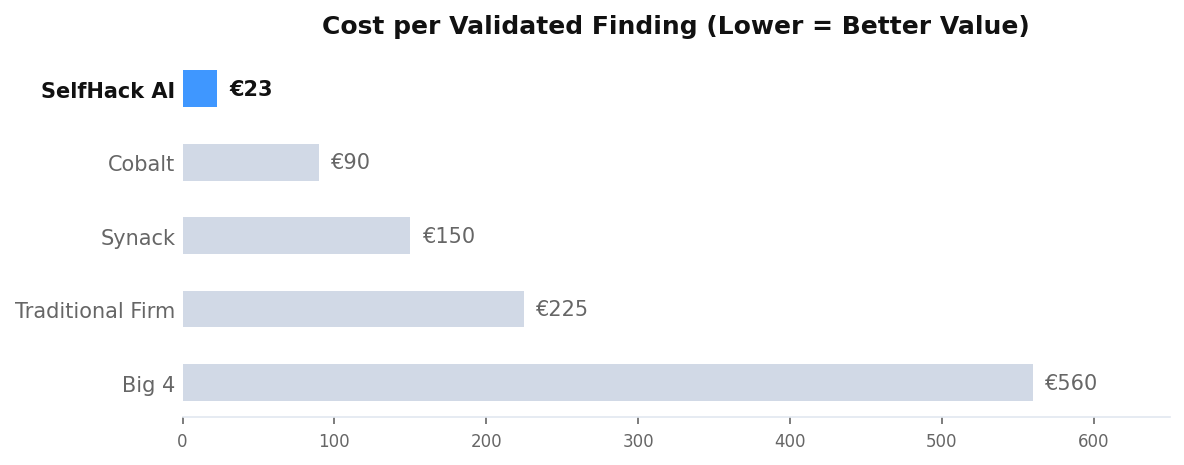
Estimates based on average engagement cost divided by average validated findings. Actual cost per finding varies by target complexity. Data from vendor case studies and industry benchmarks (Q1 2026).
At EUR 23 per validated finding, SelfHack AI delivers 4x better value than Cobalt, 6.5x better than Synack, and 24x better than Big 4 consultancies. This is not because SelfHack AI finds fewer issues — it is because 1,000+ agents find more real vulnerabilities at a fraction of the cost.
How SelfHack AI Works: Scope to Report in 3 Days
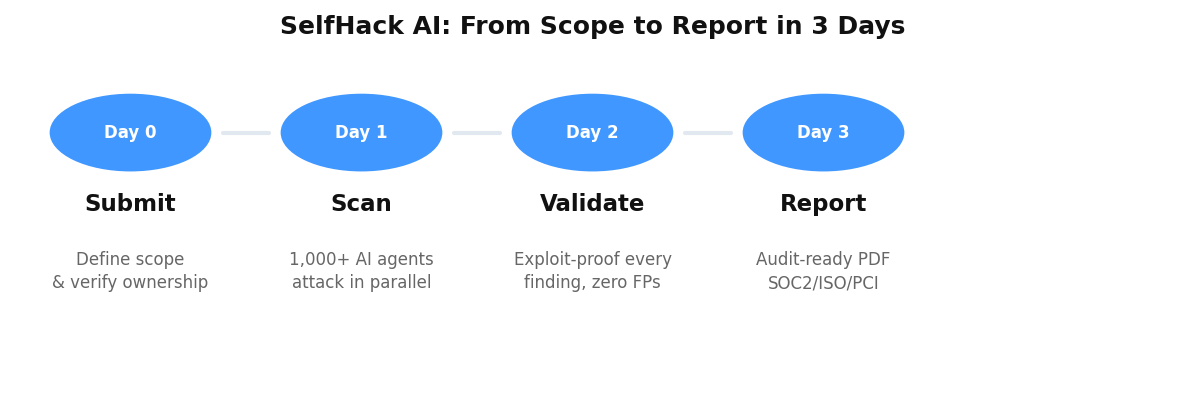
- Day 0 — Submit your scope: Define what you want tested (web applications, APIs, cloud infrastructure, internal networks). Verify domain ownership. No setup, no installation, no platform onboarding
- Day 1 — 1,000+ AI agents attack: Specialized agents deploy in parallel, testing for OWASP Top 10, business logic flaws, authentication bypasses, API vulnerabilities, cloud misconfigurations, and network exploitation paths. Each agent brings unique attack strategies trained on real-world vulnerability patterns
- Day 2 — Every finding gets exploit-validated: No theoretical “this might be vulnerable” entries. Every reported vulnerability is confirmed through controlled exploitation. Result: 92+ percent accuracy, under 3 percent false positives
- Day 3 — Audit-ready report delivered: Comprehensive PDF with CVSSv3 scoring, detailed exploit traces, step-by-step remediation guidance, and full compliance evidence for SOC2, ISO 27001, PCI-DSS, and GDPR
Who Should Choose SelfHack AI Over Traditional PTaaS?
SelfHack AI is the right choice for virtually every organization that currently uses or is considering penetration testing as a service:
- Startups and SMBs that need enterprise-grade pentesting at EUR 2,200 instead of EUR 15,000+
- Companies with compliance deadlines — SOC2, ISO 27001, PCI-DSS audits require evidence of security testing. SelfHack AI delivers audit-ready reports in 3 days, not 4 weeks
- DevOps teams deploying frequently — at EUR 2,200 per engagement, you can test every major release without blowing your budget
- Organizations frustrated with false positives — if your team wastes hours triaging scanner noise, SelfHack AI’s sub-3 percent false positive rate eliminates that problem
- Security leaders who want measurable ROI — EUR 23 per validated finding is the most efficient security investment available
When Traditional PTaaS Still Makes Sense
We believe in honest comparisons. Traditional penetration testing as a service providers like Cobalt and Synack still make sense in two specific scenarios:
- Regulatory mandates requiring human testers — some compliance frameworks explicitly require human-led testing. In those cases, PTaaS platforms with vetted human pentesters are necessary. However, even here, organizations increasingly run SelfHack AI first to identify the majority of issues, then use human testers for the compliance checkbox
- Highly specialized testing — physical security, social engineering, or extremely niche protocols may benefit from human expertise. But for web, API, network, and cloud testing, AI agents now outperform humans on detection, speed, and cost
The Bottom Line: Beyond Penetration Testing as a Service
Penetration testing as a service was a breakthrough when it replaced annual consulting engagements. But traditional PTaaS is already being surpassed. The next generation of security testing is autonomous, AI-powered, and validated — and SelfHack AI leads it.
92+ percent accuracy. Under 3 percent false positives. 3-day delivery. EUR 2,200. Zero setup. If you are evaluating penetration testing as a service options, start with the platform that goes beyond PTaaS. Start your SelfHack AI engagement today.