Your organization runs vulnerability scans every quarter. You get a report with 500 findings. Your engineering team triages them for two weeks, discovers half are false positives, patches the obvious ones, and moves on. Three months later, the cycle repeats. Sound familiar? This is the broken reality of traditional automated vulnerability scanning — and it is exactly why AI-powered scanning is replacing it at an unprecedented pace. In this guide, you will discover the secrets behind modern automated vulnerability scanning that actually delivers actionable results, not just noise.
What Makes Automated Vulnerability Scanning Different in 2026?
Automated vulnerability scanning has existed for over two decades. Tools like Nessus, Qualys, and Tenable built the industry by automating port scans and signature matching. But these legacy approaches share a fundamental flaw: they identify potential vulnerabilities without validating whether they are actually exploitable.
Modern AI-powered automated vulnerability scanning changes the equation entirely. Instead of matching signatures against a database, AI agents actively probe your systems, chain vulnerabilities together, and confirm exploitation paths — the same way a real attacker would. The result is a dramatically higher detection rate with dramatically fewer false positives.
Platforms like SelfHack AI deploy over 1,000 autonomous agents simultaneously, testing web applications, APIs, cloud configurations, and internal networks. Every finding gets validated through controlled exploitation before it reaches your report. This is not incremental improvement — it is a fundamental shift in how automated vulnerability scanning works.
Detection Rates: AI-Powered vs Traditional Scanning
The single most important metric for any automated vulnerability scanning solution is detection rate — what percentage of real vulnerabilities does it actually find? Here is how the methods compare:
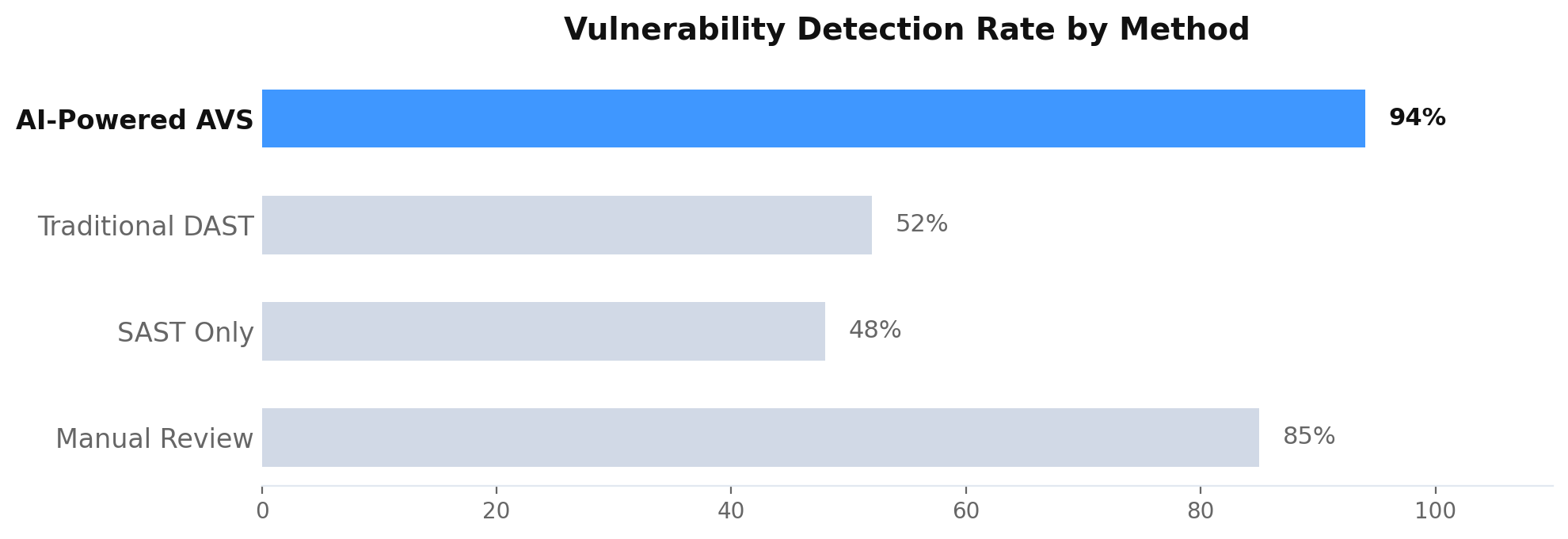
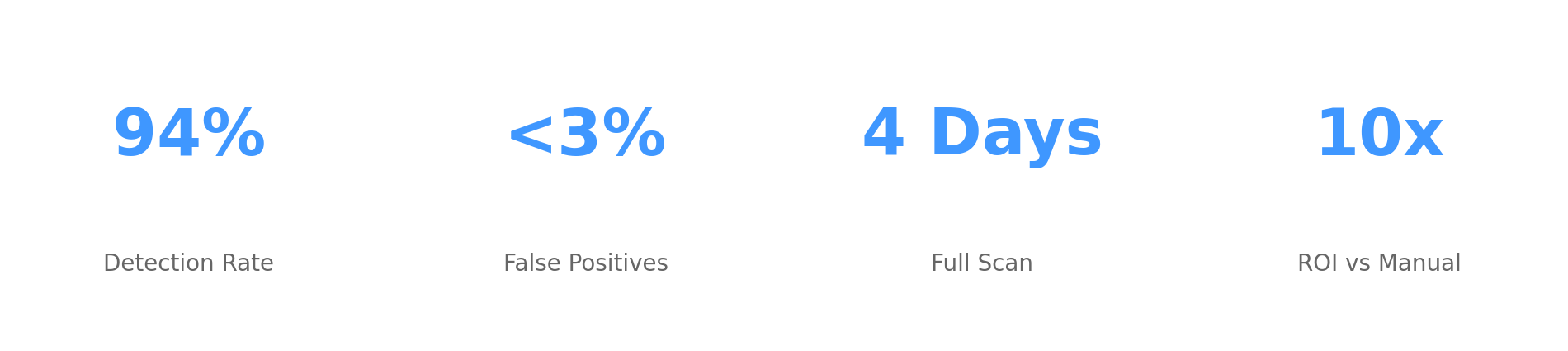
AI-powered automated vulnerability scanning achieves a 94 percent detection rate because it does not rely solely on known signatures. It tests for logic flaws, authentication bypasses, privilege escalation paths, and chained attack vectors that traditional scanners miss completely. Traditional DAST tools catch about 52 percent of real vulnerabilities — meaning nearly half of your actual security gaps go undetected.
OWASP Top 10 Coverage: Where Traditional Scanners Fail
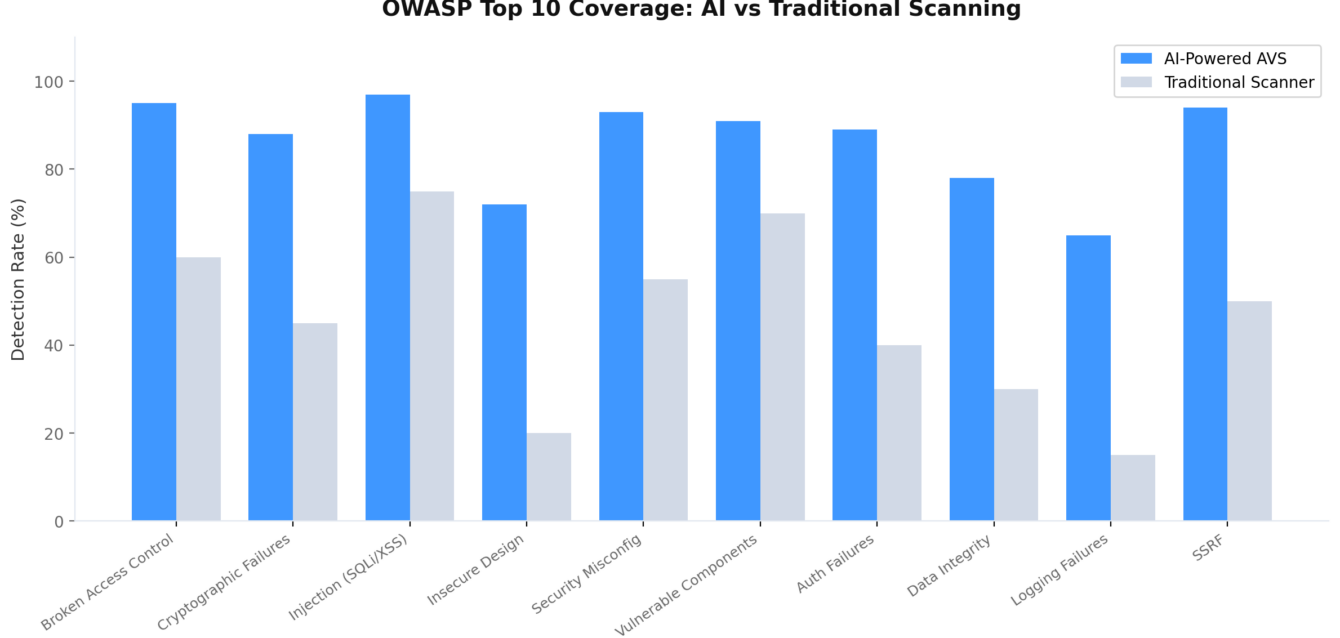
The OWASP Top 10 represents the most critical web application security risks. When we map automated vulnerability scanning coverage against each category, the gap between AI and traditional methods becomes even more striking:
Traditional scanners perform adequately on injection-based vulnerabilities (SQLi, XSS) because these follow predictable patterns. But they struggle severely with Insecure Design (20 percent detection), Authentication Failures (40 percent), and Logging/Monitoring gaps (15 percent). AI-powered automated vulnerability scanning addresses these categories through behavioral analysis and multi-step attack simulation.
Speed and Efficiency: Complete Results in Days, Not Weeks
Security teams operate under constant pressure — compliance deadlines, release cycles, incident response. The speed of your automated vulnerability scanning directly impacts your security posture.
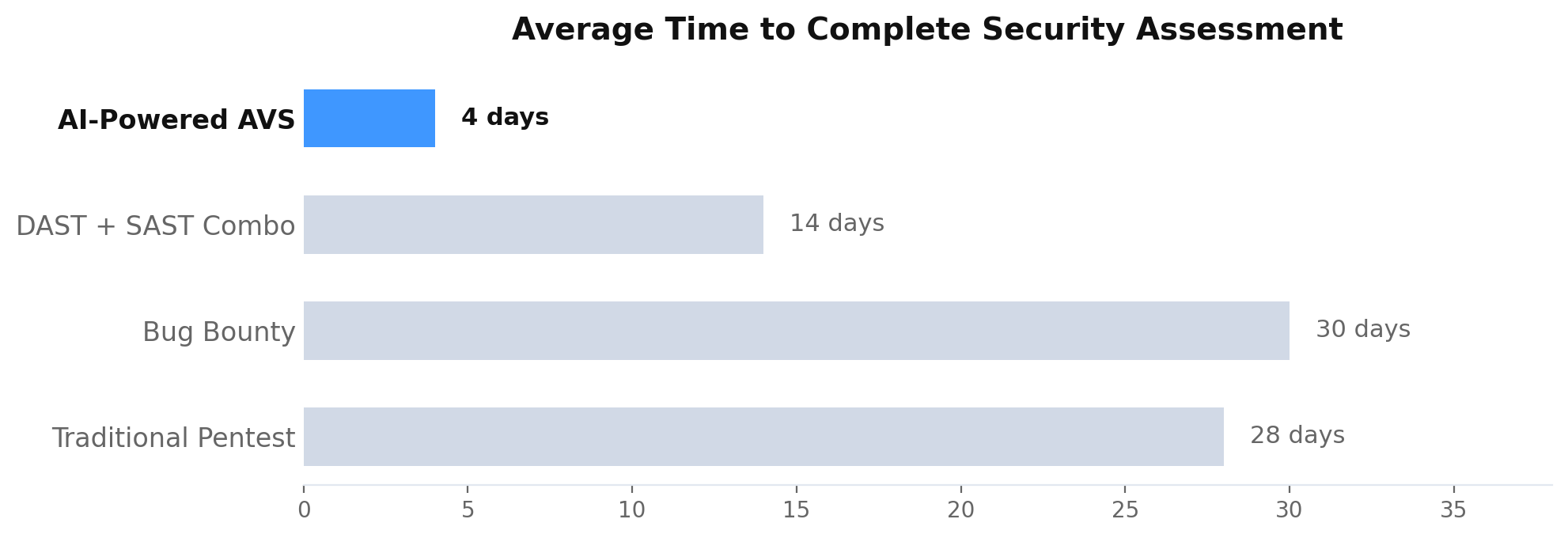
AI-powered automated vulnerability scanning completes a full assessment in approximately 4 days, including validation and report generation. Compare this to 14 days for a DAST/SAST combination, 28 days for traditional pentesting, or 30+ days for bug bounty programs. Faster results mean faster remediation, which means a shorter window of exposure for your organization.
The True Cost of Automated Vulnerability Scanning
Cost is often the deciding factor for security investments. Here is the reality of what organizations pay for automated vulnerability scanning in 2026:
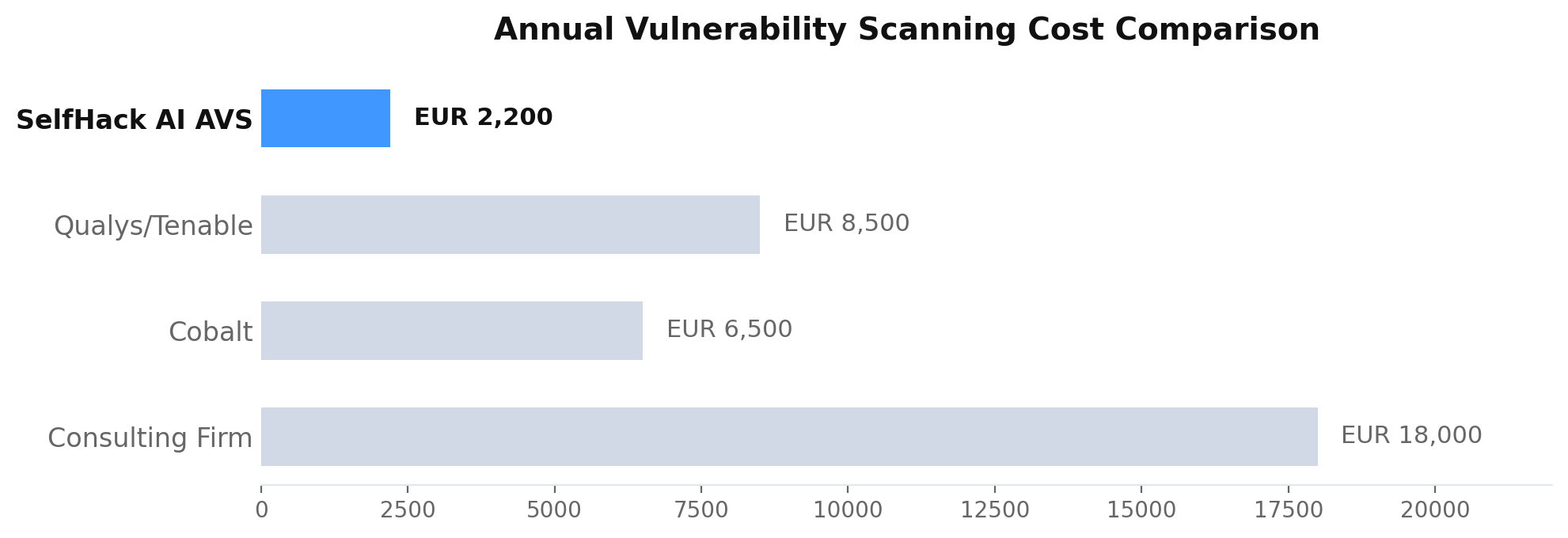
Pricing based on single-application annual scanning. Enterprise packages may differ. Verify current pricing directly with vendors.
SelfHack AI delivers AI-powered automated vulnerability scanning starting at EUR 2,200 — roughly 75 percent less than legacy scanner subscriptions and 88 percent less than traditional consulting. The cost savings compound when you factor in reduced false positive triage time (saving your engineering team an estimated 120 hours per year) and faster remediation cycles.
5 Secrets to Maximizing Your Automated Vulnerability Scanning Results
Even with the best AI-powered tools, your automated vulnerability scanning strategy needs optimization. Here are the secrets that top security teams use:
- Scan continuously, not quarterly: The average time between a vulnerability disclosure and active exploitation is now 15 days. Quarterly scans leave massive gaps. Set up monthly or bi-weekly automated vulnerability scanning cycles to stay ahead of attackers.
- Prioritize exploitability over severity: A “critical” CVE that is not exploitable in your environment is less urgent than a “medium” finding that an attacker can chain into full system access. AI-powered scanning ranks findings by actual exploitability, not theoretical risk.
- Include business logic testing: Traditional automated vulnerability scanning misses business logic flaws entirely. Ensure your scanning solution tests for authentication bypasses, payment manipulation, role escalation, and workflow abuse.
- Integrate with your CI/CD pipeline: Modern automated vulnerability scanning should plug into your deployment pipeline so new code gets tested before it reaches production. SelfHack AI supports API-triggered scans for seamless integration.
- Demand validated findings: If your scanner reports a vulnerability without proving it is exploitable, you are wasting remediation cycles on potential false positives. Insist on exploit validation for every critical and high finding.
When to Switch from Legacy Scanners to AI-Powered Scanning
You should evaluate AI-powered automated vulnerability scanning immediately if any of these apply:
- Your current scanner produces more than 10 percent false positives
- Your security team spends more time triaging than remediating
- You need compliance-ready reports for SOC2, ISO 27001, or PCI-DSS audits
- Your application includes complex business logic that signature scanners cannot test
- You want to reduce your scanning budget without sacrificing coverage
- Your CISO demands measurable ROI from security tool investments
Start Smarter Automated Vulnerability Scanning Today
The evolution from signature-based scanning to AI-powered automated vulnerability scanning is not a future trend — it is happening right now. Organizations that make the switch gain immediate advantages: higher detection rates, fewer false positives, faster turnaround, and dramatically lower costs.
SelfHack AI combines 1,000+ autonomous AI agents with exploit validation to deliver the most accurate automated vulnerability scanning available. With 94 percent detection rates, sub-3 percent false positives, and audit-ready reports in 4 days, it is the scanning platform security leaders are switching to. Try SelfHack AI today and see the difference validated scanning makes.